
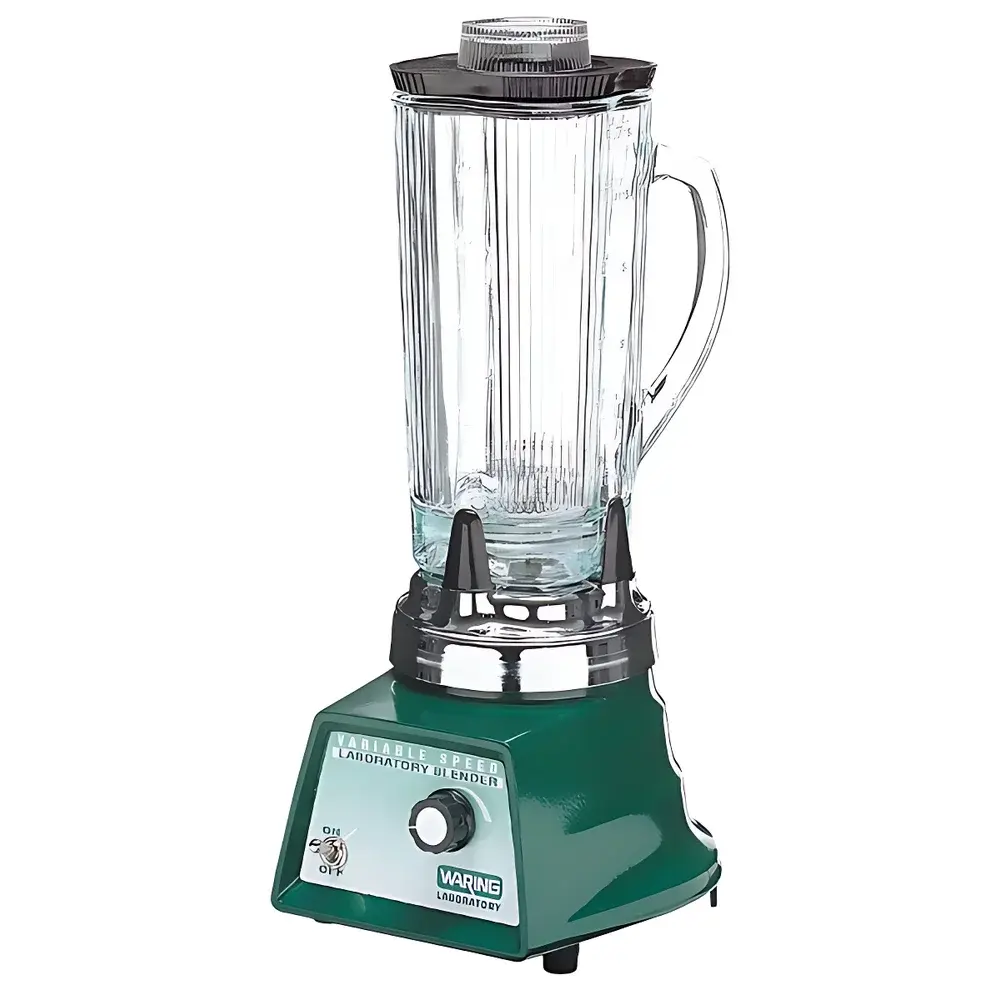
Waring LB20ES/LB20EG Adjustable-Speed Laboratory Homogenizer
| Brand | Waring |
|---|---|
| Origin | USA |
| Model | LB20ES / LB20EG |
| Capacity | 1 L (LB20ES) / 1.2 L (LB20EG) |
| Speed Range | 0–20,000 rpm |
| Base Material | Epoxy-coated metal |
| Vessel Options | Stainless steel (LB20ES) or borosilicate glass (LB20EG) with dual-layer polyethylene/polystyrene lid |
| Height | 38 cm (LB20ES) / 40.5 cm (LB20EG) |
| Weight | 4.3 kg (LB20ES) / 5.2 kg (LB20EG) |
| Compatible Accessories | CAC32 (1.2 L glass), CAC33 (1 L stainless steel), CAC19 (1.4 L polycarbonate), CAC64 (500 mL polycarbonate) |
Overview
The Waring LB20ES and LB20EG are high-performance, benchtop adjustable-speed laboratory homogenizers engineered for reproducible sample disruption, emulsification, suspension, and homogenization across diverse biological, pharmaceutical, food, and chemical applications. These units operate on the principle of high-shear mechanical homogenization—utilizing a rapidly rotating, precision-balanced blade assembly to generate intense fluid vortices, cavitation, and turbulent shear forces within the sample vessel. The motor-driven shaft transmits rotational energy directly to the blade, enabling efficient cell lysis, tissue dissociation, particle size reduction, and uniform dispersion of immiscible phases. Designed for routine use in ISO 17025-accredited labs and GLP-compliant environments, the LB20 series delivers consistent performance under variable load conditions while maintaining thermal stability during extended operation.
Key Features
- Variable speed control from 0 to 20,000 rpm via calibrated analog dial, allowing precise optimization for sensitive samples (e.g., primary cell suspensions) or high-viscosity matrices (e.g., tissue homogenates).
- Dual-vessel configuration: LB20ES features a 1 L stainless-steel beaker with ergonomic handle and chemically resistant epoxy-coated base; LB20EG employs a 1.2 L borosilicate glass vessel rated for thermal shock resistance up to 120 °C.
- Robust induction motor with sealed bearings and overload protection ensures long-term operational reliability and minimal maintenance intervals.
- Ergonomic design includes non-slip rubber feet, vertical height adjustment compatibility with standard lab stands, and integrated safety interlock that halts operation when the vessel is improperly seated.
- Blade assemblies conform to ASTM D2600–22 for homogenizer blade geometry and are replaceable with standardized Waring CAC-series accessories.
Sample Compatibility & Compliance
The LB20ES/LB20EG accommodates a broad spectrum of sample types—including soft animal tissues (liver, spleen), plant material (leaves, roots), microbial pellets, viscous food pastes (cheese emulsions, meat slurries), and synthetic polymer dispersions. Vessel materials comply with USP Class VI biocompatibility standards for stainless steel (LB20ES) and USP for borosilicate glass (LB20EG). All contact surfaces meet FDA 21 CFR 177.1520 (polyolefins) and 177.1630 (polystyrene) requirements for food-contact applications. The system supports audit-ready documentation workflows compliant with ISO/IEC 17025:2017 clause 7.7 (reporting results) and adheres to GMP Annex 11 principles for equipment qualification (IQ/OQ/PQ) when integrated into regulated manufacturing processes.
Software & Data Management
While the LB20ES/LB20EG operates as a standalone analog instrument without embedded firmware or digital connectivity, its speed calibration is traceable to NIST-certified tachometers (model: Extech 461923), and all speed settings can be documented manually in laboratory notebooks or electronic lab notebooks (ELNs) supporting 21 CFR Part 11 compliance. Optional third-party RPM logging modules (e.g., Omega DP25B-S) may be interfaced externally for time-stamped speed profiling during validation studies. Calibration certificates and maintenance logs are retained per ISO/IEC 17025 section 6.4.10, ensuring full traceability for regulatory audits.
Applications
- Life Sciences: Preparation of subcellular fractions, nuclear lysates, and mitochondrial suspensions; homogenization of rodent brain tissue for ELISA or Western blot analysis.
- Pharmaceutical Development: Formulation of nanoemulsions and liposomal drug carriers; dispersion of active pharmaceutical ingredients (APIs) in aqueous suspensions per USP <701>.
- Food Safety Testing: Homogenization of composite food samples prior to microbiological enumeration (ISO 6887-1:2017) or mycotoxin extraction (AOAC 2005.02).
- Clinical Diagnostics: Processing of biopsy specimens for histopathology or molecular testing; preparation of whole-blood lysates for PCR-based pathogen detection.
- Materials Science: Dispersing carbon nanotubes in polymer matrices; deagglomerating ceramic nanoparticles in solvent systems.
FAQ
What is the maximum recommended continuous run time at full speed?
For optimal motor longevity and thermal management, continuous operation at ≥15,000 rpm should not exceed 90 seconds per cycle, followed by a minimum 60-second cooldown period.
Can the LB20EG glass vessel be autoclaved?
Yes—the borosilicate glass vessel and polyethylene/polystyrene lid are autoclavable at 121 °C for 20 minutes; however, repeated autoclaving may reduce lid seal integrity over time.
Is blade balancing required before each use?
No—factory-balanced blades (CAC33/CAC32) are pre-calibrated and do not require user rebalancing; visual inspection for nicks or deformation is recommended prior to critical applications.
Does Waring provide IQ/OQ documentation packages?
Yes—validated qualification protocols and blank templates aligned with ASTM E2500–13 and EU GMP Annex 15 are available upon request through authorized distributors.
How often should the motor brushes be replaced?
Under typical usage (≤4 hrs/day), brush replacement is required every 1,200 operating hours; brush wear indicators are accessible via the rear service panel.



