
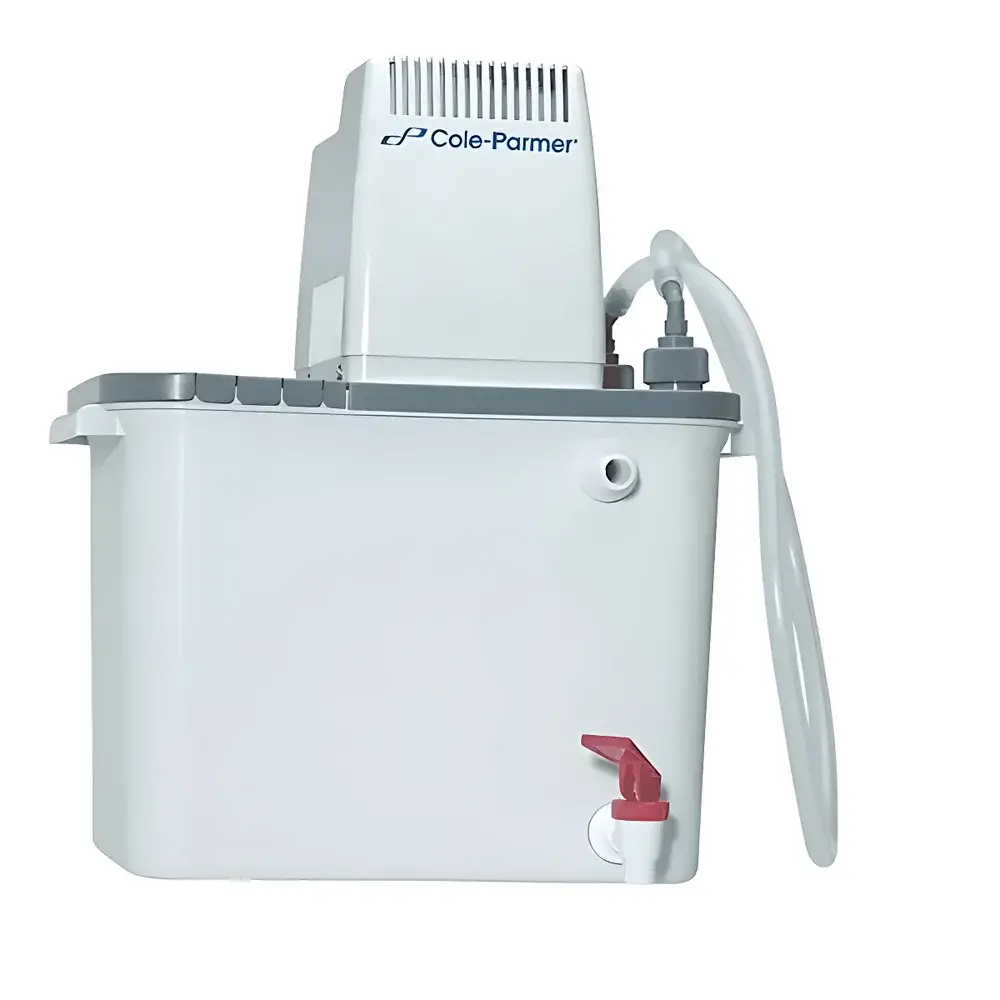
Cole-Parmer Portable Dual-Channel Water-Aspirator Vacuum Pump
| Brand | Cole-Parmer |
|---|---|
| Origin | USA |
| Manufacturer Type | Authorized Distributor |
| Origin Category | Imported |
| Model | 35031-00 / 35031-10 |
| Vacuum Pump Type | Oil-Free Water-Aspirator |
| Displacement | 0.6 CFM (18 L/min) |
| Max Vacuum | 29.5 in Hg (≈10 Torr) |
| Noise Level | 60 dB(A) |
| Port Size | 8-mm barbed hose fitting |
| Power Supply | 115 VAC, 50/60 Hz (35031-00) / 230 VAC, 50/60 Hz (35031-10) |
| Wetted Materials | Nickel-plated brass, polypropylene, silicone rubber, stainless steel |
| Reservoir Capacity | 9.5 L |
| Accessories Available | Vacuum gauge/regulator (optional), spare vacuum cooling coils (35031-60), vacuum filters (35031-70, 35031-72), stainless steel aspirator tip (35031-74) |
Overview
The Cole-Parmer Portable Dual-Channel Water-Aspirator Vacuum Pump (Models 35031-00 and 35031-10) is an oil-free, water-jet vacuum generator engineered for reliable, low-maintenance operation in teaching laboratories, field applications, and quality control environments where electrical simplicity and chemical compatibility are critical. Unlike mechanical vacuum pumps, this device operates on the Venturi principle: pressurized water flow through precision-machined nickel-plated brass Venturi nozzles generates a stable, pulse-free vacuum via Bernoulli’s equation—eliminating vibration, oil contamination, and exhaust fumes. Its integrated recirculating water system (9.5 L reservoir with drain valve and spigot) enables continuous operation without external water supply, significantly reducing resource consumption and enabling deployment in locations lacking dedicated lab utilities. Designed for Class I, Division 2 environments, it complies with UL 61010-1 safety standards for laboratory equipment and meets material compatibility requirements per ASTM D543 for resistance to dilute acids, bases, and organic solvents.
Key Features
- Dual independent aspiration channels with stainless steel and nickel-plated brass Venturi nozzles, each equipped with integrated check valves to prevent backflow into connected apparatus.
- Recirculating water architecture minimizes water usage and eliminates reliance on continuous tap water—ideal for mobile labs, remote sites, or sustainability-focused facilities.
- Quiet operation at ≤60 dB(A) due to laminar water flow and absence of rotating components; suitable for open-bench use adjacent to sensitive instrumentation or student workstations.
- Chemically resistant wetted materials—including polypropylene housing, silicone gaskets, and stainless steel hardware—ensure durability during routine exposure to common aqueous and mildly aggressive reagents.
- Modular accessory ecosystem supports process validation: optional vacuum gauge/regulator (sold separately) provides real-time pressure monitoring and fine-tuned control across the 0–29.5 in Hg range.
- Compact footprint (approx. 30 × 20 × 35 cm) and integrated carry handle facilitate transport between fume hoods, glove boxes, or classroom demonstrations without disassembly.
Sample Compatibility & Compliance
This pump is intended for non-hazardous vapor aspiration and filtration support under ambient temperature conditions. It is compatible with standard Büchner funnels, filter flasks (up to 5 L), rotary evaporator cold traps (when used with optional cooling coil 35031-60), and vacuum desiccators. It is not rated for explosive, highly toxic, or high-boiling-point solvent vapors (e.g., chlorinated hydrocarbons, DMF, DMSO). All wetted components conform to USP Class VI biocompatibility testing for polymeric materials. The unit carries CE marking for EMC Directive 2014/30/EU and Low Voltage Directive 2014/35/EU. Documentation supports GLP-compliant recordkeeping when paired with validated vacuum gauges and audit-trail-capable data loggers.
Software & Data Management
As a purely electromechanical device with no embedded microcontroller or digital interface, this pump requires no firmware, drivers, or software installation. Vacuum level verification and process documentation rely on externally connected analog or digital vacuum gauges (e.g., Cole-Parmer catalog #EW-35031-50). When integrated into regulated workflows, users may employ third-party data acquisition systems compliant with FDA 21 CFR Part 11 for electronic signatures and audit trails—particularly when correlating vacuum pressure with filtration rate, distillation endpoint, or drying cycle duration.
Applications
- Routine vacuum filtration of crystalline precipitates, cell suspensions, or particulate-laden solutions using standard filter flasks and paper or membrane filters.
- Supporting rotary evaporation setups as a secondary vacuum source for cold trap evacuation—especially during solvent recovery protocols requiring sub-atmospheric pressure stability.
- Providing controlled suction for medical or veterinary aspiration tasks in field clinics or educational anatomy labs.
- Enabling vacuum-assisted degassing of resin mixtures, casting media, or low-viscosity adhesives prior to curing.
- Serving as a primary vacuum source for teaching experiments illustrating gas laws, fluid dynamics, or phase-change phenomena in undergraduate physical chemistry curricula.
FAQ
Can this pump be used with organic solvents such as acetone or ethanol?
Yes—provided vapors are adequately trapped upstream (e.g., using a condenser or dry ice trap) to prevent solvent ingress into the water reservoir. Continuous exposure to high-vapor-pressure solvents may saturate the water phase and reduce vacuum efficiency.
Is the water reservoir resistant to corrosion from repeated use with acidic or basic solutions?
The polypropylene reservoir and nickel-plated brass nozzles exhibit strong resistance to pH 2–12 solutions per ASTM D543; however, prolonged contact with concentrated oxidizers (e.g., >10% HNO₃) is not recommended.
What maintenance is required to ensure long-term performance?
Monthly inspection of silicone seals and periodic replacement of vacuum filters (catalog #35031-70/72) is advised. Reservoir water should be refreshed after each 8-hour operational shift or when turbidity or odor develops.
Does the pump meet ISO/IEC 17025 requirements for accredited testing laboratories?
While the pump itself is not certified to ISO/IEC 17025, its design, material traceability, and accessory calibration options (e.g., NIST-traceable vacuum gauges) support method validation within accredited quality systems.
Can two separate vacuum lines operate simultaneously at different pressures?
No—the dual channels share a single water jet and reservoir; both ports generate identical vacuum levels. Independent pressure control requires separate pumps or downstream needle valves with calibrated feedback.



