
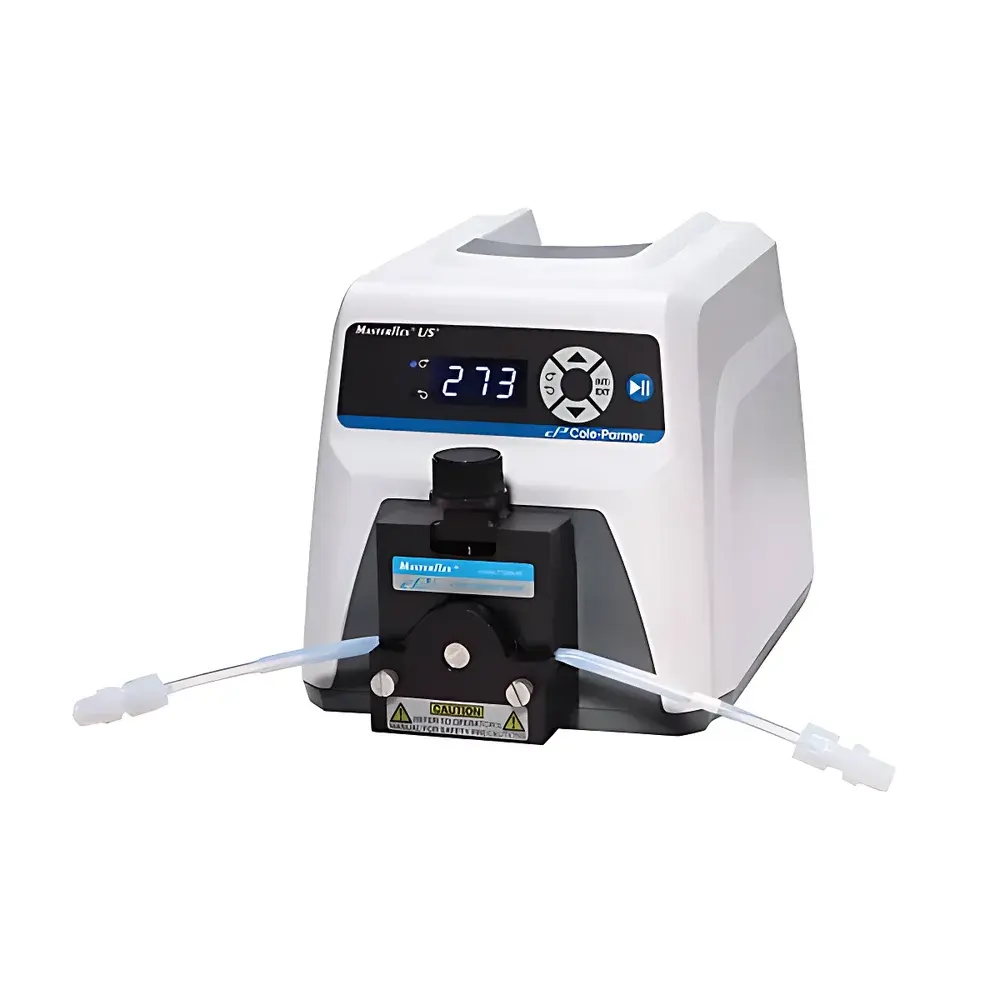
Cole-Parmer Masterflex L/S® PTFE Tubing Peristaltic Pump System Model 77912-10
| Brand | Cole-Parmer |
|---|---|
| Origin | USA |
| Model | 77912-10 |
| Pump Type | Peristaltic Pump |
| Flow Rate Range | 0.18–65 mL/min (dependent on tubing ID/OD) |
| Speed Range | 3–300 rpm |
| Maximum Continuous Pressure | 6.9 bar |
| Maximum Suction Lift | 2.4 m |
| Drive Motor Requirement | ≥0.1 hp |
| Tubing Life (at 100 rpm, 0 bar) | ~500 hours |
| Housing Material | Anodized aluminum and acetal |
| Roller Material | Stainless steel |
| Roller Count | 6 |
| Drive Dimensions (L×W×H) | 25.4 × 21.6 × 21.6 cm |
| Power Supply | 230 V, 50 Hz |
| Tubing Compatibility | Masterflex® PTFE tubing only (4 mm or 6 mm OD) |
| Included Components | L/S PTFE pump head 77390-00, PTFE tubing pack 77390-60 (2 × 38 cm, 4 mm ID / 6 mm OD), L/S variable-speed drive 07528-20, two 1/4" NPT male fittings |
Overview
The Cole-Parmer Masterflex L/S® PTFE Tubing Peristaltic Pump System Model 77912-10 is a precision-engineered fluid transfer solution designed for demanding laboratory and pilot-scale applications where chemical compatibility, purity integrity, and pressure resilience are critical. Based on the positive-displacement peristaltic principle—where rotating rollers compress flexible tubing to generate flow—the system isolates the process fluid entirely within the tubing, eliminating valves, seals, or wetted metal components. This architecture ensures zero cross-contamination and eliminates the risk of fluid degradation from metallic leaching or surface adsorption. The exclusive use of Masterflex® PTFE tubing as the sole wetted component provides exceptional resistance to aggressive organic solvents, strong acids, bases, and halogenated compounds—making it suitable for solvent delivery in HPLC mobile phase preparation, reagent dosing in synthesis reactors, and high-purity filtration setups. Its ability to sustain continuous backpressure up to 6.9 bar enables integration into pressurized filtration manifolds, inline chemical dosing loops, and controlled-permeation systems without flow deviation or tubing collapse.
Key Features
- Six-roller, adjustable occlusion pump head (Model 77390-00) allows fine-tuning of compression force: higher occlusion increases pressure capability and pulse dampening; lower occlusion extends tubing service life under low-pressure, high-cycle conditions.
- Factory-integrated L/S variable-speed drive (Model 07528-20) delivers precise speed control from 3 to 300 rpm with stable torque output across the full range—ensuring repeatable volumetric delivery independent of fluid viscosity or line resistance.
- Robust mechanical architecture: anodized aluminum and acetal housing provides corrosion resistance and dimensional stability; stainless steel rollers ensure long-term wear resistance and rotational accuracy.
- Optimized for Masterflex® PTFE tubing only—specifically 77390-50 (2 mm ID / 4 mm OD) and 77390-60 (4 mm ID / 6 mm OD)—guaranteeing consistent wall thickness, durometer uniformity, and fatigue resistance required for reproducible peristaltic performance.
- Capable of handling slurries containing suspended particles ≤100 µm in diameter without clogging or tubing abrasion, supporting applications such as cell culture media perfusion, catalyst slurry transfer, and particulate-laden extractant circulation.
Sample Compatibility & Compliance
The system is compatible exclusively with certified Masterflex® PTFE tubing assemblies, which meet USP Class VI and FDA 21 CFR 177.1550 requirements for repeated contact with pharmaceutical and bioprocess fluids. The absence of elastomeric or thermoplastic components other than PTFE eliminates extractables and leachables commonly associated with silicone or Santoprene® tubing—critical for analytical sample integrity and regulatory submissions. While the pump itself does not carry CE or UL certification as a standalone unit, its drive motor complies with IEC 61000-6-3 (EMC emission) and IEC 61000-6-2 (immunity) standards when installed per manufacturer guidelines. For GLP/GMP environments, the system supports audit-ready operation when paired with validated tubing change logs and speed calibration records traceable to NIST-certified tachometers.
Software & Data Management
The 77912-10 operates as a stand-alone analog-controlled system without embedded firmware or digital communication ports (e.g., RS-232, USB, or Ethernet). However, its analog 0–10 VDC speed input interface permits integration into centralized LabVIEW™, DeltaV™, or Siemens PCS7 control architectures via programmable logic controllers (PLCs) or industrial I/O modules. Users may log operational parameters—including actual rpm (via optional tachometer feedback), run time, and tubing replacement cycles—using external SCADA systems compliant with ISA-88 and ISA-95 frameworks. Though the drive lacks built-in data logging, its consistent speed-to-flow correlation (validated per ASTM D341 for Newtonian fluids) enables traceable volumetric delivery when combined with gravimetric or timed-collection verification protocols.
Applications
- High-purity solvent transfer in HPLC and UHPLC mobile phase delivery systems, especially where THF, chloroform, or concentrated TFA must remain free of metal ion contamination.
- In-line chemical dosing for pH control or catalyst injection in jacketed glass reactors operating under nitrogen blanket or vacuum.
- Pressurized tangential flow filtration (TFF) feed streams requiring stable flow at 3–5 bar transmembrane pressure.
- Controlled eluent delivery in ion chromatography and size-exclusion chromatography systems sensitive to pulsation-induced baseline noise.
- Reproducible media perfusion in 3D bioreactors and organ-on-chip platforms where shear-sensitive cells demand gentle, non-cavitating flow profiles.
FAQ
Can standard PTFE tubing from third-party suppliers be used with this system?
No. Only Masterflex® PTFE tubing (catalog numbers 77390-50 and 77390-60) is dimensionally and mechanically qualified for use with the L/S pump head. Non-OEM tubing exhibits inconsistent wall thickness and durometer, leading to premature failure, flow inaccuracy, or occlusion misalignment.
What is the recommended maintenance interval for roller alignment and bearing inspection?
Under continuous operation at ≤200 rpm and ambient temperature, inspect roller concentricity and drive belt tension every 1,000 operating hours. Lubrication is not required—the stainless steel rollers and acetal bushings operate dry per ISO 2041-1 specifications.
Is the system suitable for sterile applications?
While the PTFE tubing is autoclavable (121°C, 20 min, 15 psi), the pump head and drive assembly are not designed for in-situ sterilization. For aseptic processes, tubing should be pre-sterilized and replaced per batch; the system must be located outside classified zones per ISO 14644-1 Class 7 or better.
How is flow rate calibrated and verified?
Flow is calibrated gravimetrically using NIST-traceable analytical balances and certified volumetric flasks. Calibration curves are generated at three speeds (e.g., 30, 150, and 300 rpm) across the intended tubing configuration and reported with ±1.5% full-scale uncertainty per ISO 5725-2 repeatability criteria.
Does the drive support external start/stop or direction reversal?
The 07528-20 drive accepts momentary dry-contact closure for start/stop but does not support reverse rotation. Direction reversal would compromise tubing fatigue life and is not supported by the L/S pump head geometry.



