
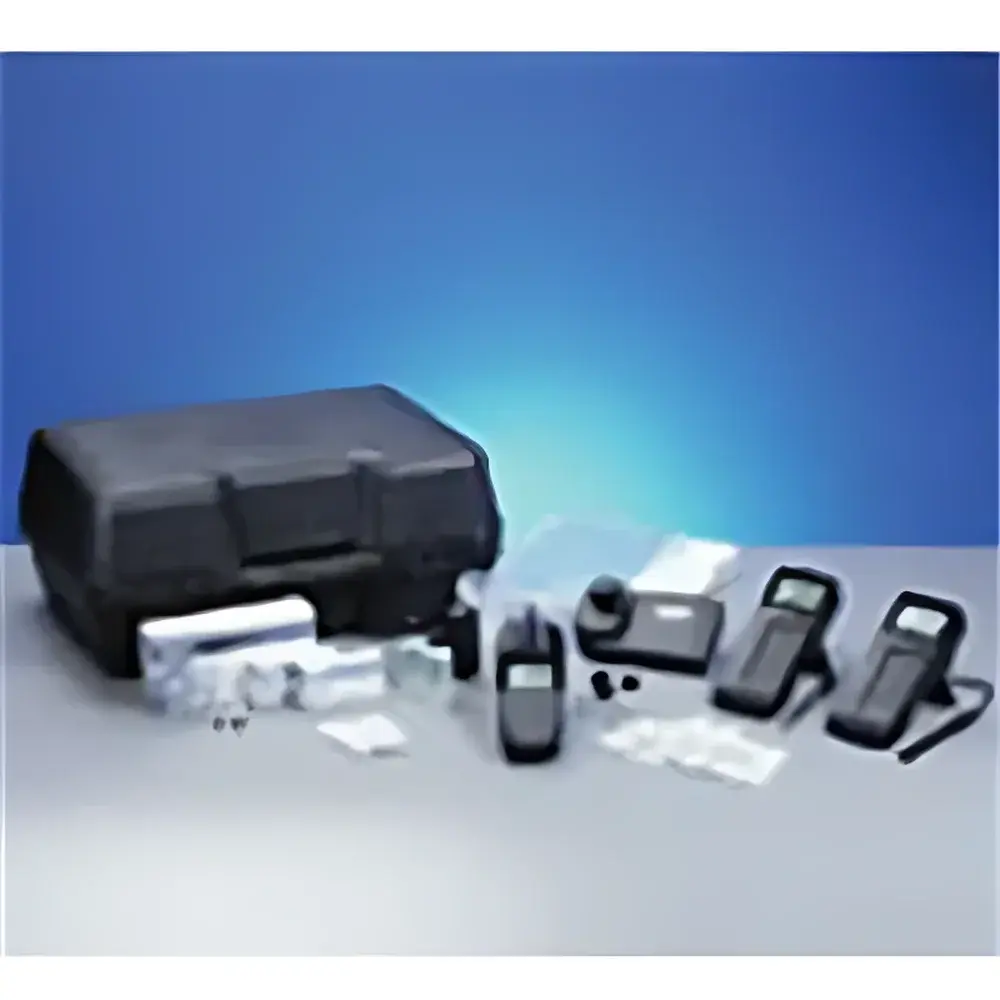
Thermo Scientific Orion AQ4EK1 Portable Water Quality Analysis Laboratory
| Brand | Thermo Scientific Orion |
|---|---|
| Origin | USA |
| Model | AQ4EK1 |
| Instrument Type | Portable Multi-Parameter Water Quality Analyzer |
| Measured Parameters | pH, Turbidity (NTU), Conductivity (mS/cm) |
| Turbidity Range | 0.1–2000 NTU |
| Conductivity Range | 0–19.9 mS/cm |
| pH Range | 0–14 pH |
| Reagent Kits Included | Alkalinity (100 tests), Aluminum (50), Free/Total Chlorine (30), Fluoride (30), Total & Soluble Iron (30), Ammonia-N (50), Nitrate-HR (30), Nitrite (30), Dissolved Oxygen (30), Phosphate-LR (30), Sulfate (30), Sulfide (30) |
Overview
The Thermo Scientific Orion AQ4EK1 Portable Water Quality Analysis Laboratory is an integrated, field-deployable solution engineered for rapid, reliable, and regulatory-relevant water quality assessment in diverse environmental and municipal settings. Designed around the AQ4000 Advanced Colorimeter platform—combined with dedicated, calibrated pH, turbidity, and conductivity modules—the system implements standardized photometric, potentiometric, and optical scattering measurement principles to deliver traceable, repeatable results under variable ambient conditions. Unlike standalone handheld meters, the AQ4EK1 functions as a cohesive analytical workflow unit: each module shares common power management, data logging architecture, and calibration traceability, minimizing inter-device variability and operator-induced error. Its architecture supports ASTM D1889 (turbidity), ISO 7888 (conductivity), and USP (electrical conductivity of purified water) methodologies, making it suitable for routine compliance monitoring in drinking water distribution systems, wastewater effluent verification, and source water reconnaissance.
Key Features
- Integrated AQ4000 Advanced Colorimeter with downloadable method library—enabling continuous expansion of EPA-compliant and ISO-standardized test protocols without hardware upgrades
- Dedicated AQUAfast IV Turbidimeter compliant with ISO 7027:2016 (nephelometric principle, 860 nm LED light source, ratio detection)
- Field-calibrated pH meter with rugged double-junction gel-filled electrode and automatic temperature compensation (ATC)
- Conductivity sensor with platinum black electrodes and linearized 0–19.9 mS/cm range, supporting TDS and salinity calculations per ASTM D1125
- Pre-configured reagent kits packaged in individually barcoded vials—each validated for shelf life, lot-specific calibration curves, and interference mitigation per APHA Standard Methods
- IP67-rated portable carry case with molded foam inserts, integrated battery pack (≥12 h operation), USB-C data export, and onboard GLP-compliant audit trail (operator ID, date/time stamp, calibration history)
Sample Compatibility & Compliance
The AQ4EK1 accepts raw, filtered, or centrifuged water samples across surface water, groundwater, treated drinking water, and secondary-treated wastewater matrices. All included reagents meet EPA Method 365.3 (phosphate), 350.1 (alkalinity), and 365.4 (nitrate HR) specifications. The turbidity module complies with USEPA Guidance for Turbidity Monitoring in Drinking Water Systems (2021), while conductivity measurements adhere to ISO 7888:2019 for electrical conductivity determination in natural and treated waters. The system supports 21 CFR Part 11–compliant data integrity when paired with Thermo Scientific SampleManager LIMS or exported via encrypted CSV with embedded metadata (instrument ID, calibration certificate numbers, analyst signature).
Software & Data Management
Data acquisition and reporting are managed through the AQ4000’s embedded firmware (v3.2+), which stores up to 1,000 test records with full parameter metadata. Results sync wirelessly via Bluetooth to the free Thermo Scientific AquaTrack Mobile App (iOS/Android), enabling real-time GPS-tagged field reporting, photo annotation, and PDF certificate generation. For laboratory integration, USB-C export delivers timestamped, comma-delimited files compatible with Microsoft Excel, LabWare LIMS, and Watson LIMS. Audit logs retain all calibration events—including standard verification, drift checks, and electrode slope validation—with immutable timestamps and user authentication. Firmware updates are delivered via secure HTTPS download from Thermo Fisher’s certified support portal.
Applications
- Routine compliance monitoring of drinking water at entry points, storage reservoirs, and distribution nodes per SDWA requirements
- Field verification of wastewater treatment plant effluent against NPDES permit limits for ammonia, nitrate, phosphate, and turbidity
- Emergency response screening during flood events or chemical spills—rapid identification of pH excursions, chloride intrusion, or suspended solids loading
- Source water characterization for watershed protection programs, including alkalinity buffering capacity and iron/manganese redox status
- Educational field labs requiring robust, low-maintenance instrumentation with pedagogical method transparency and reproducible student datasets
FAQ
Is the AQ4EK1 certified for use in regulatory reporting under EPA or ISO standards?
Yes—each instrument module carries individual NIST-traceable calibration certificates, and the AQ4000 colorimeter is pre-loaded with EPA-approved methods. Full documentation packages support GLP/GMP audits.
Can additional test parameters be added post-purchase?
Yes—new photometric methods are released quarterly via free firmware update; no hardware modification is required.
What is the expected service life of the turbidity sensor under field conditions?
With routine cleaning using the included lens tissue and isopropyl alcohol, the AQUAfast IV optical path maintains ±2% accuracy over 5 years of daily use.
Does the system support multi-user authentication and role-based access control?
Operator-level authentication is supported via PIN; full 21 CFR Part 11 compliance requires integration with Thermo Scientific SampleManager LIMS.
Are replacement reagents supplied with lot-specific calibration data?
Yes—all reagent kits include QR-coded vials linking to digital certificates containing lot-specific blank values, calibration slopes, and expiry-controlled method validation reports.
Related Products







