
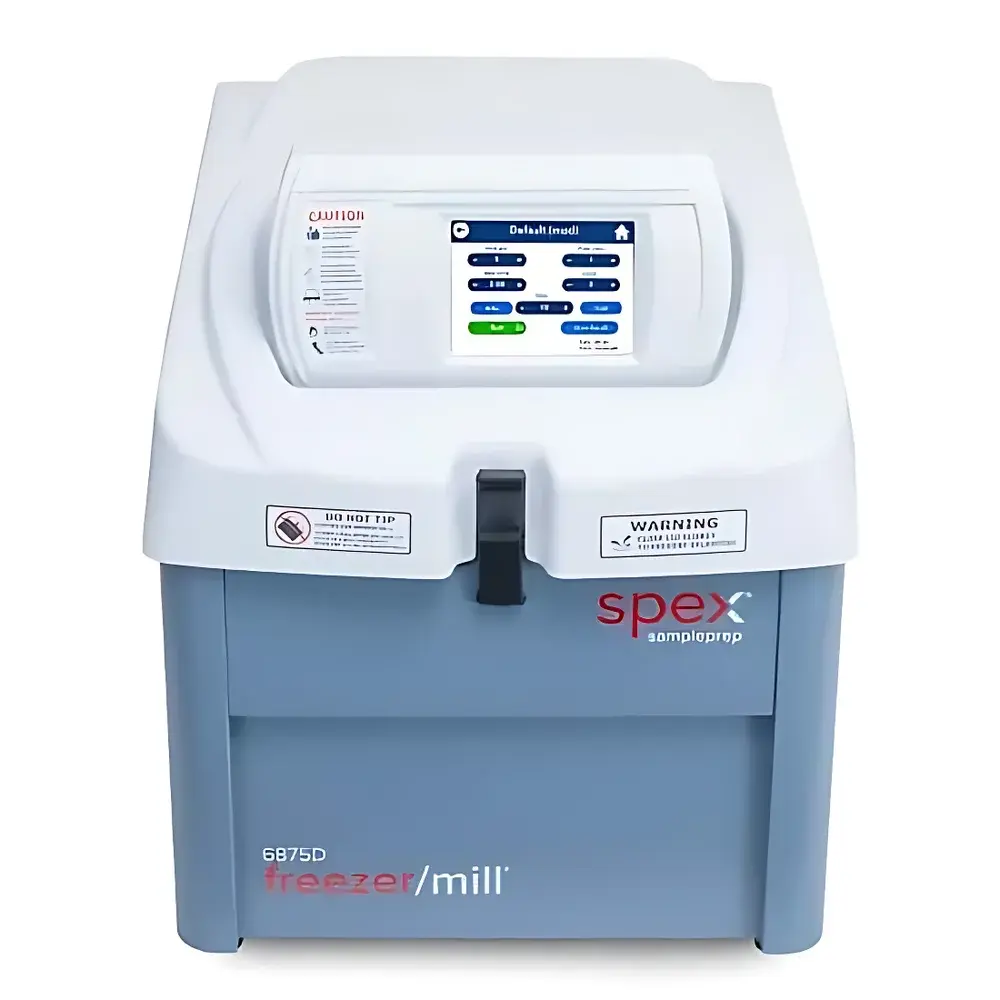
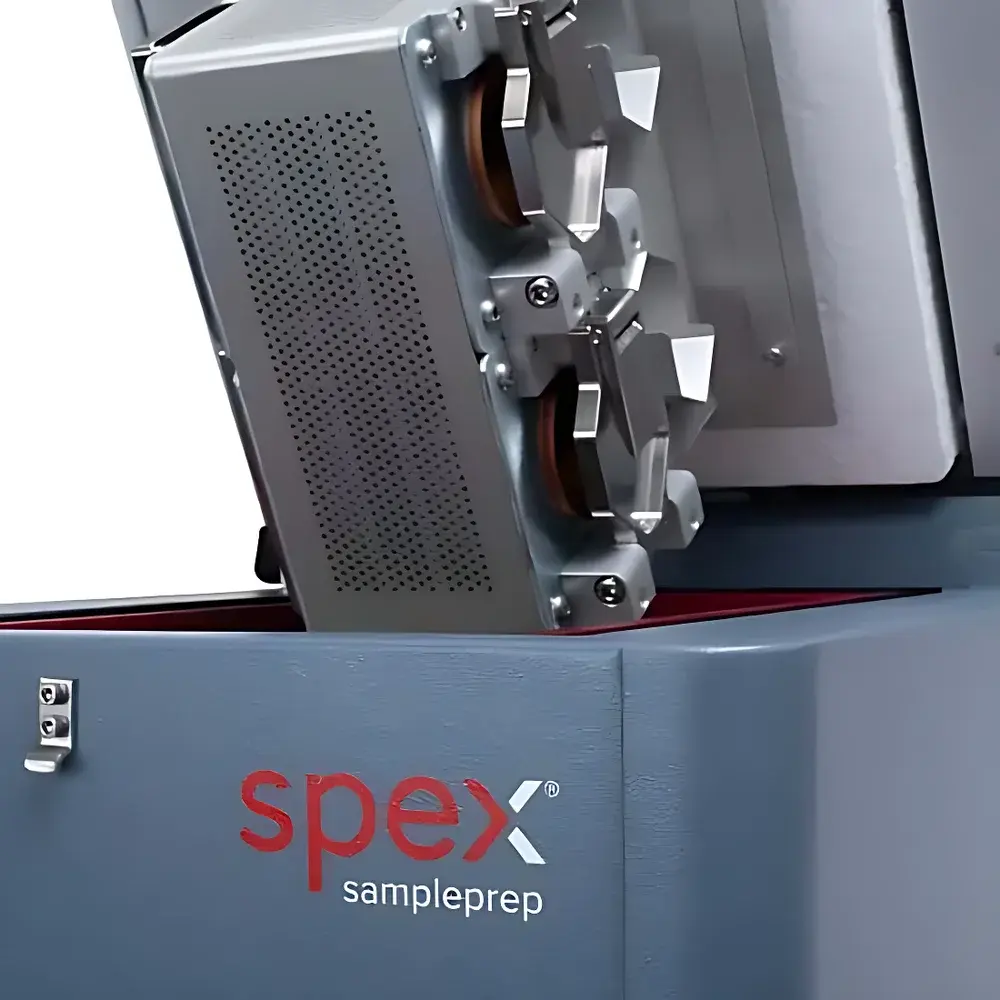
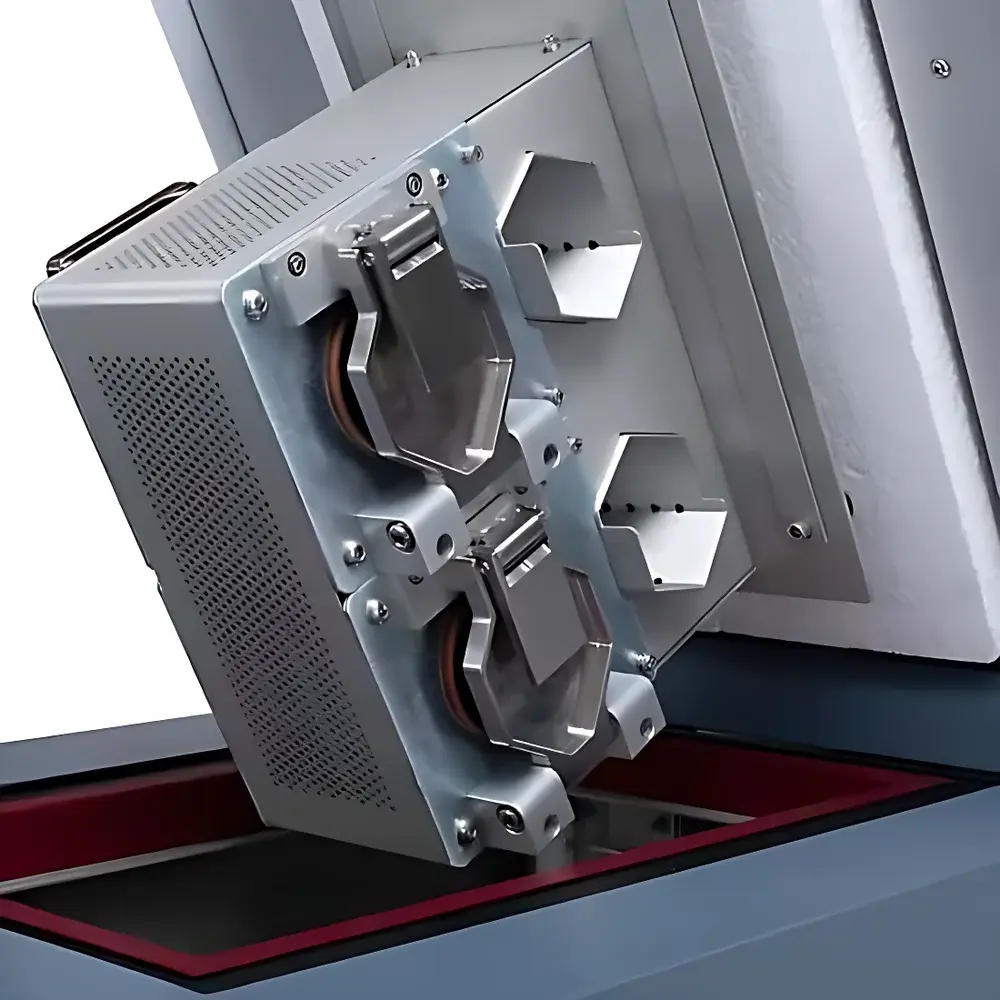
Spex SamplePrep 6875D CryoMill Dual-Chamber Cryogenic Grinding Instrument
| Brand | SPEX SamplePrep |
|---|---|
| Origin | USA |
| Model | 6875D |
| Instrument Type | Cryogenic Grinder |
| Sample Compatibility | Frozen & Temperature-Sensitive Materials |
| Grinding Mechanism | Electromagnetic Impactor Oscillation (5–15 Hz) |
| Chamber Configuration | Dual 200 mL Grinding + Dual 200 mL Precooling Chambers |
| Max Sample Capacity | 2 × 100 g per cycle |
| LN₂ Delivery | Automated Fill System |
| Power Rating | 700 W |
| Cycle Time | 2 min grinding + 4.5 min minimum precooling |
| Vial Options | 2 × Large (200 mL), 2 × Medium (100 mL), 8 × Standard (20 mL), or 24 × Micro-well (3 × 3 mL) vials per run |
| Safety Features | LN₂ Level Sensor, Interlocked Insulated Lid, Thermal-Isolated Enclosure |
| Compliance | Designed for GLP/GMP-aligned workflows |
Overview
The Spex SamplePrep 6875D CryoMill is a dual-chamber cryogenic grinding instrument engineered for high-fidelity, low-temperature mechanical disruption of thermolabile and mechanically resistant biological, polymeric, and composite materials. It operates on the principle of electromagnetic impactor oscillation—where a magnetically driven stainless-steel pestle delivers controlled, high-frequency (5–15 Hz) percussive forces inside sealed, cryogenically cooled vials. Unlike ambient or refrigerated grinders, the 6875D maintains sample integrity by immersing vials in liquid nitrogen (LN₂) prior to and during grinding, ensuring temperatures remain below –196 °C throughout processing. This eliminates thermal degradation, preserves volatile metabolites, inhibits enzymatic activity (e.g., RNases/DNases), and prevents polymer chain scission or phase separation in sensitive matrices. Its dual-chamber architecture enables concurrent precooling and grinding—maximizing throughput without cross-contamination or thermal lag—making it suitable for laboratories requiring reproducible, scalable, and traceable sample preparation for downstream analytical workflows.
Key Features
- Dual independent chambers: Each includes a 200 mL grinding chamber and a dedicated 200 mL precooling chamber, enabling continuous operation—one chamber grinds while the other preconditions the next batch.
- Automated liquid nitrogen delivery system with real-time level sensing and pressure-regulated fill control, minimizing operator intervention and LN₂ waste.
- Electromagnetic impactor drive with adjustable frequency (5–15 Hz) and programmable dwell time, delivering consistent energy input across heterogeneous sample types.
- Thermally insulated enclosure with safety-interlocked lid and vapor-tight sealing, compliant with OSHA and IEC 61000-6-4 electromagnetic compatibility standards.
- Touchscreen HMI with intuitive workflow programming: users define cooling duration, grinding time, impact frequency, and pause intervals—all stored with timestamped method IDs.
- Zero-lubrication, single-moving-part design (the impactor assembly) ensures long-term reliability, eliminates oil contamination risk, and reduces maintenance to periodic calibration checks.
- Multi-vial support: accommodates up to two 200 mL jars, eight 20 mL standard vials, or twenty-four 3 mL micro-well plates per dual-cycle run—enabling parallel processing for high-throughput labs.
Sample Compatibility & Compliance
The 6875D accepts a broad spectrum of challenging samples—including fibrous animal tissues, calcified bone and dental specimens, elastomeric polymers, PCBs, pharmaceutical tablets, plant lignocellulose, and forensic trace evidence—without thermal artifact or compositional bias. All contact surfaces are electropolished 316 stainless steel, certified non-pyrogenic and compliant with USP for extractables/leachables profiling. The instrument’s operational parameters align with ASTM E2932-22 (Standard Guide for Cryogenic Milling of Biological Samples) and ISO 17025:2017 requirements for method validation. When paired with Spex-certified vials and documented SOPs, it supports GLP audits and FDA 21 CFR Part 11-compliant data integrity—particularly when used in regulated environments such as clinical diagnostics, environmental testing, or contract research organizations.
Software & Data Management
The integrated control firmware logs all critical process parameters—including LN₂ fill volume, chamber temperature profiles (via embedded Pt100 sensors), impactor duty cycle, and user authentication—into an encrypted local database. Export options include CSV and PDF reports with digital signatures, compatible with LIMS integration via RS-232 or Ethernet (Modbus TCP). Optional SpexConnect™ software provides remote monitoring, multi-instrument fleet management, and electronic lab notebook (ELN) synchronization. Audit trails record operator ID, timestamp, method version, and any parameter overrides—ensuring full traceability for regulatory submissions and internal quality reviews.
Applications
- Molecular biology: High-yield, nuclease-free homogenization of frozen tissue for RNA-seq, ChIP, and single-cell lysate preparation.
- Forensic toxicology: Uniform comminution of hair, nails, or synthetic drugs for GC-MS/MS quantitation without analyte loss.
- Materials science: Size reduction of brittle alloys, ceramics, or battery cathode materials for SEM-EDS or XRD analysis.
- Environmental compliance: RoHS/WEEE screening of electronics and plastics via ICP-MS after cryo-milling and acid digestion.
- Food safety: Homogenization of fatty, fibrous, or viscous food matrices (e.g., chocolate, cheese, seafood) for mycotoxin or allergen ELISA testing.
- Pharmaceutical development: Batch-wise milling of lyophilized biologics or amorphous solid dispersions to assess crystallinity stability.
FAQ
What is the maximum sample mass per chamber?
Each grinding chamber supports up to 100 g of material—total capacity is 200 g per dual-cycle run.
Can the 6875D operate without liquid nitrogen?
No. The instrument requires LN₂ for both precooling and active grinding; it is not compatible with dry ice or mechanical refrigeration alternatives.
How is cross-contamination prevented between runs?
All vials are single-use or rigorously cleaned per ASTM D7215; the dual-chamber design physically isolates batches, and the sealed impactor path prevents aerosol migration.
Is method validation support available from Spex?
Yes—Spex provides IQ/OQ documentation templates, vial validation kits, and application notes aligned with ISO/IEC 17025 method verification guidelines.
What maintenance is required beyond routine cleaning?
Annual calibration of temperature sensors and impactor force profile; no lubrication or bearing replacement is necessary due to the electromagnetic actuation architecture.



