
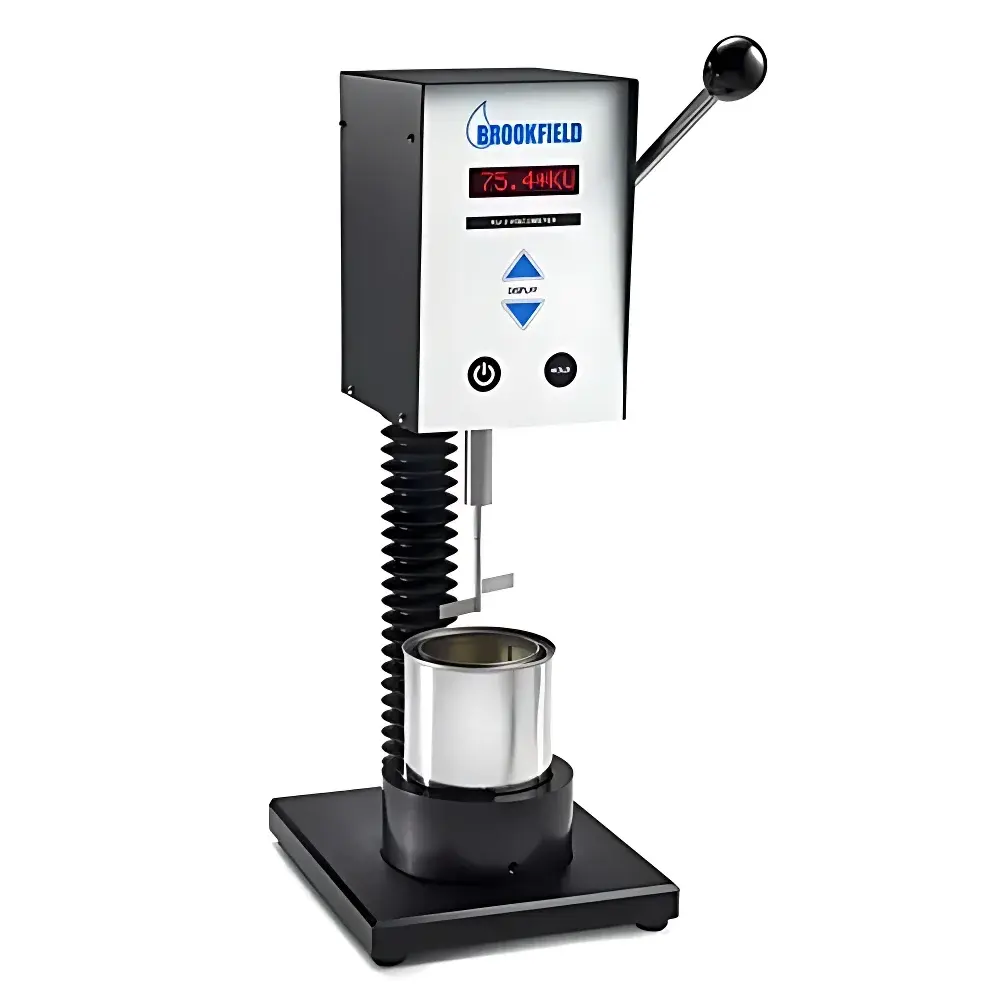
Brookfield KU-3 Digital Krebs Viscometer
| Brand | Brookfield |
|---|---|
| Origin | USA |
| Model | KU-3 |
| Viscosity Range | 1–2,000,000 cP (equivalent to 40–141 KU, 32–1,099 g, 27–5,274 cP) |
| Accuracy | ±1% of full scale |
| Repeatability | ±0.5% of full scale |
| Rotational Speed | 200 rpm ± 0.1 rpm |
| Weight | 8.2 kg (net), 10.2 kg (gross) |
| Dimensions | 533 × 305 × 432 mm (L×W×H) |
| Operating Environment | 0–40 °C, 0–80% RH non-condensing |
| Protection Rating | IP20 |
| Compliance | ASTM D562 |
Overview
The Brookfield KU-3 Digital Krebs Viscometer is a purpose-engineered instrument for rapid, standardized viscosity assessment of architectural and industrial coatings, inks, adhesives, and paste-like materials. It operates on the Krebs unit (KU) measurement principle—a rotational method defined by ASTM D562—where a specially shaped paddle-type rotor (Krebs spindle) rotates at a fixed speed of 200 rpm ± 0.1 rpm in a standard 1-pint (473 mL) or ½-pint container. The torque required to maintain this rotation under controlled geometry and immersion depth (up to 20 mm) is converted into three concurrently displayed units: Krebs Units (KU), grams-force (g), and centipoise (cP). This tri-unit output enables direct cross-referencing with legacy specification sheets, QC checklists, and formulation databases without unit conversion errors. Unlike general-purpose rotational viscometers, the KU-3 implements a fixed-shear-rate, fixed-geometry protocol that ensures inter-laboratory reproducibility and eliminates operator-dependent variables such as spindle selection or gap calibration.
Key Features
- Dual-position operating lever: “Up” position disengages motor and locks rotor; “Down” position initiates measurement—enabling immediate start/stop control during routine QC checks.
- HOLD function allows real-time toggling between KU, g, and cP readings on a high-contrast LED display with 0.1-KU resolution, 1-g resolution, and 1-cP resolution within its extended range.
- Magnetic rotor coupling ensures rapid, tool-free spindle attachment and precise alignment—minimizing mechanical hysteresis and thermal drift during sequential measurements.
- Integrated parallel printer interface supports automated generation of test records compliant with internal audit requirements; no proprietary software or PC connection required.
- Modular base accommodates standard pint, half-pint, and quart containers per ASTM D562; optional high-torque paddle spindles are available for viscous pastes (e.g., roller mill pastes) up to 1,099 g.
- Calibration traceable to NIST-certified reference standards—including Brookfield’s proprietary KU-certified oil set—ensuring metrological continuity across global manufacturing sites.
Sample Compatibility & Compliance
The KU-3 is validated for Newtonian and near-Newtonian fluids typical of solvent-based and waterborne paints, architectural coatings, flexographic and gravure inks, pressure-sensitive adhesives, and low-yield-stress pastes. Its fixed-geometry design inherently excludes shear-thinning or thixotropic interpretation; instead, it delivers a single-point consistency index optimized for pass/fail release testing and batch-to-batch comparability. The instrument conforms strictly to ASTM D562 “Standard Test Method for Viscosity of Paints, Varnishes, Lacquers, and Related Products by Krebs Stormer Viscometer”, and supports documentation practices aligned with ISO/IEC 17025 accredited laboratories. While not designed for GLP/GMP-regulated environments requiring electronic audit trails, its analog-digital hybrid architecture meets baseline data integrity expectations for Tier-2 quality control labs operating under internal SOPs.
Software & Data Management
The KU-3 operates as a standalone hardware platform with no embedded firmware or network connectivity. All data output is generated via its built-in parallel port (Centronics-compatible), enabling direct printing of timestamped results—including test date, KU/g/cP values, and operator ID if manually annotated on printed forms. No drivers, licenses, or cloud dependencies are involved. For laboratories requiring digital archiving, scanned printouts may be integrated into LIMS or ELN systems via standard PDF ingestion protocols. Calibration certificates and NIST-traceable validation reports are provided with each unit shipment and remain valid for 12 months under normal use conditions.
Applications
- Final QC release testing of architectural latex paints prior to canning.
- In-process monitoring of pigment dispersion stability in mill bases.
- Batch verification of ink rheology before plate mounting in packaging printing lines.
- Adhesive formulation screening for open time and green strength correlation.
- Comparative assessment of thickener efficacy across polymer grades (e.g., HEC vs. associative thickeners).
- Supplier qualification audits where KU specifications are contractually mandated.
FAQ
Is the KU-3 suitable for non-Newtonian or thixotropic samples?
No. The KU-3 provides a single-point consistency value under fixed shear rate and geometry. It does not characterize flow curves, yield stress, or time-dependent behavior. For such analyses, a controlled-stress rheometer (e.g., Brookfield DVNext) is required.
Can I use my own sample containers?
Only standard ASTM D562-compliant containers (1-pint or ½-pint tin or plastic cans with defined diameter and depth) ensure measurement validity. Deviations invalidate KU reporting and compromise repeatability.
What maintenance is required?
Routine cleaning of the paddle spindle and base fixture with solvent; annual verification using Brookfield KU-certified reference oils; no lubrication or internal adjustment is user-serviceable.
Does the KU-3 comply with FDA 21 CFR Part 11?
No. It lacks electronic signature capability, audit trail logging, or user access controls. It is intended for non-GxP environments where paper-based records satisfy regulatory expectations.
How often must calibration be performed?
Brookfield recommends verification before each shift when used in high-volume production settings, and at minimum once per day using certified reference oils. Full recalibration by an authorized service center is advised every 12 months or after physical impact.
Related Products



