
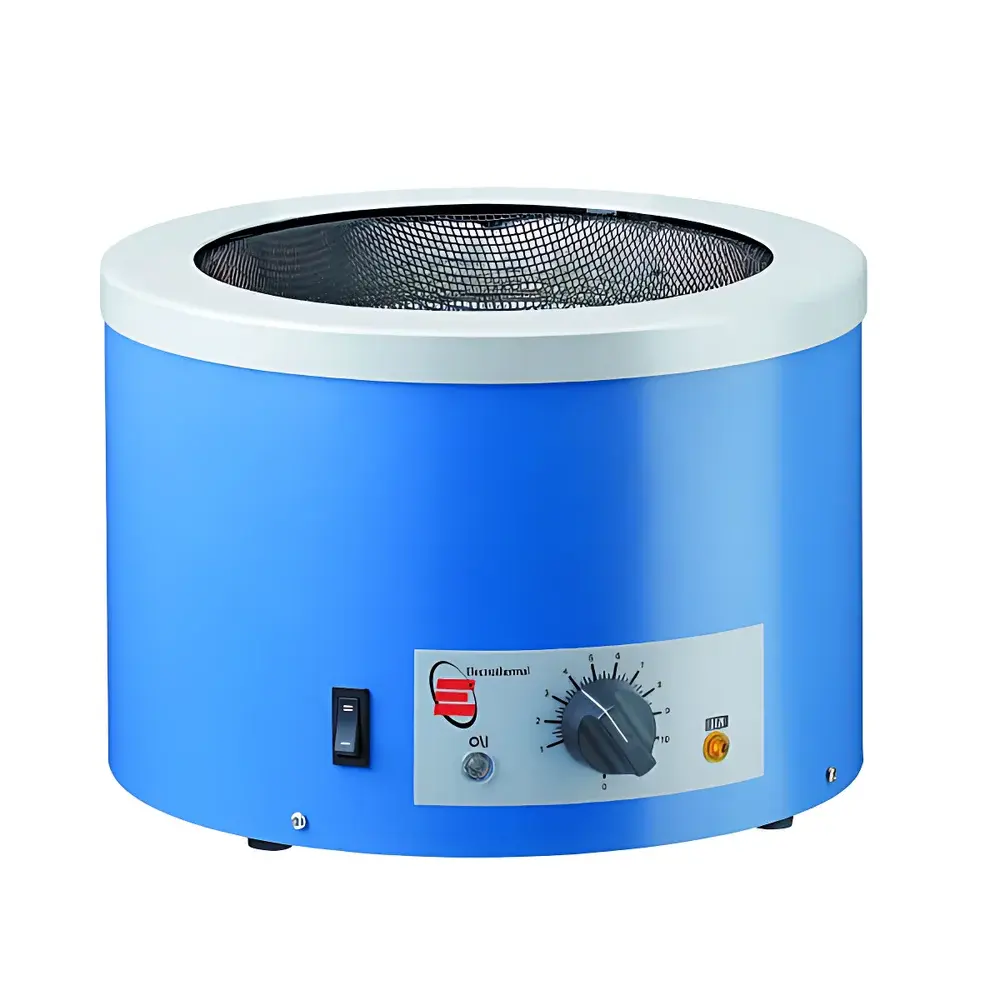
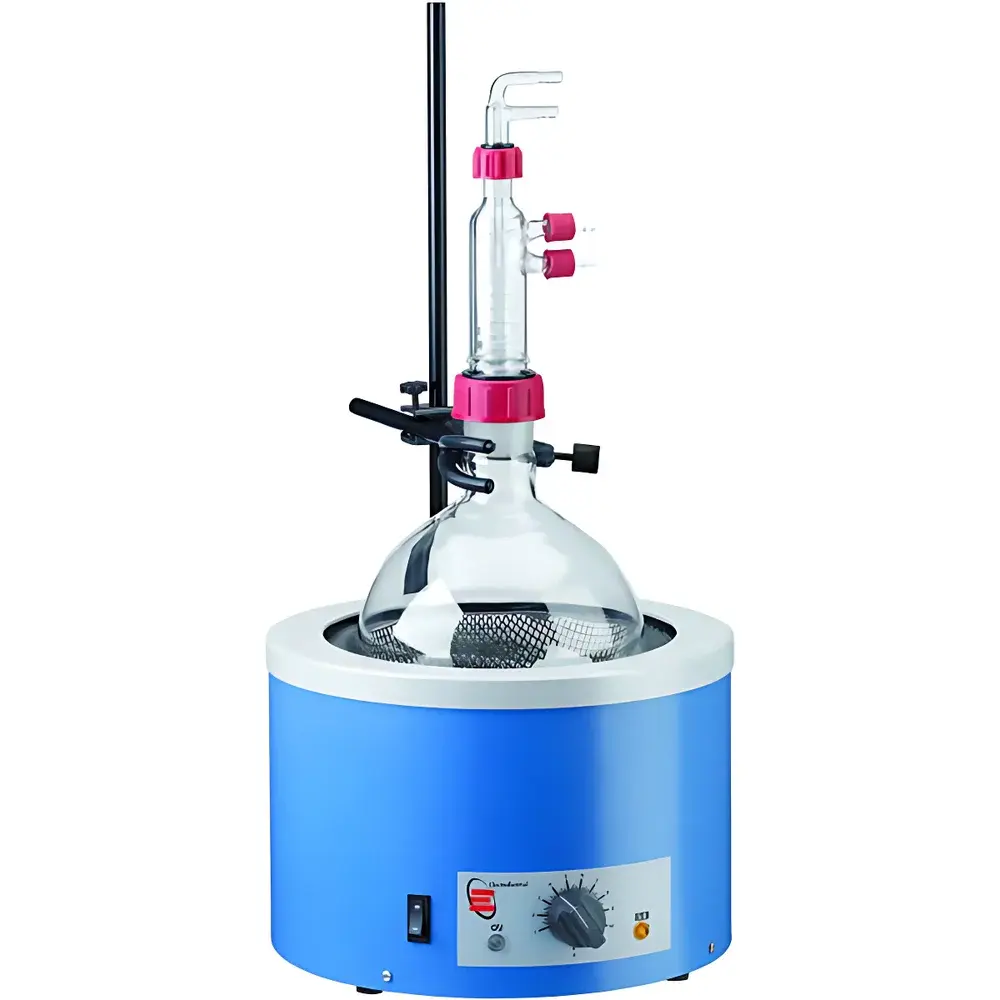
Electrothermal CMUT Multi-Volume Electric Heating Mantle
| Brand | Electrothermal |
|---|---|
| Origin | United Kingdom |
| Model | CMUT |
| Heating Capacity | 250–1000 mL |
| Max Element Temperature | 450 °C |
| Power Rating | 300 W |
| Voltage Options | 230 V 50/60 Hz (CE/CEX6) or 115 V 50/60 Hz (CEX1) |
| Dimensions (D × W × H) | 220 × 220 × 170 mm |
| Net Weight | 1.5 kg |
| Safety Certifications | CSA, CE-compliant |
| Housing Material | Electrostatically Powder-Coated Aluminum |
Overview
The Electrothermal CMUT Multi-Volume Electric Heating Mantle is an engineered thermal platform designed for precise, reproducible, and safe heating of round-bottom flasks in chemical synthesis, distillation, reflux, and sample preparation workflows. Unlike single-capacity mantles, the CMUT employs a modular thermal architecture optimized to accommodate glassware volumes ranging from 250 mL to 1000 mL—enabling consistent heat transfer across variable flask geometries without manual reconfiguration. Its core heating principle relies on resistive nickel-chromium alloy elements embedded within thermally conductive ceramic-insulated layers, delivering uniform radial heat distribution while minimizing hot spots. The mantle operates under open-loop temperature control via an integrated power regulator; actual flask temperature is governed by input wattage, ambient conditions, and thermal mass—not by closed-loop feedback—making it suitable for applications where stable power delivery is prioritized over absolute setpoint accuracy. Designed and manufactured in the UK, the CMUT adheres to IEC 61000-6-3 (EMC) and IEC 61010-1 (safety) standards, with full CSA certification confirming compliance for use in North American laboratories.
Key Features
- Dual independent control circuits enable segmented power management—ideal for simultaneous or staggered heating protocols across multiple vessels or experimental phases.
- Cool-to-touch powder-coated aluminum housing maintains surface temperatures below 50 °C during operation, significantly reducing burn risk and enabling safe proximity handling.
- Heating elements rated to 450 °C ensure compatibility with high-boiling-point solvents (e.g., ethylene glycol, silicone oil baths) and extended thermal stability under continuous load.
- Interchangeable heating plates allow users to retrofit the CMUT with application-specific inserts—including low-profile variants for short-path distillation or deep-well configurations for tall flasks—extending functional lifespan beyond standard product cycles.
- Integrated safety systems include grounded electromagnetic shielding, dual redundant fusing, automatic liquid-splash detection circuitry (IEC 60335-1 compliant), and reinforced insulation barriers between live components and external surfaces.
- Ergonomic design features non-slip rubber feet, adjustable retaining rod clamps for flask stabilization, and front-panel LED indicators for both power status and active heating state.
Sample Compatibility & Compliance
The CMUT is validated for use with standard borosilicate glass round-bottom flasks (ISO 3585, ASTM E438 Type I Class A) ranging from 250 mL to 1000 mL. Its flexible internal geometry accommodates variations in flask neck diameter (24/40 to 45/50 joints) and base curvature without mechanical interference. The unit meets CE marking requirements under the Low Voltage Directive (2014/35/EU) and Electromagnetic Compatibility Directive (2014/30/EU). CSA certification confirms conformance with CAN/CSA-C22.2 No. 61010-1 and UL 61010-1 for laboratory electrical equipment. While not intrinsically rated for hazardous locations, its grounding integrity, double insulation, and auto-shutoff functionality support safe deployment in general-purpose fume hoods and controlled lab environments per ANSI Z9.5 ventilation guidelines.
Software & Data Management
The CMUT operates as a standalone analog thermal instrument with no embedded microprocessor or digital interface. It does not feature data logging, remote control, or software integration capabilities. All operational parameters—including power level, duration, and thermal output—are manually configured via front-panel controls. This design philosophy prioritizes reliability, electromagnetic noise immunity, and long-term serviceability in regulated settings where unvalidated firmware or network-connected peripherals may introduce audit complications. For laboratories requiring traceable heating records, the CMUT is compatible with external temperature monitoring systems (e.g., calibrated PT100 probes connected to GLP-compliant data loggers meeting ISO/IEC 17025 requirements).
Applications
- Controlled heating during organic synthesis reactions (Grignard, Friedel-Crafts, esterification) where solvent reflux stability is critical.
- Distillation setups—including simple, fractional, and vacuum-assisted configurations—leveraging uniform thermal gradients to minimize bumping and foaming.
- Preparative chromatography solvent evaporation and fraction concentration using rotary evaporator-compatible flasks.
- Standardization of dissolution testing vessels in pharmaceutical QC labs operating under USP <711> and Ph. Eur. 2.9.3 guidelines.
- Environmental sample digestion (EPA Method 3050B, 3051A) when paired with acid-resistant PTFE-coated flasks and fume hood containment.
- Teaching laboratories requiring robust, low-maintenance heating platforms compliant with undergraduate safety curricula (e.g., ACS Committee on Professional Training standards).
FAQ
Is the CMUT compatible with 115 V power supplies?
Yes—the CEX1 variant supports 115 V, 50/60 Hz operation at 300 W. Ensure correct regional plug configuration and verify local outlet grounding before use.
Can the CMUT be used with flat-bottom flasks?
No. It is specifically engineered for round-bottom flasks only. Flat-bottom or Erlenmeyer vessels will not achieve stable contact or uniform heat transfer.
Does the CMUT support temperature setpoint programming?
No. It provides adjustable power output only. For precise temperature control, integrate with an external PID controller and immersion probe.
What maintenance is required for long-term reliability?
Wipe the powder-coated housing with isopropyl alcohol after each use; inspect heating plates annually for ceramic insulation cracking or discoloration; replace fuses only with specified 3.15 A slow-blow type.
Is calibration documentation provided with the unit?
No factory calibration certificate is included, as the CMUT is classified as a Class B general-purpose heater per ISO/IEC 17025 Annex A. Users must perform in-house verification using NIST-traceable thermometers prior to first use and at defined intervals per internal SOPs.



