
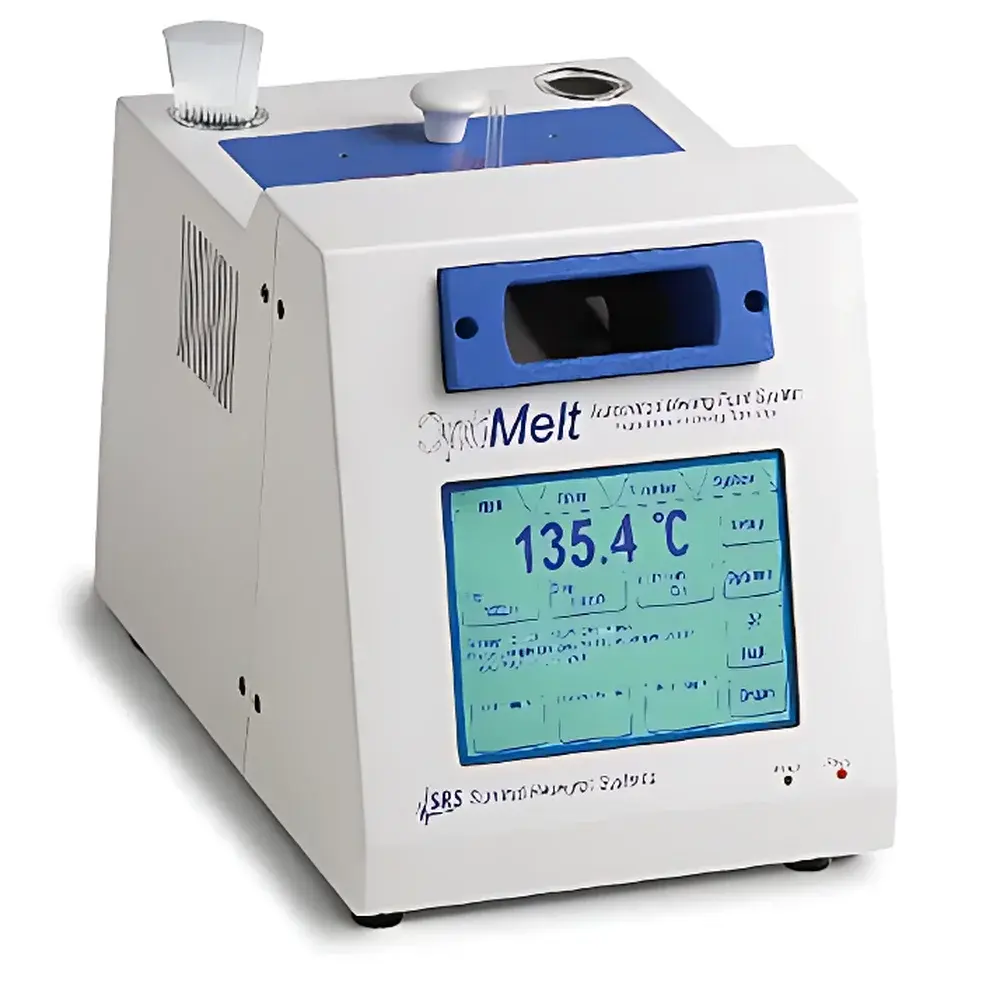
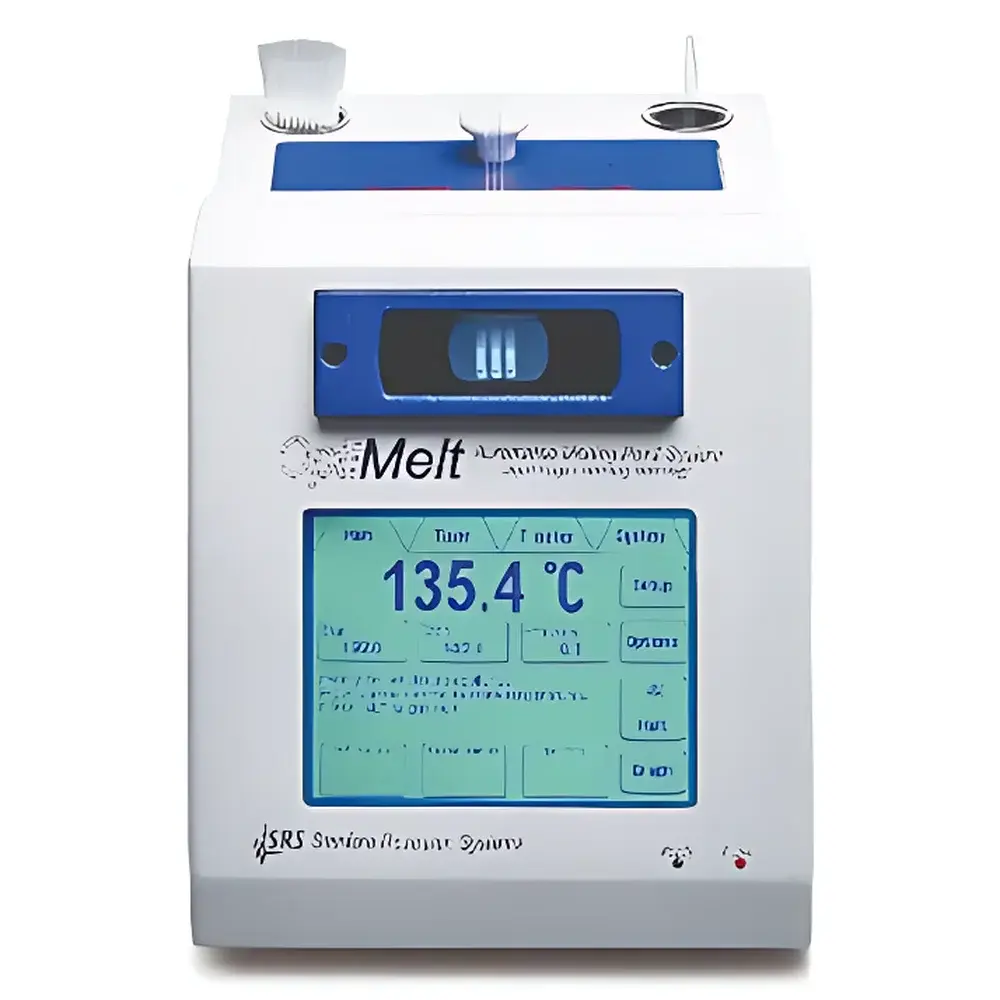
SRS OptiMelt MPA100 Automated Melting Point Apparatus
| Brand | SRS |
|---|---|
| Origin | USA |
| Model | MPA100 |
| Temperature Range | Ambient to 396 °C |
| Heating Rate | 0.1–20.0 °C/min (in 0.1 °C/min increments) |
| Temperature Repeatability | ±0.2 °C |
| Temperature Accuracy | ±0.3 °C (up to 100 °C), ±0.5 °C (up to 250 °C), ±0.8 °C (up to 400 °C) |
| Capillary Dimensions | OD 1.4–2.0 mm, Length 100 mm |
| Sample Capacity | 3 capillaries |
| Temperature Resolution | 0.1 °C |
Overview
The SRS OptiMelt MPA100 Automated Melting Point Apparatus is a precision thermal analysis instrument engineered for reliable, operator-independent determination of melting points and melting ranges of organic and pharmaceutical compounds. It employs a dual-sensor closed-loop PID temperature control system coupled with real-time digital image analysis—eliminating subjective visual interpretation. The system heats samples in standard glass capillaries within a compact aluminum heating block, while an integrated high-resolution digital camera continuously captures sequential images of the sample morphology. Proprietary image-processing algorithms detect phase transitions by analyzing changes in light transmission, meniscus formation, and clarity onset—providing objective, traceable endpoints aligned with pharmacopoeial definitions (USP & EP). Designed for routine QC labs and R&D environments, the MPA100 delivers reproducible results under GLP-compliant conditions without requiring continuous operator supervision.
Key Features
- Triple-capillary capacity enabling parallel analysis of up to three independent samples per run
- Programmable heating rate from 0.1 to 20.0 °C/min in precise 0.1 °C/min increments for method flexibility and regulatory alignment
- Platinum RTD (Pt100) temperature sensor with 0.1 °C resolution and NIST-traceable calibration capability
- Backlit 5.8-inch resistive touchscreen interface with on-screen numeric keypad—no external peripherals required
- Real-time video capture and frame-by-frame playback via MeltView™ PC software; supports animation export for documentation and training
- Onboard memory stores up to 24 user-defined methods and 8 complete analytical reports—including timestamps, operator ID, and calibration history
- Dual functionality as a general-purpose digital thermometer and event timer (three independent timers) for auxiliary lab use
- Compliance-ready architecture: Optional 21 CFR Part 11-compliant firmware package available with electronic signatures, audit trails, and role-based access control
Sample Compatibility & Compliance
The MPA100 accepts standard melting point capillaries (1.4–2.0 mm OD, 100 mm length) filled to 2–3 mm height—compatible with USP & Ph. Eur. guidelines for sample preparation. Its optical detection system eliminates interference from colored or opaque samples that challenge traditional photometric or reflection-based instruments. The device meets essential requirements for ISO/IEC 17025-accredited laboratories and supports full traceability per FDA guidance for analytical instrument qualification (AIQ). Built-in calibration verification routines allow daily performance checks using certified reference standards (e.g., indium, caffeine, vanillin), with automatic logging of calibration dates and deviations. All temperature data are timestamped and associated with unique sample IDs, satisfying GLP documentation standards for pharmaceutical stability and release testing.
Software & Data Management
MeltView™ software provides full remote control, live video streaming, and post-run analysis on Windows platforms. Each measurement generates a structured report containing raw thermal profiles, annotated image sequences, and metadata (operator, date/time, method parameters, calibration status). Reports export in PDF or CSV formats and support direct USB transfer to networked PCs. Audit trail functionality (in Part 11-enabled configuration) logs all user actions—including method edits, report deletions, and calibration events—with immutable timestamps and operator authentication. Data integrity is reinforced through password-protected user roles (Administrator, Analyst, Reviewer) and encrypted local storage. Instrument firmware supports SCPI-style command sets over USB, enabling integration into LIMS or automated QA workflows.
Applications
- Pharmaceutical quality control: Identity confirmation and purity assessment per USP & ICH Q5 guidelines
- Chemical synthesis validation: Monitoring reaction completion and intermediate purity in API manufacturing
- Academic research: Characterization of novel organic compounds, polymorph screening, and eutectic behavior studies
- Regulatory submissions: Generation of auditable, image-supported melting data for ANDA, NDA, and CMC dossiers
- Material science: Thermal profiling of small-molecule crystals, co-crystals, and hydrate/dehydrate transitions
- Forensic and customs labs: Rapid identification of illicit substances based on characteristic melting behavior
FAQ
How does the OptiMelt MPA100 determine melting point without human observation?
It uses synchronized thermal ramping and real-time image acquisition, applying edge-detection and contrast-threshold algorithms to identify the onset of meniscus formation and endpoint of transparency—correlating directly with classical visual criteria.
Can the instrument be calibrated in-house?
Yes—using certified reference standards (e.g., USP reference standards), users perform two-point or multi-point calibrations via the front-panel menu; results are automatically logged with date, standard ID, and deviation values.
What is the cooling time between runs?
Approximately 10 minutes to cool from 350 °C to 50 °C, enabled by passive dissipation and optimized thermal mass design—no active Peltier or forced-air cooling required.
Is method validation supported for GMP environments?
The MPA100’s deterministic image-based detection, temperature traceability, and optional 21 CFR Part 11 firmware enable full IQ/OQ/PQ execution per ASTM E2554 and WHO TRS 992 Annex 5.
Does it support non-standard capillary dimensions?
No—only capillaries conforming to ISO 11357-3 specifications (1.4–2.0 mm OD, 100 mm length) are mechanically and optically compatible with the fixed-focus imaging chamber.
How is data integrity ensured during USB transfer?
All exported files include embedded digital signatures and checksums; MeltView software verifies file integrity upon import and flags any corruption or unauthorized modification.



