
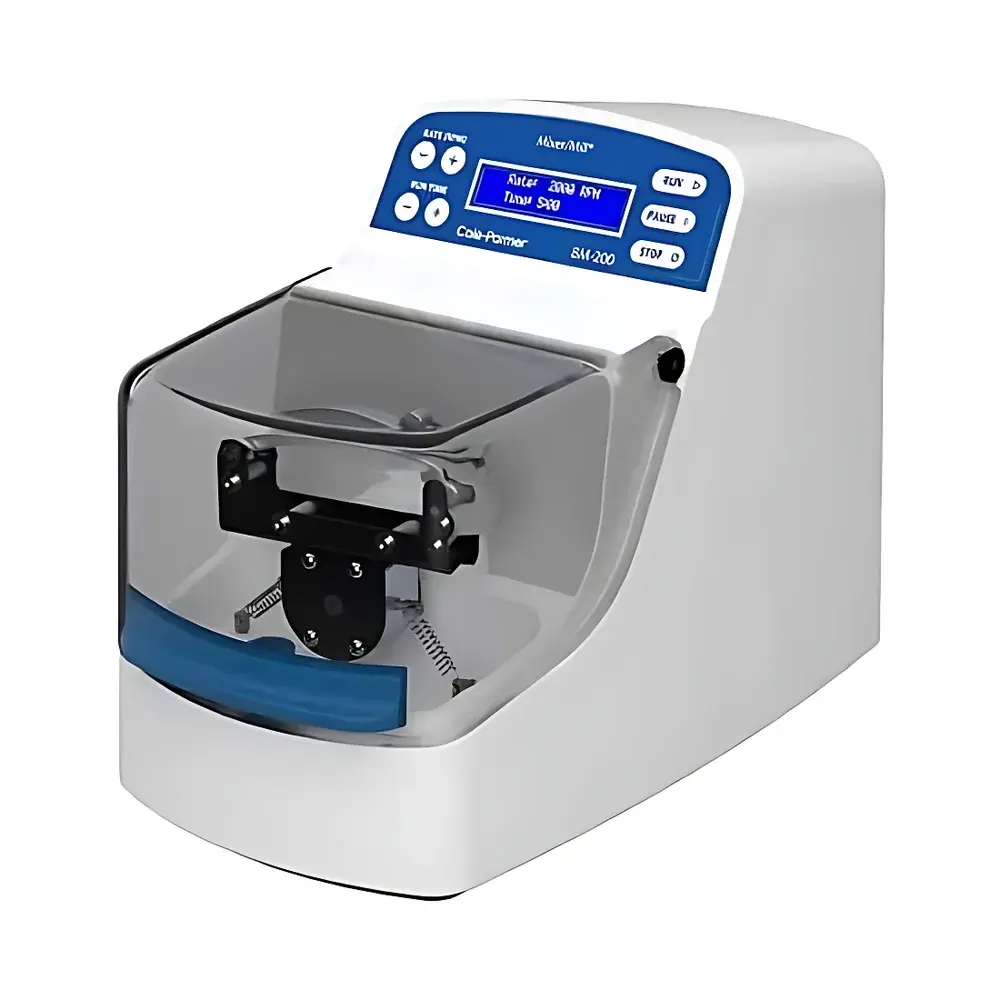
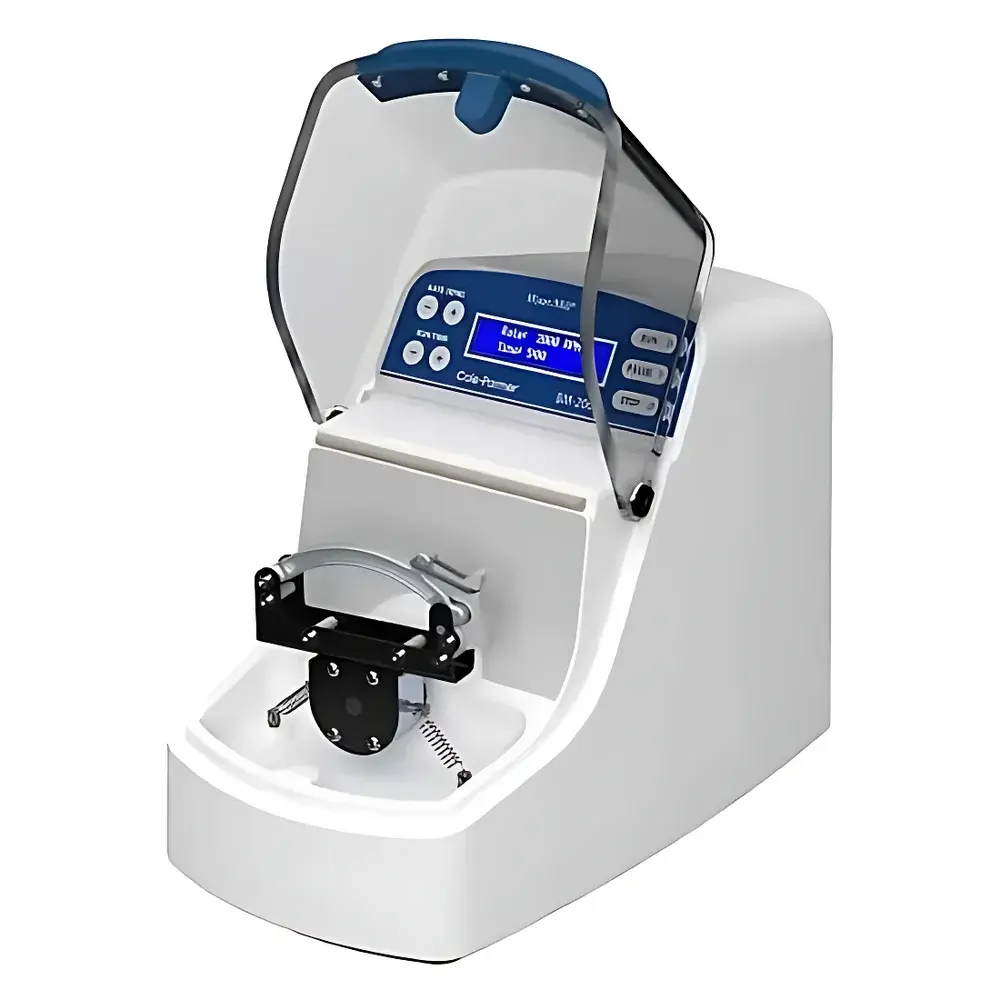
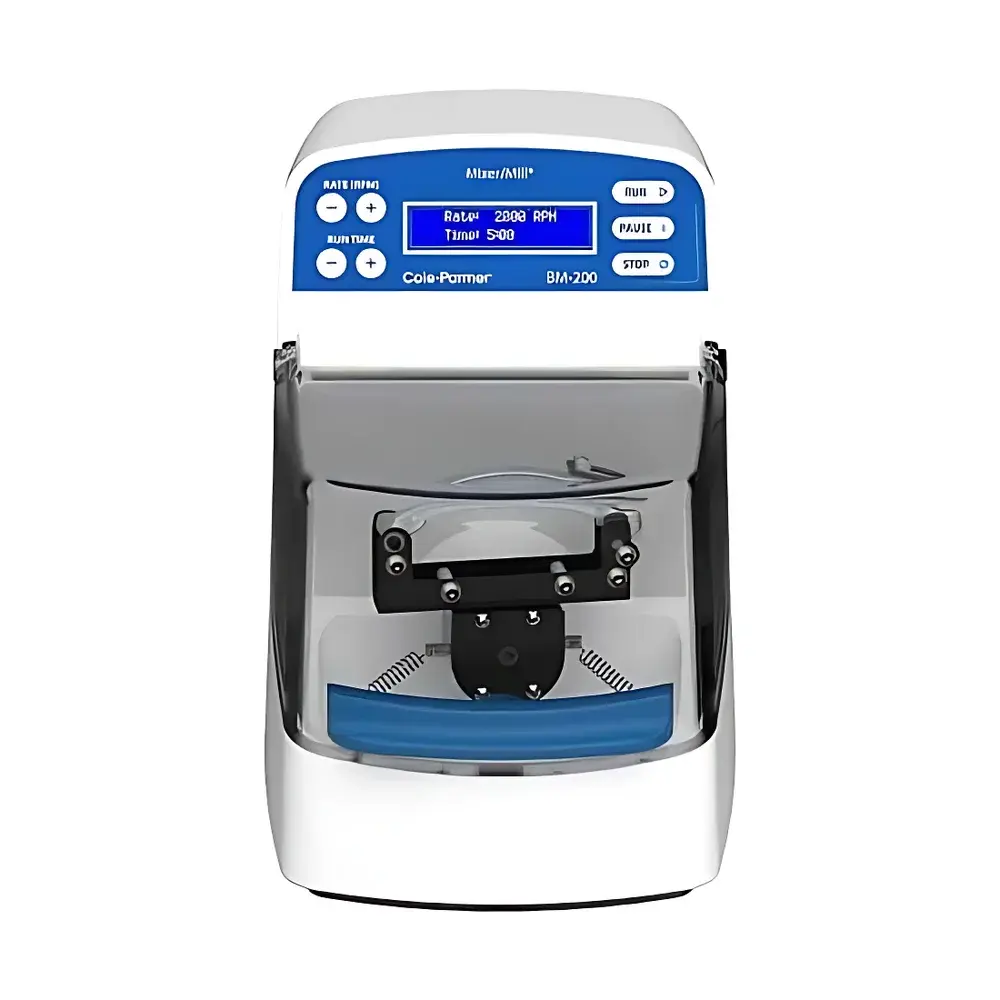
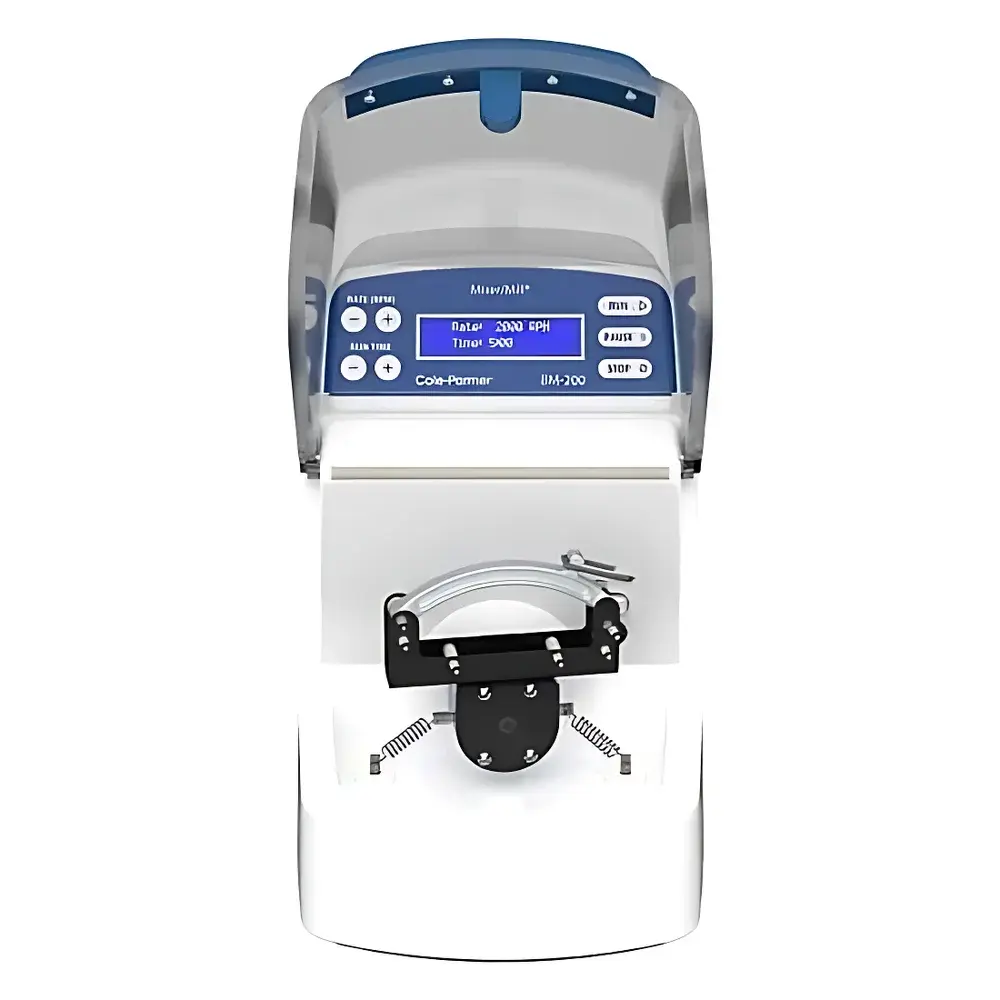
Cole-Parmer SamplePrep BM-200 Compact High-Energy Ball Mill (Formerly SPEX 5120)
| Brand | Cole-Parmer |
|---|---|
| Origin | USA |
| Manufacturer Type | Authorized Distributor |
| Product Category | Imported Instrument |
| Model | BM-200 (formerly SPEX 5120) |
| Instrument Type | High-Energy Ball Mill |
| Sample Applicability | Hard and Brittle Materials |
| Sample Capacity | Up to 1 g solid or 3 mL liquid/slurry |
| Oscillation Frequency Range | 750–3500 cpm |
| Programmable Time Setting | 0.1–99.9 min |
| Safety Interlock | Motor-disabled lid switch with mechanical latch |
| Power Consumption | ≤120 W |
| Operating Modes | Mixing, Homogenization, Pulverization, Emulsification |
| Compatible Vial Types | Stainless steel, tungsten carbide, agate, polycarbonate, polypropylene, polyethylene |
| Grinding Media | 3–7.9 mm stainless steel, zirconia, agate, and tungsten carbide balls |
Overview
The Cole-Parmer SamplePrep BM-200 Compact High-Energy Ball Mill (formerly SPEX 5120) is a laboratory-scale vibratory mill engineered for rapid, reproducible size reduction and homogenization of small-volume samples. It operates on the principle of high-frequency, multi-axis oscillation—generating intense inertial forces that drive grinding media against sample material within sealed vials. Unlike conventional planetary or rotary ball mills, the BM-200 employs a patented dual-motion mechanism: each oscillation cycle combines longitudinal reciprocation with transient lateral displacement, inducing an “infinity-shaped” (figure-eight) trajectory at the vial ends. This motion ensures uniform energy transfer across the entire sample bed, minimizing thermal buildup and preferential particle attrition. Designed specifically for analytical sample preparation workflows, the BM-200 delivers consistent sub-10 µm particle distributions from hard, brittle matrices—including silicates, oxides, ceramics, cement clinkers, and geological specimens—without manual intervention or operator fatigue.
Key Features
- Four discrete oscillation speeds (750, 2000, 3000, and 3500 cycles per minute), enabling method-specific selection from gentle mixing to aggressive pulverization
- Programmable digital control panel with adjustable run time (0.1–99.9 minutes), pause function, and real-time status feedback
- Integrated safety interlock system: motor automatically deactivates when the transparent polycarbonate lid is opened or improperly latched
- Ergonomic clamping mechanism with reinforced handle and stretchable safety ring for secure vial retention during high-cpm operation
- Low-power design (≤120 W nominal draw) compatible with portable DC power sources for field-deployable use in mobile labs or remote sampling sites
- Optically transparent lid allows visual monitoring of vial motion, media behavior, and sample consistency without interrupting operation
- Modular vial compatibility: accepts standardized 2–12 mL containers in stainless steel, tungsten carbide, agate, and polymer materials to prevent contamination and support diverse chemistries
Sample Compatibility & Compliance
The BM-200 accommodates a broad spectrum of inorganic and organic solids, including but not limited to quartz, feldspar, basalt, alumina, silicon carbide, pharmaceutical excipients, and metal alloys. Its ability to process up to 1 g of material per run aligns with standard ICP-OES, ICP-MS, AA, XRF, and XRD sample submission requirements. When used with certified reference materials (CRMs) and trace-metal-clean vials, the system supports ISO/IEC 17025-compliant analytical preparation protocols. For regulated environments, the instrument’s repeatable timing and fixed speed settings facilitate SOP documentation and audit-ready process validation. While the BM-200 itself does not carry FDA 21 CFR Part 11 certification, its deterministic operational parameters and absence of data storage make it suitable for GLP/GMP-aligned laboratories where procedural traceability is maintained through external logbooks or LIMS integration.
Software & Data Management
The BM-200 operates via a standalone microprocessor-based controller with no embedded software or network interface. All operational parameters—including speed selection, duration, and pause state—are set manually using tactile push-button controls and displayed on a dual-digit LED screen. This architecture eliminates firmware dependencies, cybersecurity vulnerabilities, and version-control overhead. For laboratories requiring electronic recordkeeping, time-stamped run logs can be generated externally via connected timers or LIMS interfaces. The absence of onboard memory ensures full compliance with data integrity principles outlined in ALCOA+ (Attributable, Legible, Contemporaneous, Original, Accurate) frameworks when paired with appropriate procedural documentation.
Applications
- Rapid comminution of geological and metallurgical samples prior to XRF fusion or pressed-pellet analysis
- Homogenization of heterogeneous powders for quantitative XRD phase analysis and crystallite size determination
- Preparation of ultrafine suspensions for laser diffraction particle size distribution (PSD) measurement
- Cell disruption and tissue homogenization in proteomics workflows using cryogenic vials
- Blending of ceramic precursors and battery electrode materials under inert atmosphere (with optional glovebox-compatible vial loading)
- Emulsification of immiscible liquid phases for stability testing in formulation development
FAQ
What is the maximum recommended sample mass for optimal grinding efficiency?
The BM-200 achieves highest reproducibility with 0.2–1.0 g of dry, brittle material. Overfilling beyond 1 g may reduce impact frequency and compromise particle size uniformity.
Can the BM-200 be used for cryogenic grinding?
Yes—when equipped with stainless steel or tungsten carbide vials and pre-chilled grinding media, the BM-200 supports cryo-milling down to –196 °C using liquid nitrogen immersion or cryo-cooled jackets.
Is there a validated method for cleaning between runs to prevent cross-contamination?
Vials and grinding media should be cleaned using solvent sonication (e.g., acetone, ethanol) followed by low-temperature baking (120 °C, 2 h) for inorganic residues; acid-wash protocols are recommended for trace-metal applications.
Does the BM-200 meet CE or UL safety standards?
The instrument complies with UL 61010-1 (2nd Ed.) and IEC 61010-1:2010 for laboratory electrical equipment, and carries ETL listing for North American markets.
How frequently should mechanical components be inspected or serviced?
Annual inspection of the eccentric drive assembly, clamp hinge pins, and lid switch actuation is recommended. No routine lubrication is required due to sealed bearing construction.



