
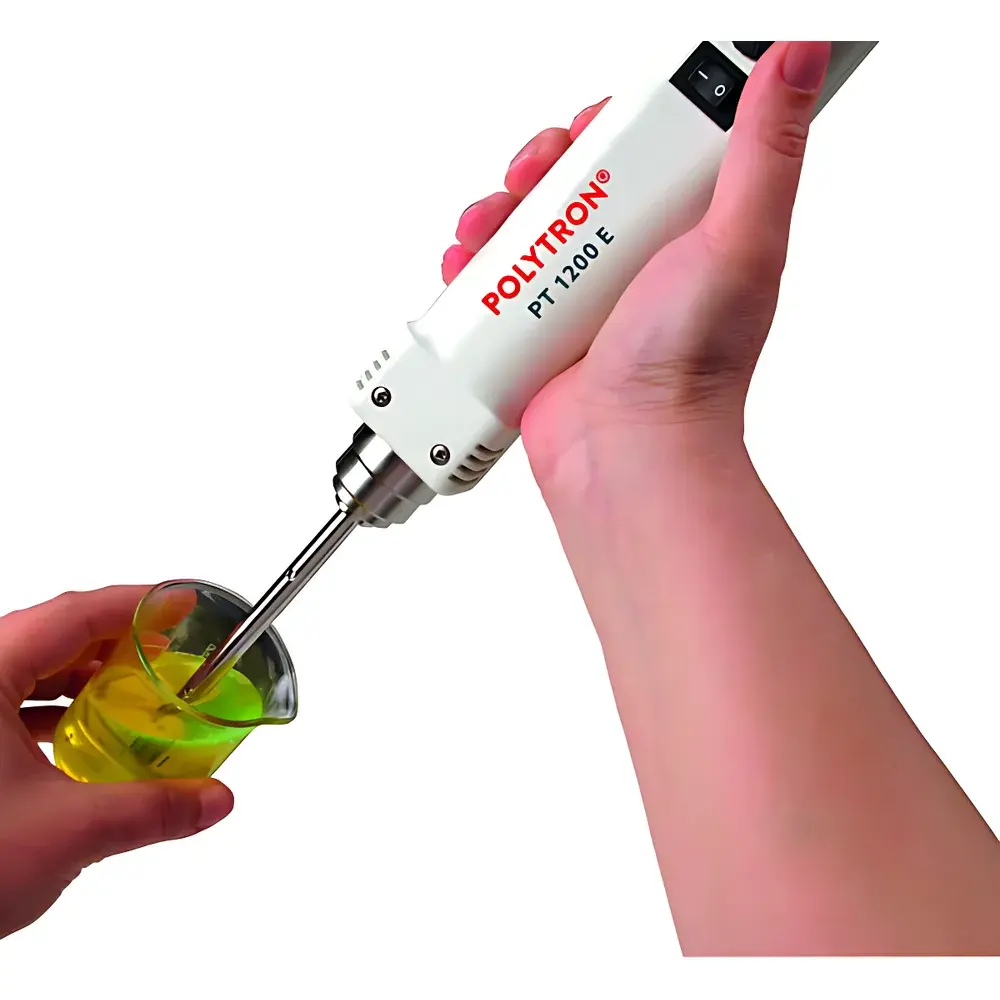
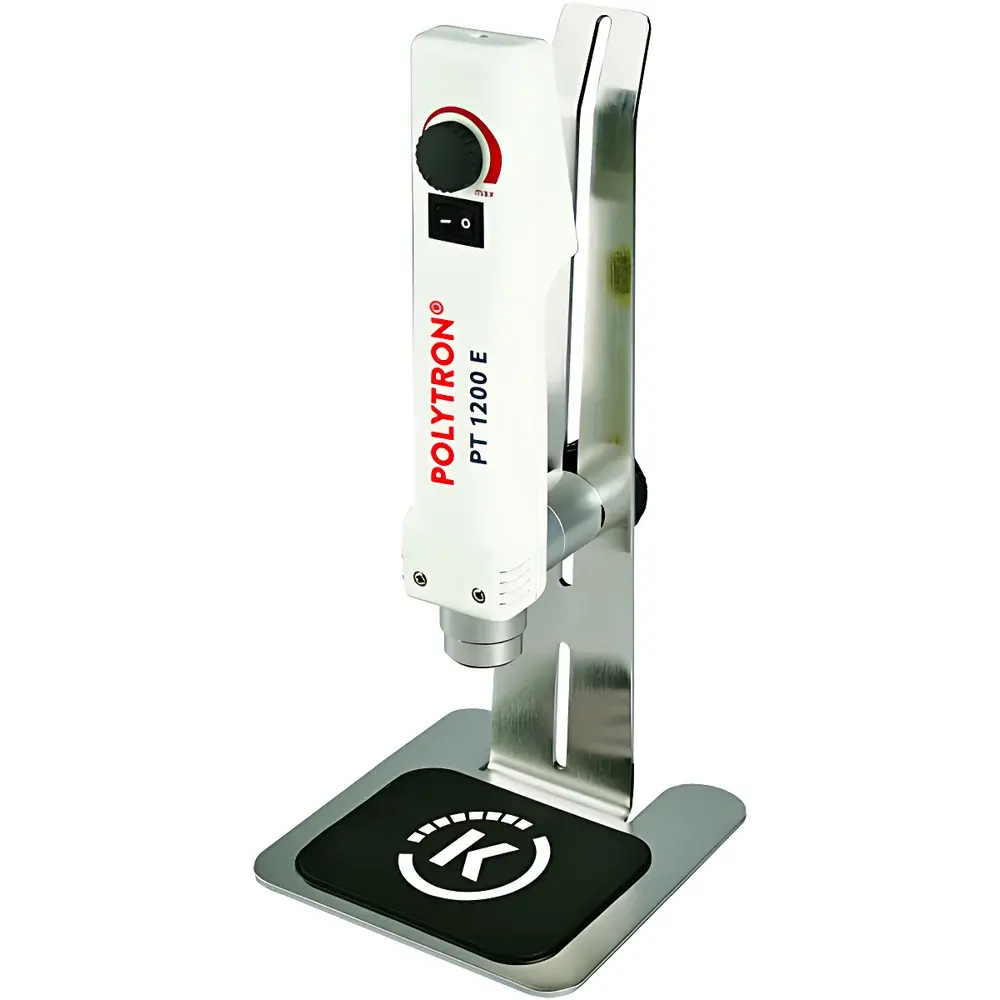
Kinematica POLYTRON PT1200E Handheld Homogenizer
| Brand | Kinematica |
|---|---|
| Origin | Switzerland |
| Model | PT1200E |
| Instrument Type | Probe-type rotor-stator homogenizer |
| Dimensions (W×D×H) | 220 × 44 × 55 mm |
| Processing Volume | 0.05–250 mL |
| Maximum Speed | 0–25,000 rpm |
| Tip Linear Velocity | up to 14 m/s (standard tips), up to 21 m/s (X-type tip) |
| Motor | Universal brushed motor, 100 W |
| Voltage | 90–230 V ±10%, 50/60 Hz |
| Noise Level | ≤65 dB(A) at 20,000 rpm (no tip), ≤76 dB(A) at 25,000 rpm (no tip) |
| IP Rating | IP20 |
| Operating Temperature | 0–40 °C |
| Relative Humidity (operating/storage) | ≤80% |
| Compliance | IEC/EN 61010-2-51, IEC/EN 61000-6-2/6-3 |
Overview
The Kinematica POLYTRON PT1200E is a precision-engineered handheld homogenizer designed for high-shear, reproducible sample disruption and dispersion in life science, pharmaceutical, and analytical laboratories. Based on the proven rotor-stator principle, it generates intense hydrodynamic shear forces through rapid rotation of a precisely machined probe within a fixed stator sleeve—effectively reducing particle and cell aggregate size while maintaining biomolecular integrity under controlled conditions. Its compact, ergonomic design enables single-handed operation with minimal fatigue during extended use, making it ideal for benchtop workflows involving small-volume samples (0.05–250 mL). The PT1200E delivers consistent energy input across viscosity changes via intelligent speed regulation, ensuring stable rotational velocity regardless of sample rheology—a critical requirement for quantitative RNA/DNA extraction, enzymatic assays, and suspension homogeneity validation.
Key Features
- Ergonomic handheld housing (220 × 44 × 55 mm; 440 g) with non-slip grip and balanced weight distribution for precise control during manual operation.
- Intelligent electronic speed control with real-time feedback, maintaining set rpm ±2% even during dynamic viscosity shifts (e.g., lysate thickening or polymer addition).
- E-type quick-connect interface enabling tool-free, repeatable attachment/detachment of interchangeable dispersing heads—reducing cross-contamination risk and setup time.
- High-efficiency universal brushed motor (100 W) operating across global voltage ranges (90–230 V, 50/60 Hz) with thermal overload protection and extended service life.
- Optimized acoustic design: noise emission ≤65 dB(A) at 20,000 rpm without tip; compliant with ISO 7779 for laboratory ambient noise management.
- Modular dispersing head system supporting standardized EC, sterile SYN, and high-turbulence BIOTRONA® configurations—each engineered for specific shear profiles and contamination control requirements.
- IP20-rated enclosure suitable for standard laboratory environments; meets IEC/EN 61010-2-51 safety standards for laboratory electrical equipment.
Sample Compatibility & Compliance
The PT1200E accommodates diverse biological and chemical matrices including soft animal tissues (liver, spleen), plant leaves, cultured cells, bacterial pellets, tablet excipients, and viscous suspensions (e.g., nanocellulose dispersions). Its rotor-stator geometry ensures efficient cell lysis without excessive foaming or heat generation when operated within recommended time limits (<60 s per sample). Dispersing heads are manufactured from medical-grade stainless steel (EC series), PES (SYN sterile kits), or specialized POM (BIOTRONA®), all certified for USP Class VI biocompatibility. The system supports GLP-compliant workflows through traceable tip lot numbers, documented calibration intervals, and compatibility with audit-ready lab notebooks. While not intrinsically 21 CFR Part 11 compliant, its analog speed control and mechanical operation allow integration into validated processes where electronic signature requirements are managed externally.
Software & Data Management
The PT1200E operates as a stand-alone instrument without embedded firmware or digital connectivity. All operational parameters—including speed setting, runtime, and tip type—are manually recorded by the user. This analog architecture eliminates software validation burdens and ensures deterministic performance unaffected by OS updates or cybersecurity vulnerabilities. For laboratories requiring documentation traceability, Kinematica provides optional printed calibration certificates (traceable to national standards) and maintenance logs aligned with ISO/IEC 17025 quality management frameworks. Tip-specific performance data—including maximum linear velocity, recommended processing volume, and shear rate approximations—is published in the official Technical Reference Manual (Rev. 4.2), facilitating method transfer between instruments and labs.
Applications
- Routine homogenization of tissue biopsies for histopathology, proteomics, and metabolomics sample preparation.
- Preparation of uniform suspensions for particle size analysis (e.g., DLS, laser diffraction) and rheological characterization.
- Cell lysis in genomic workflows: mechanical disruption of mammalian, insect, and microbial cells prior to RNA/DNA isolation.
- API extraction from solid dosage forms (tablets, capsules) under pharmacopeial guidance (USP <701>, EP 2.9.32).
- Dispersion of nanomaterials (e.g., graphene oxide, quantum dots) in aqueous and organic media for stability testing.
- Emulsification of oil-in-water systems for food science and cosmetic formulation development.
- Homogenization of clinical specimens (blood, saliva, swabs) in diagnostic assay development and validation protocols.
FAQ
What is the maximum recommended continuous operating time per sample?
For optimal temperature control and biomolecule preservation, limit single-sample operation to ≤60 seconds at speeds above 15,000 rpm; allow ≥30 seconds cooling between cycles.
Can the PT1200E be used for sterile applications?
Yes—SYN-series disposable dispersing heads (sterile-packed in PES or POM) are validated for aseptic processing and eliminate autoclaving requirements.
Is speed calibration traceable to international standards?
Kinematica offers factory calibration services with NIST-traceable tachometer verification and certificate issuance upon request.
How does the E-type quick-connect ensure tip alignment repeatability?
The dual-pin keyed interface guarantees radial and axial positioning accuracy within ±0.05 mm, minimizing vibration and ensuring consistent shear zone geometry across tip swaps.
Does the PT1200E meet CE marking requirements for the European Economic Area?
Yes—the device carries the CE mark under the Low Voltage Directive (2014/35/EU) and EMC Directive (2014/30/EU), verified per harmonized standards EN 61010-1 and EN 61000-6-2/3.
Related Products



