
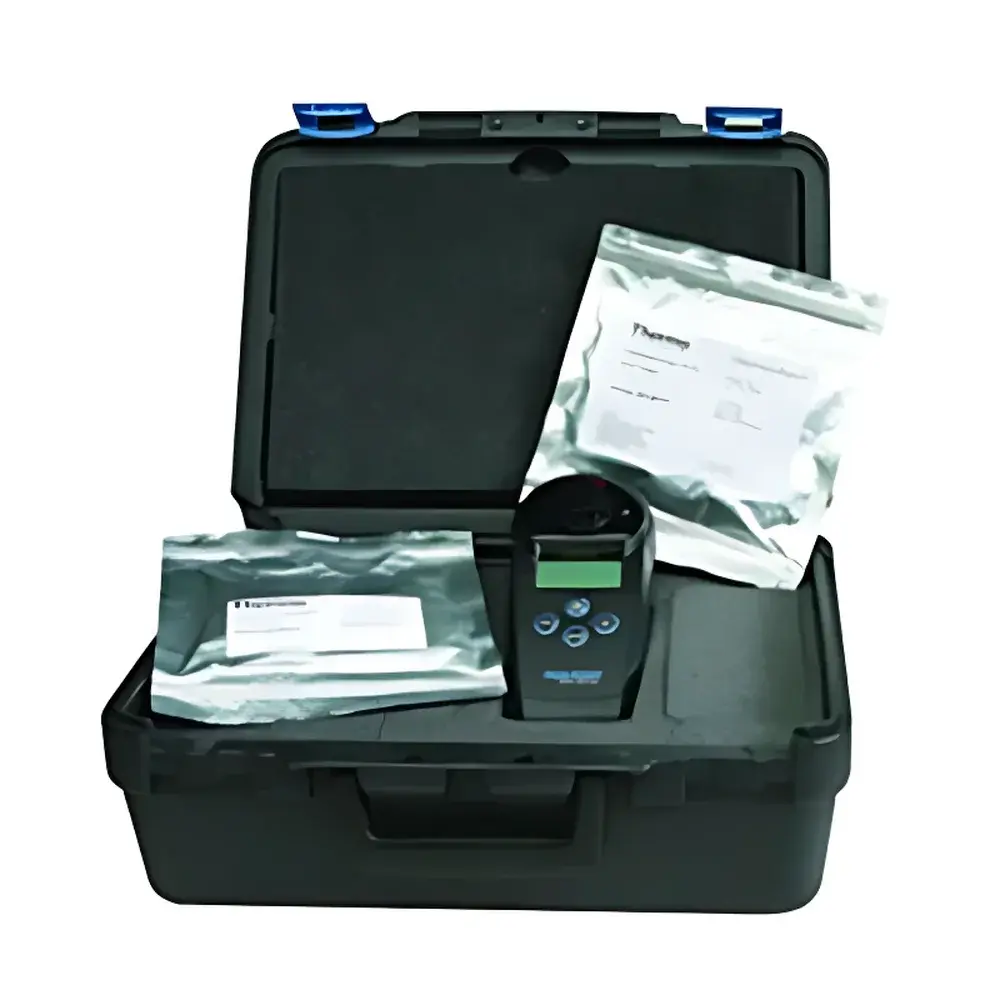
Thermo Scientific Orion AQ3070 Residual and Total Chlorine Colorimeter
| Brand | Thermo Scientific Orion |
|---|---|
| Origin | USA |
| Model | AQ3070 |
| Instrument Type | Portable |
| Measurement Parameters | Residual Chlorine, Total Chlorine, pH, Chlorine Dioxide, Cyanuric Acid |
| Measurement Range | Residual Chlorine: 0.02–4.0 mg/L |
| Total Chlorine | 0.02–4.0 mg/L |
| Chlorine Dioxide | 0–9 mg/L |
| pH | 5.9–8.2 |
| Cyanuric Acid | 5–90 mg/L |
| Display | LCD |
| Keys | Power, Mode, Zero, Read/Enter |
| Sample Volume | 10 mL |
| Power Supply | 4 × AAA batteries (≥3000 measurements, auto-off) |
| Environmental Rating | IP67 |
| Operating Conditions | 0–50 °C, 0–90% RH (non-condensing at 30 °C) |
| Compliance | CE, TÜV, FCC Part 15 |
Overview
The Thermo Scientific Orion AQ3070 is a field-deployable, multi-parameter colorimeter engineered for rapid, reliable quantification of residual chlorine, total chlorine, chlorine dioxide, cyanuric acid, and pH in water matrices. It operates on the principle of standardized colorimetric analysis—where reagent-mediated chromogenic reactions generate measurable absorbance changes proportional to analyte concentration. Unlike spectrophotometric platforms requiring wavelength selection or calibration curves, the AQ3070 embeds EPA-validated method algorithms directly into its firmware, enabling direct concentration readout without user intervention in curve fitting or pathlength correction. Designed for regulatory compliance in drinking water, wastewater, recreational water (pools/spas), and aquaculture applications, the instrument implements U.S. EPA-approved methods AC4P71 (residual chlorine) and AC4P72 (total chlorine), ensuring alignment with federal monitoring requirements under the Safe Drinking Water Act (SDWA) and Clean Water Act (CWA). Its optical architecture features fixed-wavelength LED sources and matched photodiode detectors optimized for each assay’s absorption maxima, delivering high reproducibility across environmental temperature gradients.
Key Features
- EPA-compliant methodology: Pre-programmed AC4P71 (residual Cl₂) and AC4P72 (total Cl₂) protocols validated per U.S. EPA Method 334.0 and Standard Methods 4500-Cl G.
- Five-parameter capability: Simultaneous support for residual chlorine, total chlorine, chlorine dioxide (ClO₂), cyanuric acid (CYA), and pH—all within a single handheld platform.
- IP67-rated enclosure: Fully dust-tight and submersible up to 1 m for 30 minutes, enabling operation in wet, outdoor, or splash-prone environments without protective housing.
- Optimized workflow design: No light-blocking cap required during measurement; integrated sample chamber geometry minimizes ambient light interference while accelerating analysis throughput.
- Long-life reagent compatibility: Solid-phase tablet and powder reagents (e.g., AC2099 for ClO₂, AC2098 for CYA) maintain stability for ≥12 months when stored per manufacturer guidelines, reducing inventory turnover and field recalibration frequency.
- Intuitive four-button interface: Dedicated Power, Mode, Zero, and Read/Enter keys eliminate menu navigation complexity—critical for operators performing routine checks under time constraints or PPE limitations.
Sample Compatibility & Compliance
The AQ3070 is validated for use with clarified, low-turbidity water samples (≤1 NTU) commonly encountered in municipal distribution systems, swimming pool recirculation lines, cooling towers, and hatchery effluents. Turbid or highly colored samples require pre-filtration (0.45 µm membrane) or dilution to avoid spectral interference. All measurement protocols conform to ISO 7888 (chlorine), ISO 10303 (cyanuric acid), and ASTM D1253 (residual chlorine). The device supports audit-ready data integrity through timestamped results and non-editable internal memory storage (up to 500 readings), facilitating GLP-compliant recordkeeping. While not 21 CFR Part 11–certified out-of-the-box, its output files (CSV export via optional USB adapter) are compatible with LIMS integration and electronic signature workflows when deployed within validated laboratory information management systems.
Software & Data Management
Data capture is performed internally with automatic timestamping, parameter identification, and unit annotation. Results are viewable on the high-contrast LCD display and retrievable via manual scrolling or batch export. Optional Thermo Scientific AQUAlink™ software (v3.2+) enables PC-based download, report generation (PDF/Excel), and trend visualization across multiple instruments. Firmware updates preserve method validation status and are distributed exclusively through Thermo Fisher Scientific’s secure support portal—ensuring traceability and version control in regulated environments. Calibration verification is performed using NIST-traceable standard solutions (e.g., potassium iodate for chlorine, sodium thiosulfate for CYA), with acceptance criteria defined per Standard Methods 4500-B.
Applications
- Municipal water utilities: Routine verification of disinfectant residual at entry points, storage tanks, and distribution endpoints.
- Recreational water facilities: Daily compliance testing for chlorine and cyanuric acid in swimming pools and spas per CDC Model Aquatic Health Code (MAHC) requirements.
- Food & beverage processing: Monitoring sanitizer concentrations in CIP rinse cycles and process water lines.
- Aquaculture operations: Tracking free chlorine decay kinetics and stabilizer (CYA) levels to prevent toxic chloramine accumulation in recirculating aquaculture systems (RAS).
- Wastewater treatment plants: Effluent chlorine quench verification prior to discharge, aligned with NPDES permit conditions.
FAQ
Does the AQ3070 require annual recalibration by an accredited lab?
No—field zeroing and verification with certified standards suffice per Standard Methods guidance. Full recalibration is only necessary after physical damage or firmware reset.
Can the instrument measure combined chlorine separately from total chlorine?
No. Combined chlorine is calculated as the difference between total and residual chlorine values; the AQ3070 does not implement a dedicated DPD3-based combined chlorine assay.
Is the pH measurement suitable for regulatory reporting?
Yes—the pH assay uses bromocresol green indicator chemistry (AC3001 reagent) and meets ASTM D1293 accuracy specifications for field screening; however, for primary compliance reporting, a calibrated glass-electrode meter remains the reference method.
What is the shelf life of unopened reagent kits under ambient storage?
AC4P71 and AC4P72 powders: 24 months. AC2099 (ClO₂) and AC2098 (CYA) tablets: 36 months. All reagents must be stored desiccated at 15–30 °C and protected from UV exposure.
How does the AQ3070 handle interferences from monochloramine or organic chloramines?
The AC4P71 method measures oxidant capacity attributable to free chlorine and monochloramine; results reflect total available oxidant, not free chlorine alone. For speciation, HACH DR3900 or equivalent spectrophotometers with DPD sequential addition are recommended.







