
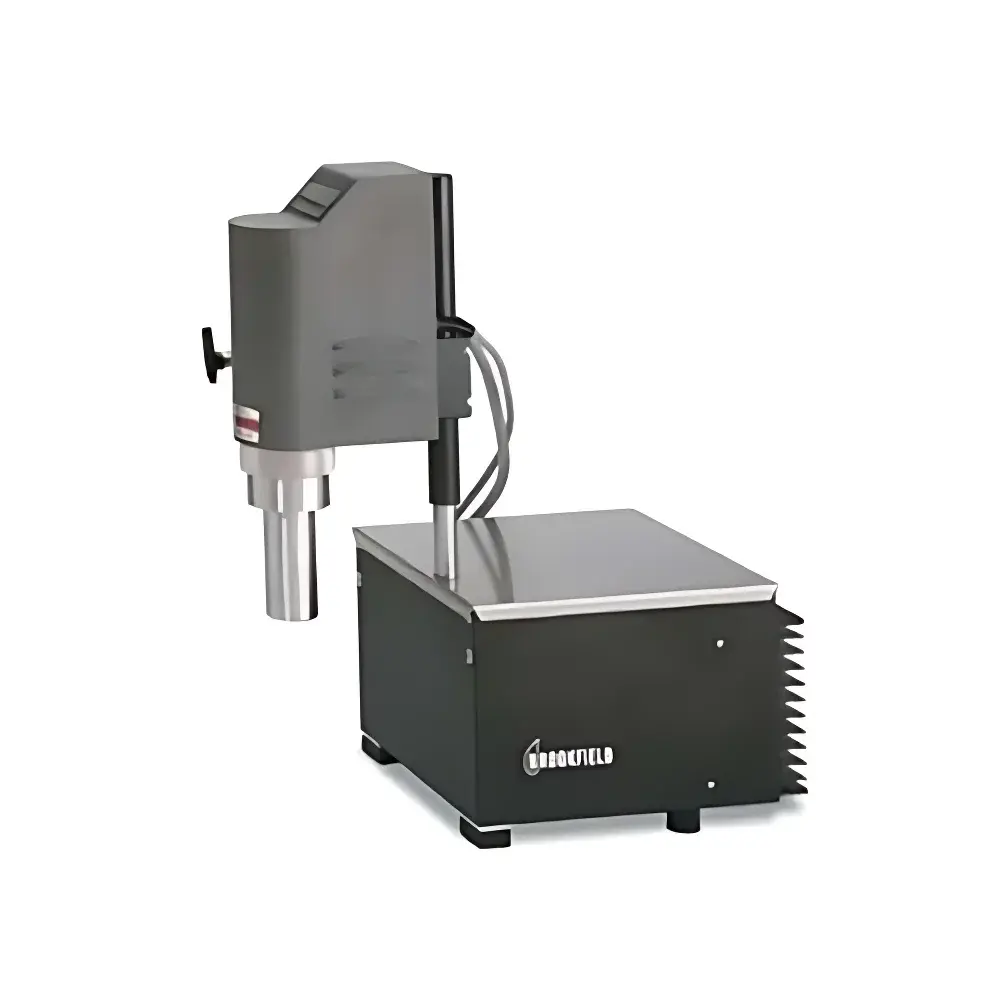
Brookfield PVS High-Temperature High-Pressure Rotational Rheometer
| Brand | Brookfield |
|---|---|
| Origin | USA |
| Model | PVS-B1-D-HC |
| Viscosity Range | 2–5 × 10⁶ cP (mPa·s) |
| Shear Rate Range | 0.05–1700 s⁻¹ |
| Temperature Range | −40 °C to +260 °C |
| Pressure Range | Vacuum to 1000 psi |
| Sample Volume | 12 mL |
| Geometry | Coaxial Cylinder (Rotating Outer Cup / Stationary Inner Spindle with Surface-Mounted RTD) |
| Compliance | API RP 13B-1, ASTM D2196, ISO 3219 |
| Software | Rheovision™ (FDA 21 CFR Part 11–ready, GLP/GMP audit trail enabled) |
Overview
The Brookfield PVS High-Temperature High-Pressure Rotational Rheometer is a precision-engineered coaxial cylinder rheometer designed for controlled-shear-rate viscometry under extreme thermal and pressure conditions. It operates on the Couette flow principle: the outer cup (sample containment vessel) rotates at precisely defined speeds while the inner spindle (stationary sensor element) remains fixed. Torque transmission occurs via a patented torque tube assembly that isolates all electronics, bearings, and mechanical interfaces from process fluids and vapor—ensuring long-term reliability and measurement integrity in aggressive chemical environments. Unlike open-bath or ambient-pressure viscometers, the PVS maintains full sample containment throughout testing, eliminating solvent loss, oxidation, or compositional drift during high-temperature measurements. Its architecture enables direct simulation of industrial process conditions—including downhole drilling, hydraulic fracturing, polymer processing, and high-boiling-point formulation development—within a compact benchtop footprint.
Key Features
- Hermetically sealed pressure chamber rated from full vacuum to 1000 psi (6.9 MPa), fitted with ASME-certified safety relief valve
- Wide operational temperature range: −40 °C to +260 °C, with surface-mounted RTD embedded directly on the stationary inner spindle for real-time, contact-based sample temperature monitoring
- Motor-driven outer cup rotation from 0.05 to 1000 RPM, corresponding to shear rates from 0.05 s⁻¹ up to 1700 s⁻¹ (geometry-dependent)
- Hastelloy C-276 sample cup and spindle as standard—resistant to chloride-induced stress corrosion cracking and H₂S exposure
- Modular geometry system: interchangeable cup/spindle sets (e.g., PVS-B1-D-HC, PVS-B2-D-HC) optimized for distinct viscosity and shear sensitivity requirements
- Torque tube signal transmission eliminates mechanical friction and fluid ingress into the drive train—critical for repeatable low-torque measurements under high-pressure conditions
- Compact footprint (12″ × 12″ × 24″) with integrated leveling feet and vibration-damping base for stable operation in shared laboratory spaces
Sample Compatibility & Compliance
The PVS accommodates volatile, thermally labile, and chemically aggressive samples without degradation or evaporative artifact—including hydrocarbon-based drilling muds, crosslinked fracturing fluids, concentrated black liquor, reactive monomer systems, edible oils, and high-molecular-weight polymer melts. All wetted parts conform to NACE MR0175/ISO 15156 for sour service applications. Testing protocols align with API Recommended Practice RP 13B-1 (for drilling fluid rheology), ASTM D2196 (non-Newtonian fluid viscosity), and ISO 3219 (rotational viscometry of polymer solutions). Data acquisition and instrument control comply with FDA 21 CFR Part 11 requirements when used with validated Rheovision™ software configurations, supporting electronic signatures, user access controls, and immutable audit trails required for regulated QC/QA environments.
Software & Data Management
Rheovision™ software provides full instrument orchestration—including automated ramp-and-hold temperature/pressure profiles, multi-step shear rate sweeps, LSRV (Low-Shear Rate Viscosity) determination at 0.2 s⁻¹, and real-time viscosity vs. time or shear rate plotting. Raw torque, rotational speed, temperature, and pressure data are timestamped and stored in HDF5 format for traceability. Export options include CSV, Excel, and PDF reports compliant with internal SOPs or external regulatory submissions. The software supports method validation workflows per ICH Q2(R2) guidelines and includes built-in uncertainty estimation based on calibration certificate metadata and sensor tolerances.
Applications
- Downhole rheology simulation for oilfield drilling and completion fluids under reservoir-relevant T/P conditions
- Stability assessment of volatile organic formulations (e.g., coatings, adhesives, cleaning agents) during thermal aging
- Quality control of high-viscosity polymer melts and reactive resins prior to extrusion or casting
- Rheological fingerprinting of food-grade suspensions (e.g., chocolate, nut butters, dairy concentrates) under processing-relevant shear histories
- Development and optimization of water-based fracturing fluids containing guar gum, cellulose derivatives, or synthetic polymers
- Characterization of spent pulping liquors (black liquor) for Kraft process modeling and recovery boiler feed control
FAQ
What distinguishes the PVS from standard rotational viscometers?
The PVS integrates simultaneous high-temperature, high-pressure, and full-sample containment capabilities—enabling measurements impossible with ambient-pressure instruments due to volatility, decomposition, or oxidation.
Can the PVS perform yield stress measurements?
Yes—via controlled-stress ramp tests and Herschel-Bulkley model fitting using Rheovision™, provided the selected geometry delivers sufficient torque resolution for the target yield value.
Is calibration traceable to NIST standards?
All torque and temperature transducers are supplied with NIST-traceable calibration certificates; field recalibration kits and procedures are available through Brookfield’s global service network.
How is data integrity maintained during extended high-temperature runs?
The isolated torque tube design prevents thermal drift in load cells; active RTD compensation and dual-point temperature verification ensure ±0.3 °C accuracy across the full operating range.
Are custom geometries available for specialized applications?
Yes—Brookfield offers application-specific cup/spindle configurations, including narrow-gap designs for low-viscosity Newtonian fluids and vane geometries for heterogeneous suspensions.



