
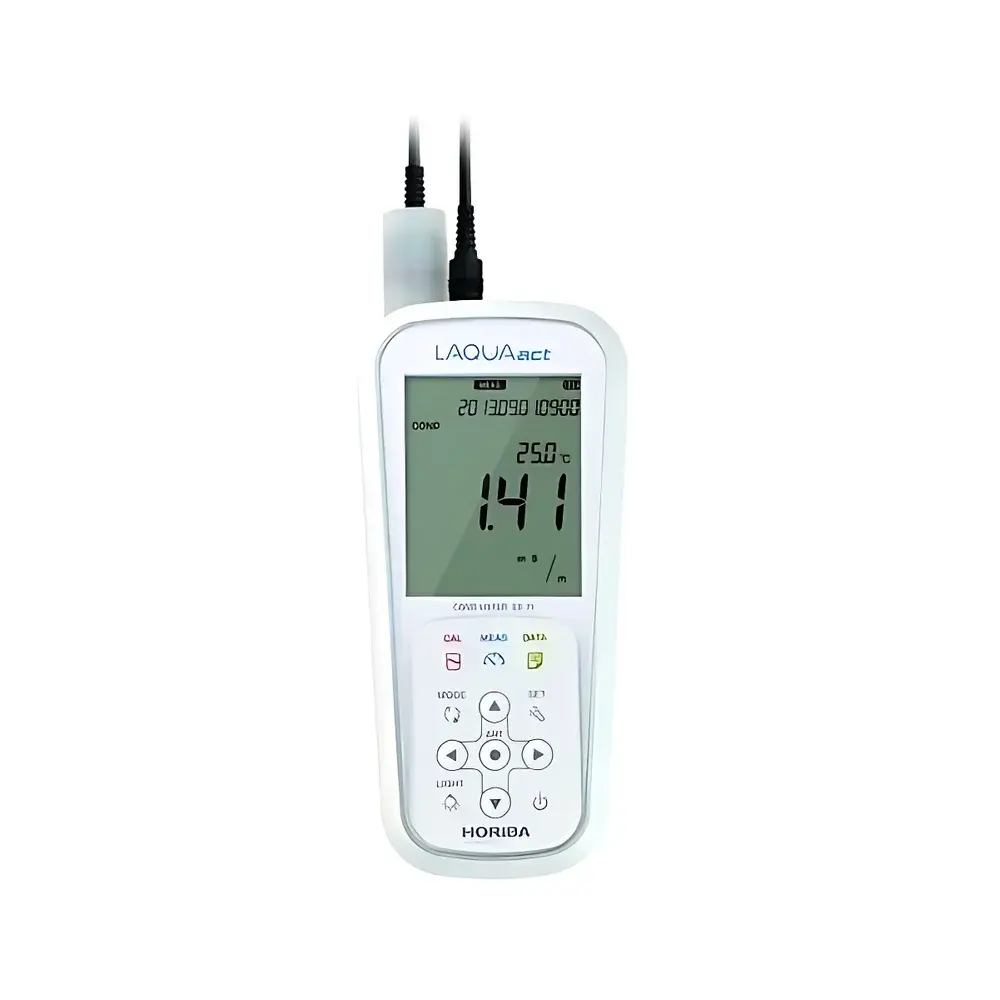
HORIBA EC110 & EC120 Portable Conductivity Meters
| Brand | HORIBA |
|---|---|
| Origin | Japan |
| Model | EC110 / EC120 |
| Portability | Portable |
| Conductivity Range | 0.001 µS/cm to 200.0 mS/cm (EC110) / up to 2000.0 mS/cm (EC120) @ k = 1.0 |
| TDS Range | 0.00 ppm to 100.0 ppt (TDS factor = 0.5) |
| Resistivity Range | 0.000 Ω·cm to 200.0 MΩ·cm |
| Temperature Range | −30.0 °C to +130.0 °C |
| Accuracy | ±0.6% F.S. (±1.5% F.S. above 18.0 mS/cm or 1.80 MΩ·cm) |
| Resolution | 0.05% F.S. |
| Temp. Accuracy | ±0.4 °C |
| IP Rating | IP67 |
| Battery Life | >200 h (alkaline) / >1000 h (low-power operation mode) |
| Data Storage | 100 entries (EC110) / 1000 entries (EC120) |
| Compliance | GLP/GMP-compliant data logging, RS232C output (EC120), auto time/date stamping, audit-ready calibration records |
Overview
The HORIBA EC110 and EC120 are rugged, field-deployable conductivity meters engineered for high-reliability electrochemical measurement in demanding environmental, industrial, and quality control applications. Based on four-electrode (tetrapolar) AC conductance measurement principles, these instruments eliminate polarization errors and electrode fouling effects—critical for stable readings in turbid, high-solids, or low-conductivity samples. The EC110 delivers single-parameter EC/TDS/resistivity/temperature capability, while the EC120 extends functionality with integrated salinity measurement (0.0–100.0 ppt), real-time clock, and RS232C digital interface for traceable data export. Both models comply with ISO 7888 (water quality — determination of electrical conductivity) and support configurable temperature compensation (0.0–10.0%/°C) and reference temperature selection (15–30 °C), enabling accurate normalization across diverse sample matrices—from ultrapure water to concentrated brines.
Key Features
- IP67-rated polycarbonate housing: Fully submersible to 1 m for 30 minutes; resistant to mechanical shock, vibration, and chemical exposure—including ethanol, weak acids/bases, and hydrocarbon oils.
- Ergonomic handheld design with rotating electrode holder: Accommodates up to two electrodes simultaneously (e.g., k = 0.1, 1.0, or 10.0 cells); enables one-handed adjustment and tabletop stabilization via integrated stand.
- Ultra-low power architecture: Optimized circuitry reduces current draw by ~10% versus conventional portable meters; achieves >1000 hours of standby operation and >200 hours of active use per set of AAA alkaline batteries.
- Intelligent measurement modes: Auto-hold freezes display upon signal stabilization; auto-stabilize continuously updates readings with visual stability indicator (••• → ●●●).
- Backlit 64 mm × 52 mm LCD: High-contrast monochrome display with diagnostic icons, unit indicators, and multi-parameter readouts visible under low-light or outdoor conditions.
- Four-point calibration support: Automatic or manual calibration using certified standards (e.g., 1413 µS/cm, 12.88 mS/cm); programmable cell constant (0.1 / 1.0 / 10.0 cm⁻¹) and selectable TDS conversion curves (EN 27888, Standard 442, NaCl, linear).
Sample Compatibility & Compliance
The EC110/EC120 series is validated for use across aqueous matrices ranging from deionized water (≥18.2 MΩ·cm) to saturated salt solutions (up to 2000 mS/cm). Its tetrapolar sensor design minimizes electrode polarization drift during long-term immersion, making it suitable for continuous monitoring in wastewater effluents, cooling tower circuits, aquaculture systems, and pharmaceutical process water loops. All firmware and data handling routines adhere to GLP and GMP requirements: timestamped measurements include operator ID (via BNS input), calibration history, and system diagnostics. EC120’s RS232C interface supports FDA 21 CFR Part 11–compliant data transfer when paired with validated software, ensuring audit readiness for regulated laboratories.
Software & Data Management
The EC110 stores 100 measurement records with date/time stamps (when powered externally); the EC120 expands capacity to 1000 entries with built-in real-time clock and automatic metadata tagging. Both units support direct USB-to-serial or RS232C connection to PCs for bulk data export in CSV format. Calibration logs retain full traceability—including standard values used, cell constant applied, and temperature-compensated results—facilitating internal audits and ISO/IEC 17025 documentation. Optional HORIBA LabManager™ software provides trend analysis, report generation, and electronic signature workflows compatible with laboratory information management systems (LIMS).
Applications
- Environmental field testing: Surface water, groundwater, and seawater conductivity profiling per EPA Method 120.1 and ASTM D1125.
- Pharmaceutical water systems: USP compliant conductivity verification of Purified Water (PW) and Water for Injection (WFI) at 25 °C.
- Food & beverage QC: Brine concentration control in pickling, dairy processing, and brewing operations.
- Industrial process monitoring: Boiler feedwater purity, reverse osmosis reject stream analysis, and electroplating bath management.
- Educational labs: Teaching fundamental electrochemistry concepts including Kohlrausch’s law, ion mobility, and temperature dependence of conductivity.
FAQ
What is the difference between EC110 and EC120?
The EC120 adds salinity measurement (0.0–100.0 ppt), RS232C digital output, real-time clock with auto time/date stamping, and expanded memory (1000 vs. 100 entries). Both share identical core measurement performance and IP67 durability.
Can the instrument be calibrated with non-standard solutions?
Yes—manual calibration allows entry of user-defined standard values and associated temperature; all calibrations are logged with timestamps and operator identifiers.
Is temperature compensation adjustable?
Yes—linear temperature coefficient (0.0–10.0 %/°C) and reference temperature (15–30 °C) are fully configurable to match application-specific requirements.
Does the meter support GLP-compliant reporting?
Yes—both models generate calibration and measurement records with embedded metadata (time, date, operator ID, cell constant, standard used); EC120 enables electronic export for LIMS integration.
What electrode types are compatible?
Standard titanium/platinum-black electrodes (e.g., model 93004-25, k = 1.084 cm⁻¹) are supplied; optional k = 0.1 and k = 10.0 cells are supported via manual cell constant input.




