
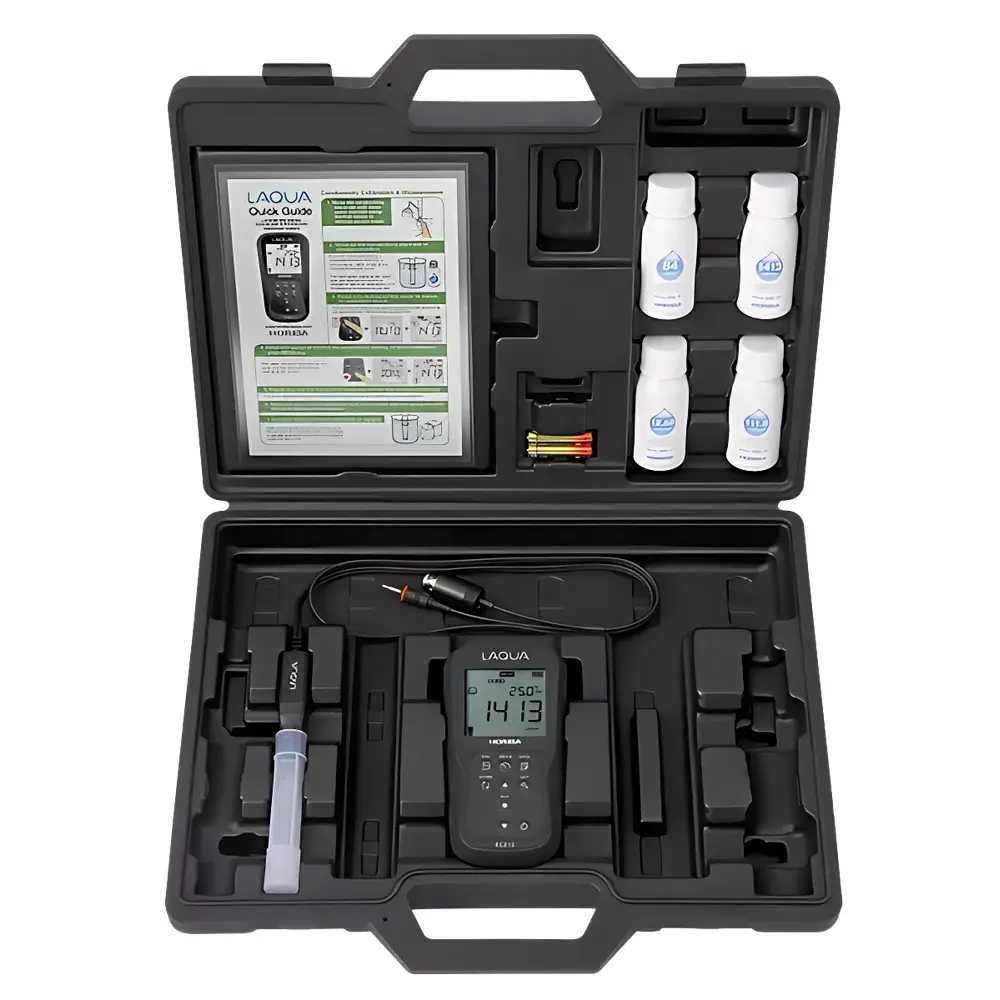
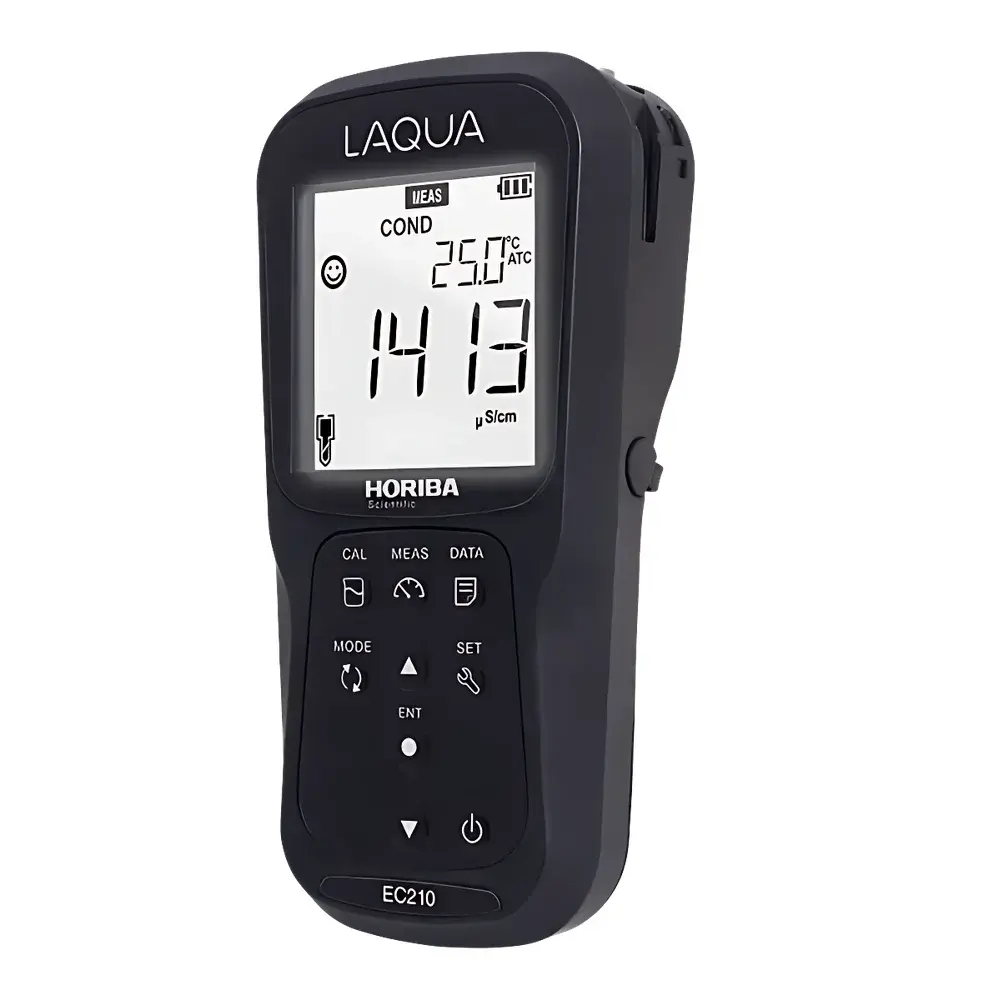
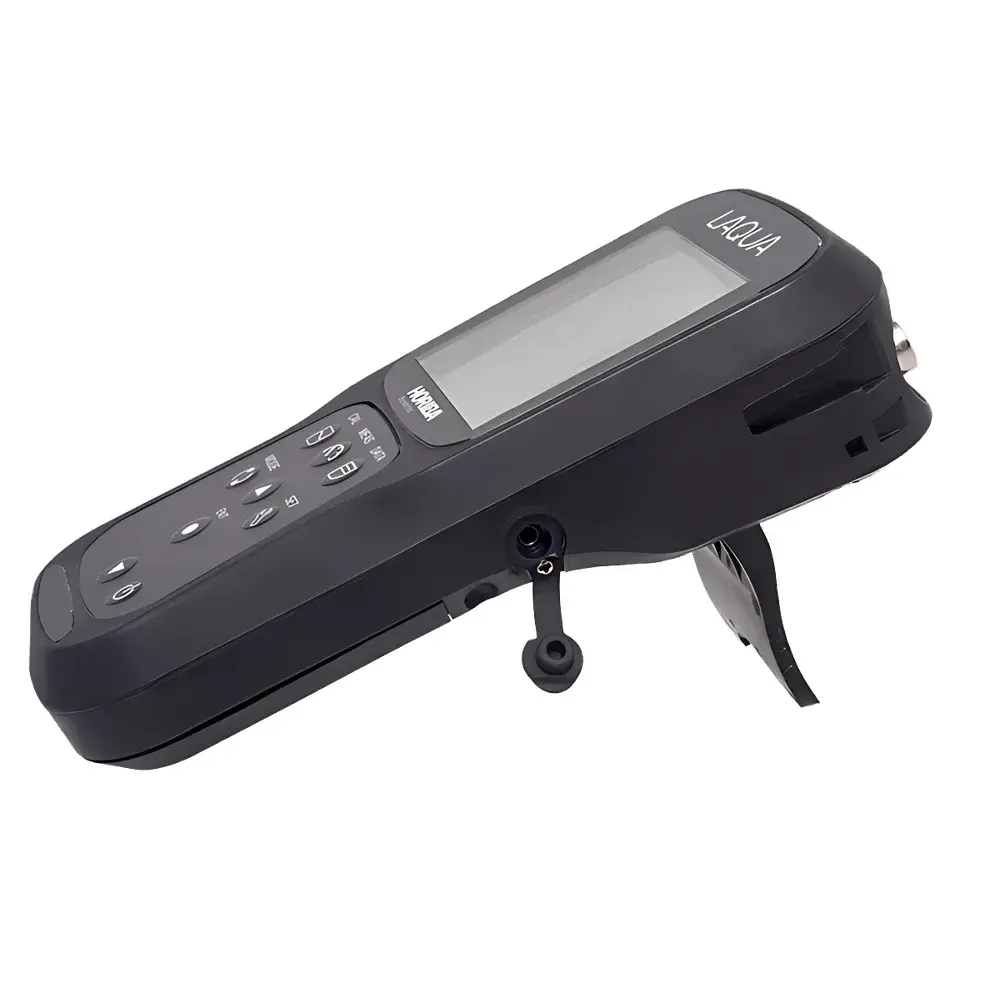
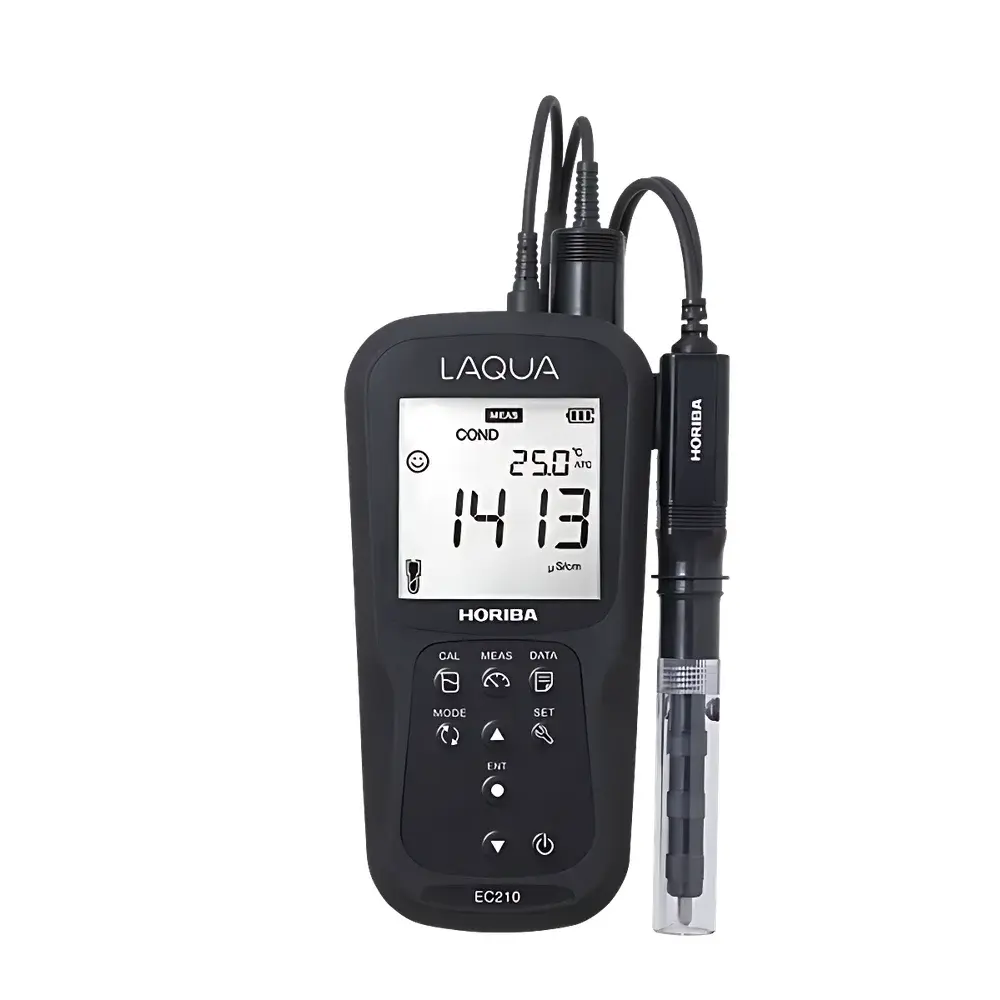
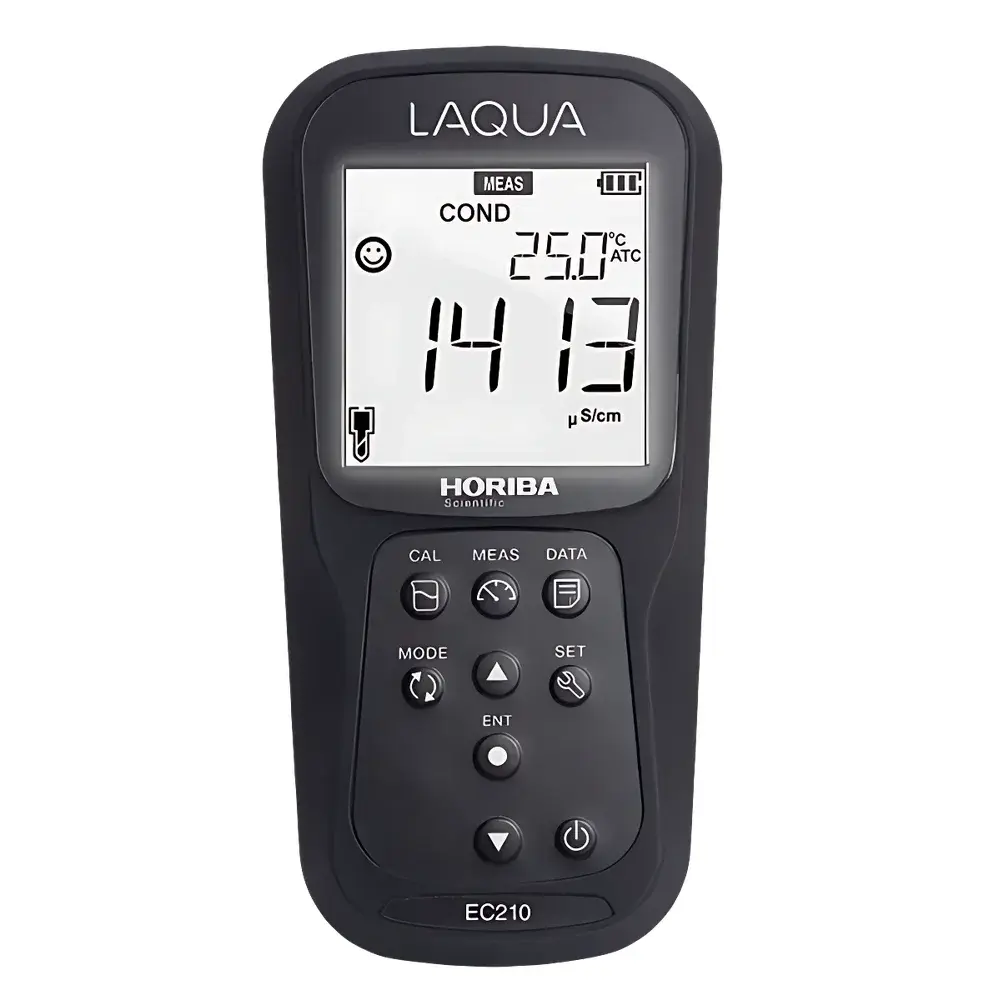
HORIBA LAQUAact EC210 Portable Conductivity Meter
| Brand | HORIBA |
|---|---|
| Origin | Japan |
| Model | EC210 |
| Portability | Portable |
| Conductivity Range | 0.001 µS/cm to 200.0 mS/cm (cell constant k = 1.0) |
| TDS Range | 0.00 ppm to 100.0 ppt (TDS factor = 0.5) |
| Resistivity Range | 0.000 Ω·cm to 20.0 MΩ·cm |
| Salinity Range | 0.0 to 100.0 ppt / 0.00 to 10.00 % |
| Temperature Range | −30.0 to 130.0 °C |
| Accuracy | ±0.6% of full scale (±1.5% above 18.0 mS/cm or 18.0 MΩ·cm) |
| Resolution | 0.05% of full scale |
| Calibration | Up to 4-point auto / 5-point manual |
| IP Rating | IP67 |
| Data Storage | 500 points |
| Power | 2 × AA batteries (>500 h life) |
| Dimensions | 160 × 80 × 40.6 mm |
| Weight | 260 g (with batteries) |
Overview
The HORIBA LAQUAact EC210 is a rugged, field-deployable portable conductivity meter engineered for high-precision electrochemical measurement of conductivity, total dissolved solids (TDS), resistivity, salinity, and temperature in diverse aqueous environments. Based on four-electrode AC conductivity measurement principles—minimizing polarization errors and electrode fouling—the EC210 delivers stable, reproducible readings across a wide dynamic range (0.001 µS/cm to 200.0 mS/cm). Its dual-range capability supports both ultrapure water monitoring (e.g., pharmaceutical water systems per USP ) and high-conductivity industrial effluents or seawater analysis. The instrument integrates temperature compensation using either linear or non-linear (EN 27888-compliant) algorithms, with user-adjustable reference temperature (15–30 °C), temperature coefficient (0.00–10.00 %/°C), and cell constant (0.1, 1.0, or 10.0 cm⁻¹), ensuring traceable compliance with ISO 7888, ASTM D1125, and IEC 60746-3 standards.
Key Features
- Rugged IP67-rated housing: Fully dust-tight and submersible up to 1 m for 30 minutes; impact- and scratch-resistant polycarbonate casing with ergonomic anti-slip grip.
- Intelligent calibration architecture: Supports up to four automatic conductivity calibration points (using certified KCl standards: 84 µS/cm, 1413 µS/cm, 12.88 mS/cm, 111.8 mS/cm) and five manual points; includes dual salinity curves (NaCl and seawater) and four TDS conversion models (Linear, EN 27888, 442, NaCl).
- Multi-parameter measurement engine: Simultaneous real-time display of conductivity, TDS (ppm/mg/L or ppt/g/L), resistivity, salinity (% or ppt), and temperature (°C/°F) with automatic unit scaling.
- Advanced data integrity tools: Built-in audit trail for calibration events; auto-stabilize and auto-hold functions with configurable stability threshold; programmable auto-power-off (1–30 min).
- High-visibility interface: Monochrome LCD (50 × 50 mm) with white LED backlight; intuitive icon-driven menu navigation; on-screen electrode status diagnostics and error logging.
- Long-term field operation: >500 hours battery life on two AA alkaline cells; low-battery warning and remaining-life indicator; BNC input for conductivity electrodes and dedicated thermistor input for integrated or external temperature sensors.
Sample Compatibility & Compliance
The EC210 is validated for use with a broad spectrum of liquid samples—from deionized water in semiconductor rinse baths and cleanroom utilities to wastewater influent, brackish estuarine water, and concentrated process streams. Its titanium/platinum black conductivity probe (model 9383-10D, k = 1.0) features an integrated Pt1000 temperature sensor, enabling true simultaneous measurement without time-lag artifacts. The instrument meets GLP/GMP documentation requirements through timestamped data logging (500 entries), automatic calibration record retention, and traceable parameter configuration history. All measurement algorithms adhere to internationally recognized electrochemical metrology frameworks, including ISO/IEC 17025-aligned uncertainty estimation for conductivity and resistivity modes. Regulatory alignment extends to FDA 21 CFR Part 11 readiness via optional PC software (LAQUAact Studio v3.x), supporting electronic signatures, audit trails, and secure export for QA/QC reporting.
Software & Data Management
Data transfer and firmware updates are performed via phono-jack connection using HORIBA’s proprietary USB adapter (PN 3200779639) and LAQUAact Studio software. The software enables batch export of measurement logs in CSV or Excel-compatible formats, graphical trend analysis, calibration certificate generation (including uncertainty budgets), and customizable report templates compliant with ISO 17025 and internal SOPs. No cloud dependency: all data remains local unless explicitly exported. Firmware upgrades preserve user-configured settings—including custom TDS factors, salinity curves, and temperature coefficients—ensuring continuity across instrument lifecycles and multi-site deployments.
Applications
- Environmental monitoring: Field validation of freshwater quality (EPA Method 120.1), estuarine salinity profiling, and groundwater resistivity mapping.
- Pharmaceutical manufacturing: USP purified water and water-for-injection (WFI) conductivity verification at 25 °C.
- Food & beverage QC: Brine concentration control in pickling, sugar syrup conductivity checks, and dairy processing rinse water verification.
- Power generation: Boiler feedwater purity assurance and condensate leak detection in thermal plants.
- Academic research: Teaching labs requiring robust, standards-compliant instrumentation for electrochemistry fundamentals and environmental science curricula.
FAQ
Does the EC210 support GLP-compliant data recording?
Yes—each stored measurement includes date/time stamp, operator ID (configurable), electrode ID, calibration status, and ambient temperature. Full audit logs for calibrations and configuration changes are retained onboard.
Can the EC210 measure conductivity in high-viscosity or suspended-solid samples?
It is optimized for low-to-moderate turbidity aqueous solutions. For slurries or viscous media, use the optional k = 0.1 or k = 10.0 cells with appropriate cleaning protocols to prevent coating-induced drift.
Is temperature calibration traceable to NIST standards?
The integrated Pt1000 sensor is factory-calibrated to ±0.1 °C at 25 °C; users may perform two-point temperature verification (e.g., ice bath and stirred water bath) with documented reference standards.
What maintenance is required for long-term accuracy?
Regular cleaning of the Ti/Pt electrode with mild detergent and DI water; annual verification against certified conductivity standards; storage in moistened protective cap to prevent drying of the sensing surface.
How does the EC210 handle temperature compensation in non-linear media like seawater?
It applies the built-in seawater salinity curve (based on PSS-78) for automatic compensation, eliminating manual correction factors and reducing operator error in marine applications.







