
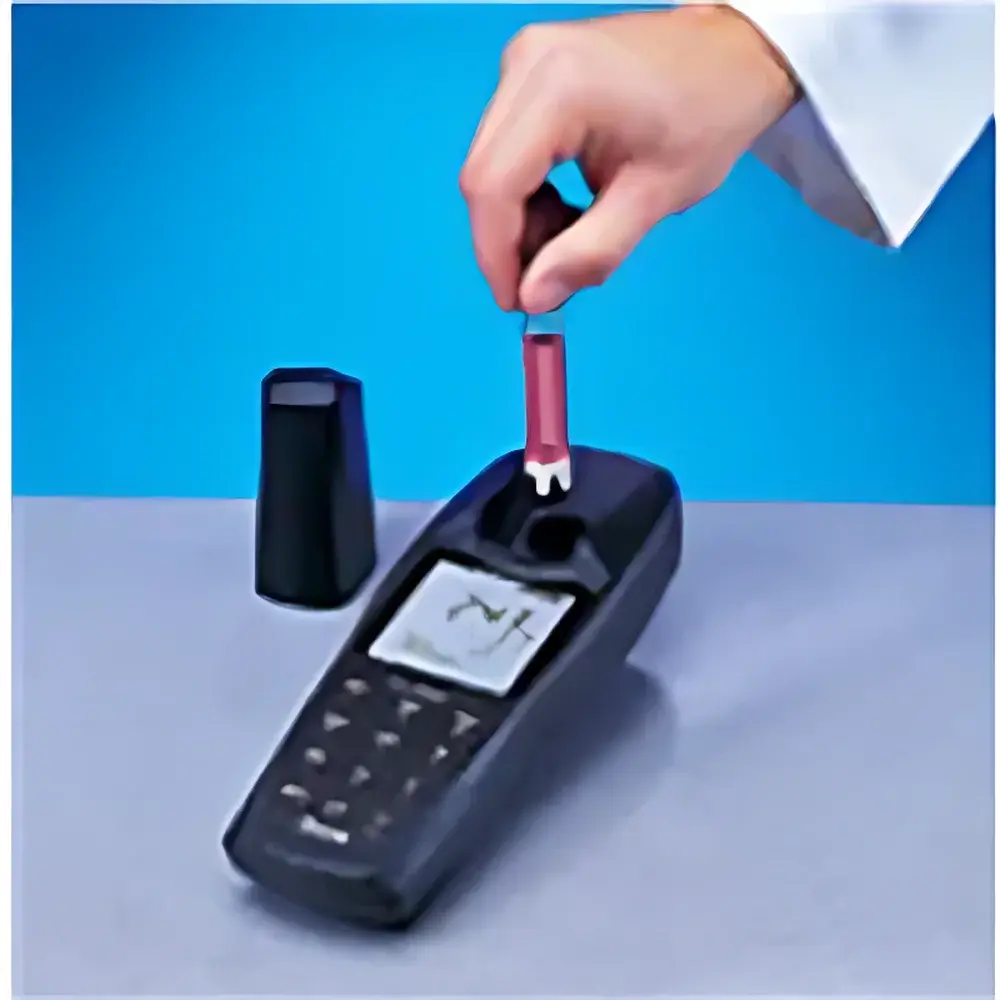
Thermo Scientific Orion AQ4000 Portable Multi-Parameter Water Quality Analyzer
| Brand | Thermo Scientific Orion |
|---|---|
| Origin | USA |
| Model | AQ4000 |
| Instrument Type | Portable/Handheld Water Quality Analyzer |
| Detection Parameters | COD, Free Chlorine, Total Chlorine |
| Wavelengths | 420 nm, 520 nm, 580 nm, 610 nm |
| Wavelength Accuracy | ±2 nm |
| Photometric Linearity | ±0.002 A (0–1 A) |
| Photometric Reproducibility | ±0.005 A (0–1 A) |
| Photometric Accuracy | ±0.005 A at 1.0 ABS |
| Stray Light | <1.0% at 400 nm |
| Light Source | LED |
| Detector | Photodiode |
| Bandwidth | 10±2 nm |
| Operating Temperature | 0.0–45.0 °C |
| Relative Humidity | ≤90% at 50.0 °C |
| Ingress Protection | IP67 |
| Power Supply | 4×AA alkaline batteries (2500 h) or lithium batteries (10,000 h) |
| Data Storage | 100 measurement sets |
| Interface | RS232 |
| Sample Cell Compatibility | 13 mm, 16 mm, 24 mm cuvettes |
| Auto-ID Support | Barcode-enabled 13 mm cuvettes only |
| Display | LCD |
| Units | mg/L, ppm, µg/L, Abs, %T |
| Memory Protection | Yes |
| Timer, Zero/Blank Calibration, Standby Mode | Yes |
Overview
The Thermo Scientific Orion AQ4000 Portable Multi-Parameter Water Quality Analyzer is a rugged, field-deployable photometric instrument engineered for precise, on-site quantification of critical water quality parameters—including chemical oxygen demand (COD), free chlorine, and total chlorine—using standardized colorimetric methods. Built upon a solid-state LED-based optical architecture, the AQ4000 operates across four fixed wavelengths (420 nm, 520 nm, 580 nm, and 610 nm), enabling selective detection of analytes according to established EPA, APHA, and ISO-compliant test chemistries. Its photometric performance meets stringent metrological requirements: linearity within ±0.002 A over 0–1 A absorbance range, reproducibility of ±0.005 A, and accuracy of ±0.005 A at 1.0 ABS—ensuring traceable, laboratory-grade results under variable environmental conditions. Designed for continuity between field sampling and regulatory reporting, the AQ4000 supports method validation protocols aligned with US EPA Method 410.4 (COD), Standard Methods 4500-Cl G (chlorine), and ISO 7890-3 (free/total chlorine).
Key Features
- IP67-rated enclosure for full dust ingress protection and submersion resistance up to 1 m for 30 minutes—validated per IEC 60529.
- Auto-ID™ technology: automatic recognition of pre-packaged, barcoded 13 mm reagent vials enables seamless method selection, wavelength assignment, and result calculation without manual input.
- Integrated photometric engine with narrow-band LED sources (10±2 nm bandwidth) and photodiode detection—eliminating thermal drift and reducing maintenance intervals.
- Onboard storage for 100 measurement records with timestamp, sample ID, and method metadata; exportable via RS232 interface to LIMS or spreadsheet software.
- Extended battery life: 2500 hours with standard alkaline AA cells or 10,000 hours with optional lithium AA batteries—optimized for remote deployments without external power.
- Multi-cuvette compatibility (13 mm, 16 mm, 24 mm) accommodates both standard reagent kits and legacy labware; Auto-ID functionality restricted to 13 mm barcoded vials.
- Preloaded library of 190 validated measurement programs—including EPA-approved COD digestion protocols when paired with optional AQ4000-compatible COD reactors—and support for up to 10 user-defined methods.
Sample Compatibility & Compliance
The AQ4000 accepts aqueous samples across municipal drinking water, wastewater effluent, industrial process streams, and surface water matrices. Its optical design minimizes interferences from turbidity and colored organics through dual-wavelength correction algorithms where applicable. All factory-calibrated methods comply with international standardization frameworks: ASTM D1253 (residual chlorine), ISO 8467 (COD by dichromate oxidation), and EN ISO 7890-3 (chlorine speciation). The instrument’s firmware architecture supports audit-ready data integrity features—including immutable timestamps, operator ID fields (via optional password configuration), and non-volatile memory with power-loss protection—facilitating adherence to GLP and ISO/IEC 17025 documentation requirements. While not FDA 21 CFR Part 11–certified out-of-the-box, its data export structure and logging capabilities are compatible with validated third-party electronic lab notebook (ELN) integrations used in regulated environmental testing laboratories.
Software & Data Management
Data acquisition and method management are handled entirely onboard via a 12-key capacitive touch interface with tactile feedback. The AQ4000 does not require proprietary PC software for routine operation; however, Thermo Fisher provides the free Orion AQ Manager desktop utility (Windows-compatible) for firmware updates, method library synchronization, and batch export of CSV-formatted datasets. Each stored record includes absorbance values, calculated concentration (in mg/L, ppm, or µg/L), method name, date/time stamp, and cuvette ID. RS232 output supports ASCII protocol with configurable baud rates (default 9600), enabling direct integration into SCADA-linked environmental monitoring systems or centralized QA/QC databases. Firmware updates—including newly validated test procedures—are distributed via downloadable .bin files and applied using the instrument’s built-in update mode—ensuring long-term method currency without hardware replacement.
Applications
- Field verification of disinfection residual in potable water distribution networks (free/total chlorine compliance per WHO and EU Drinking Water Directive).
- Routine COD monitoring at wastewater treatment plants during influent/effluent screening and biological process control.
- Regulatory sampling for NPDES permit compliance, including stormwater runoff and industrial discharge points.
- Educational and research applications requiring portable, interference-resistant photometry for environmental chemistry coursework and field studies.
- Emergency response scenarios—e.g., post-flood water safety assessment—where rapid, battery-powered, self-contained analysis is essential.
FAQ
Does the AQ4000 require annual calibration certification?
No formal annual certification is mandated; however, users must perform documented zero and blank calibrations before each analytical session per Standard Methods 10th ed. guidelines. Factory calibration certificates are provided with initial shipment.
Can the AQ4000 measure nitrate or phosphate without additional hardware?
Only parameters supported by preloaded or user-uploaded methods are measurable. Nitrate and phosphate require compatible reagent kits and corresponding method files—available separately from Thermo Fisher as part of the AQ4000 method library expansion.
Is the RS232 interface compatible with modern USB-equipped computers?
Yes—when used with the included AQ4CBL cable (25-pin to 9-pin DB9) and a certified USB-to-serial adapter, the interface maintains full ASCII communication integrity.
What is the temperature coefficient of photometric accuracy?
The instrument maintains specified photometric accuracy (±0.005 A at 1.0 ABS) across its full operating range (0.0–45.0 °C) without active thermal stabilization, verified per internal Thermo Fisher engineering validation reports.
How is method traceability maintained during firmware updates?
Each method file carries a unique version hash and publication date. Updated methods overwrite prior versions but retain full revision history in the AQ Manager desktop log—supporting ISO/IEC 17025 clause 7.7.1 requirement for method change documentation.







