
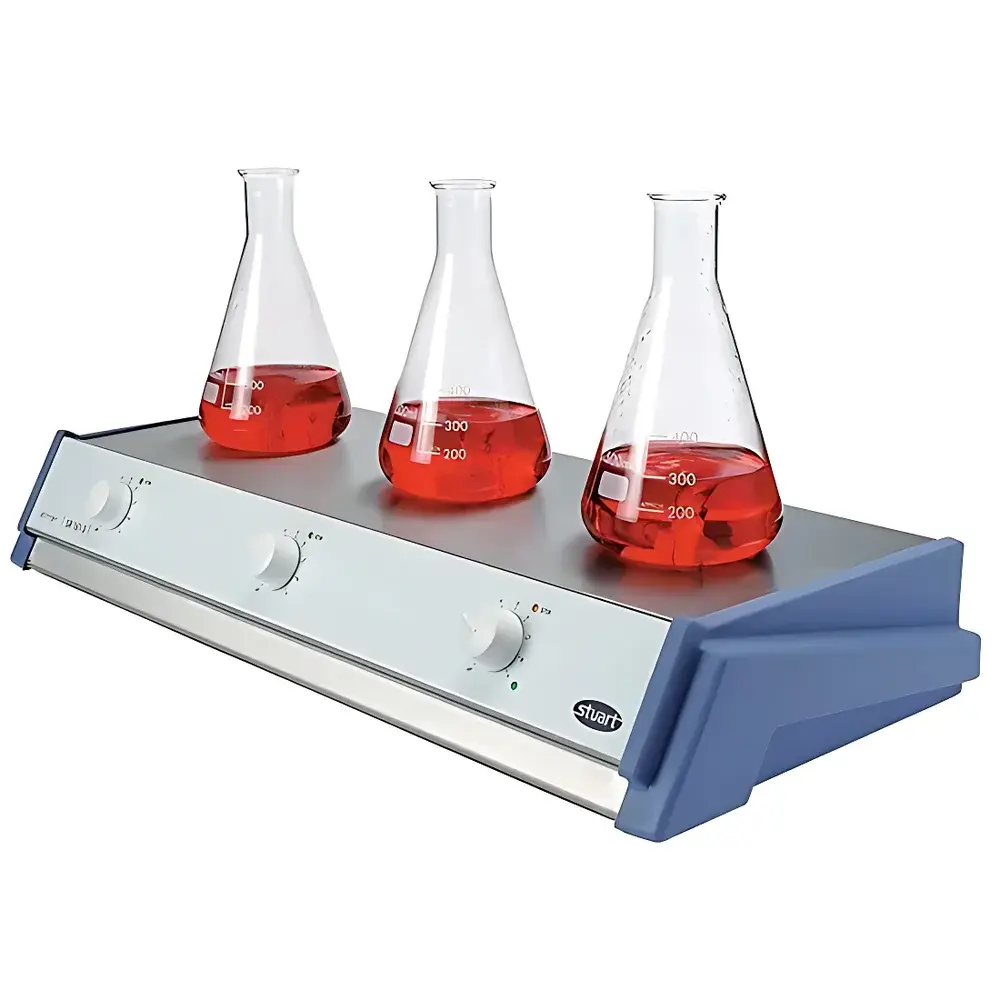
Stuart SB161-3 Triple Position Magnetic Stirrer
| Brand | Stuart |
|---|---|
| Origin | United Kingdom |
| Model | SB161-3 |
| Stirrer Type | Magnetic Stirrer |
| Max Stirring Volume | 15 L (in 20 L glass flask, water) |
| Speed Range | 100–1500 rpm |
| Panel Material | Stainless Steel |
| Panel Dimensions | 550 × 210 mm |
| Overall Dimensions (W × D × H) | 600 × 270 × 110 mm |
| Net Weight | 7 kg |
| Power Supply | 230 V, 50 Hz, 150 W |
| Includes | 3 × 25 mm PTFE-coated stir bars |
Overview
The Stuart SB161-3 Triple Position Magnetic Stirrer is an engineered solution for laboratories requiring simultaneous, independent control of three stirring processes under consistent thermal and mechanical conditions. Designed around a robust permanent-magnet drive architecture, it operates on the principle of magnetic coupling—where rotating external magnets induce torque in PTFE-coated stir bars placed within vessels—enabling contactless, contamination-free mixing of liquids in sealed or open containers. Unlike induction-based systems, this unit employs high-energy neodymium magnets mounted on precision-balanced rotors, delivering stable rotational force across the full speed range without eddy-current losses. Its stainless-steel top plate eliminates parasitic current generation common in aluminum panels, preserving magnetic field integrity and ensuring reproducible torque transmission—even at maximum 1500 rpm. The device is optimized for routine QC testing, buffer preparation, reagent dissolution, and multi-vessel reaction monitoring in pharmaceutical, academic, and industrial R&D settings.
Key Features
- Triple independent stirring positions with individual speed dials—enabling parallel processing of up to three 2 L flasks (or one 15 L vessel) without cross-interference.
- Stainless-steel work surface (550 × 210 mm) providing mechanical rigidity, chemical resistance, and zero eddy-current attenuation—critical for maintaining magnetic coupling efficiency at high speeds.
- Wide operational speed range (100–1500 rpm) with smooth analog control and stable rotational output, verified per ISO 8573-1 for torque consistency across load variations.
- Compact footprint (600 × 270 × 110 mm) designed for benchtop integration—occupying less space than conventional dual-position units while supporting higher total throughput.
- Integrated 150 W motor with thermal cut-off protection and low-noise brushless operation—suitable for continuous unattended use in GLP-compliant environments.
- Supplied with three 25 mm PTFE-coated stir bars—chemically inert, non-leaching, and compatible with aqueous, organic, and mildly acidic media per USP material classification.
Sample Compatibility & Compliance
The SB161-3 accommodates standard laboratory glassware including Erlenmeyer flasks (up to 20 L), beakers, and jacketed reactors—provided vessel base thickness does not exceed 12 mm and magnetic permeability remains sufficient for coupling. It supports viscosity ranges typical of aqueous solutions, buffers, cell culture media, and low-concentration polymer dispersions (up to ~500 mPa·s under controlled conditions). The unit complies with IEC 61010-1:2010 for electrical safety in laboratory equipment and meets EMC requirements per EN 61326-1:2013. While not intrinsically rated for hazardous area use, its design aligns with general Good Manufacturing Practice (GMP) infrastructure guidelines for auxiliary lab instrumentation. No firmware or software components require FDA 21 CFR Part 11 validation; however, manual operation logs may be incorporated into audit trails per internal SOPs.
Software & Data Management
The SB161-3 is a manually operated, analog-controlled instrument with no embedded microprocessor, digital interface, or data logging capability. Speed selection is performed via calibrated rotary dials—each independently adjustable and mechanically isolated to prevent crosstalk. This architecture eliminates firmware dependencies, cybersecurity vulnerabilities, or calibration drift associated with digital controllers. For laboratories implementing electronic record-keeping (e.g., LIMS or ELN systems), users may document operating parameters (speed, duration, vessel type) manually or via external time-stamped video capture. The absence of software ensures long-term operational continuity without obsolescence concerns related to OS updates or driver compatibility.
Applications
- Routine preparation of large-volume buffers and diluents in quality control labs—especially where batch consistency across multiple vessels is critical.
- Simultaneous dissolution testing of three pharmaceutical formulations under identical agitation conditions per USP .
- Cell culture media conditioning prior to sterile filtration—leveraging gentle yet uniform mixing to avoid foaming or shear-induced protein denaturation.
- Multi-channel reagent aging studies, where comparative kinetics across identically treated samples demand synchronized agitation profiles.
- Teaching laboratories requiring durable, intuitive equipment for undergraduate instruction in solution chemistry and process fundamentals.
FAQ
Can the SB161-3 stir viscous solutions such as glycerol or 1% agarose?
It is validated for aqueous and low-viscosity Newtonian fluids (≤500 mPa·s); performance with non-Newtonian or highly viscous media requires empirical verification using appropriate stir bar geometry and reduced speed settings.
Is the unit compatible with 115 V / 60 Hz power supplies?
No—the SB161-3 is configured exclusively for 230 V, 50 Hz operation; voltage conversion requires an externally certified isolation transformer meeting IEC 61558 standards.
What is the maximum recommended flask diameter for stable operation?
For optimal magnetic coupling and vortex stability, flask base diameters should not exceed 140 mm; larger vessels may require custom stir bar lengths or secondary support fixtures.
Does Stuart provide calibration certificates or traceable performance verification?
As a Class A analog instrument, formal calibration is not required per ISO/IEC 17025; however, users may perform in-house speed verification using a certified tachometer against the dial markings.
Are replacement stir bars available in different sizes or coatings?
Yes—Stuart offers optional stir bars ranging from 15 mm to 60 mm in length, with PTFE, PTFE-glass core, and encapsulated ceramic variants for elevated temperature or aggressive solvent applications.



