
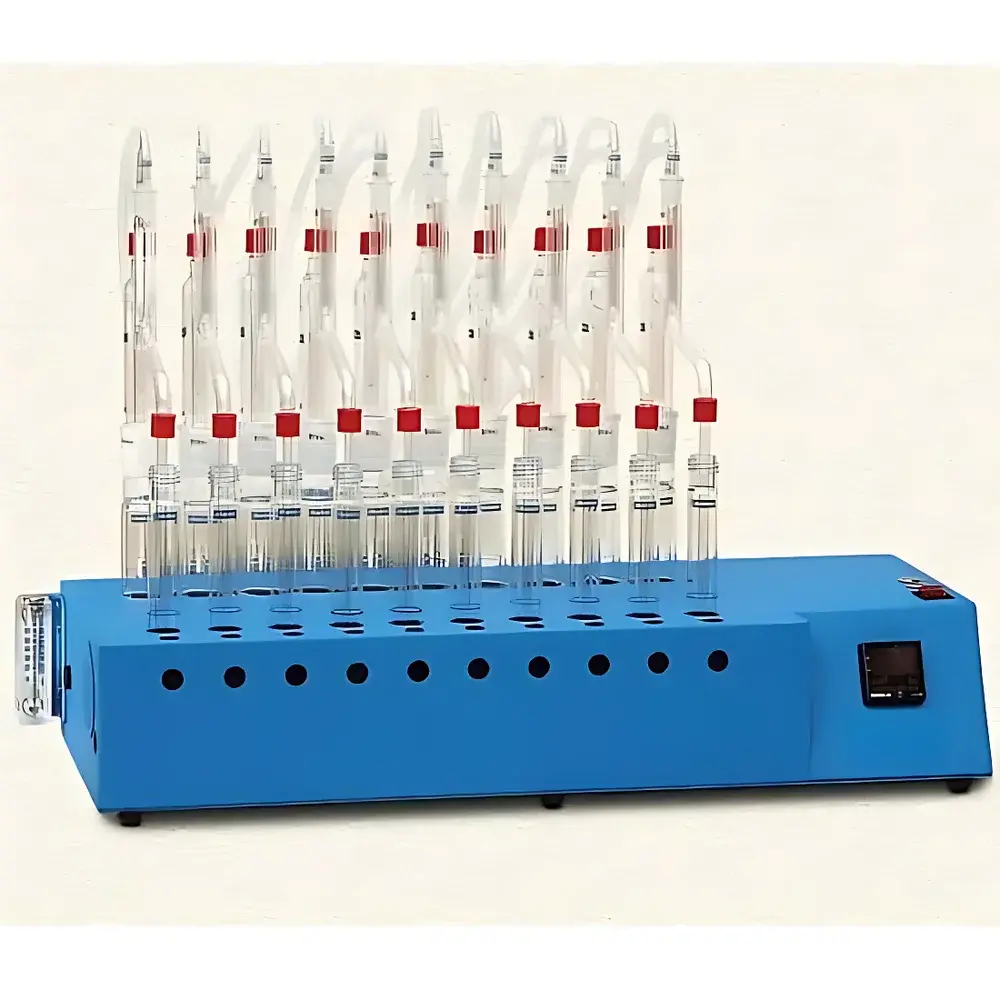
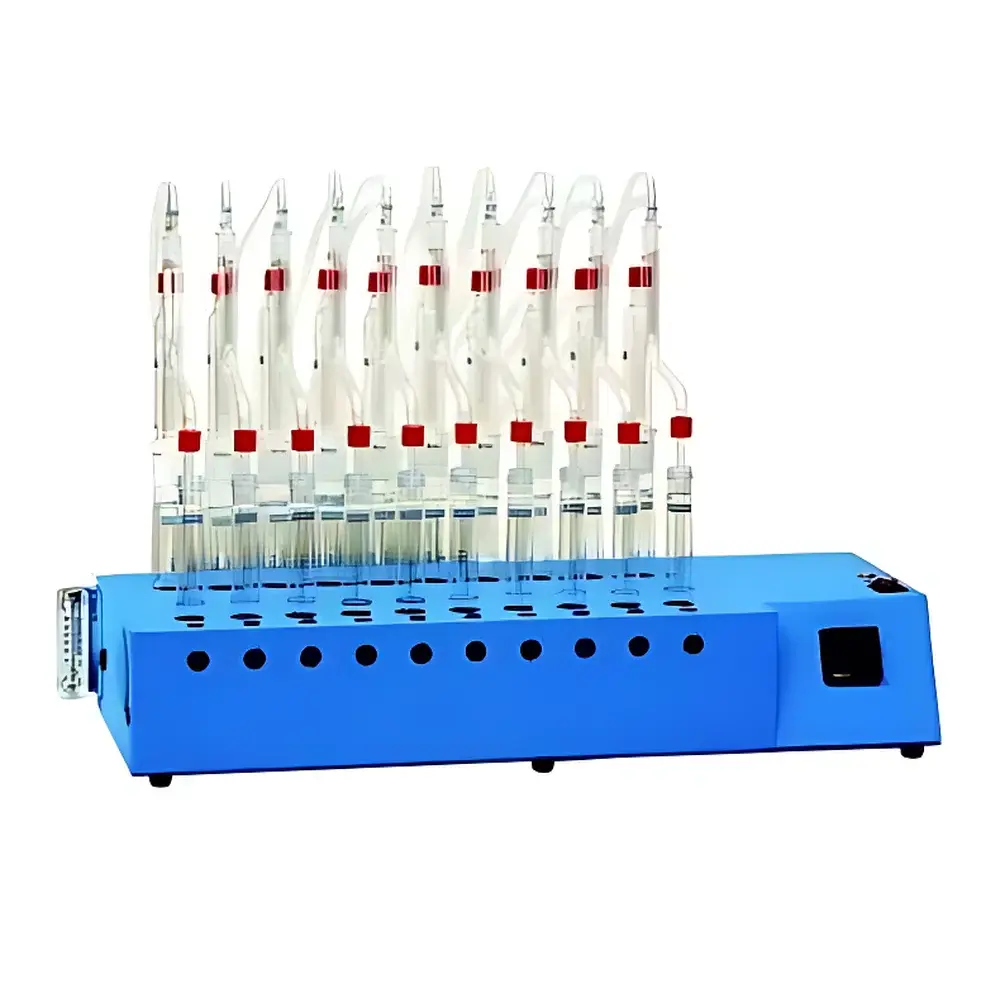
Environmental Express MicroBlock-V Distillation System
| Brand | Environmental Express |
|---|---|
| Origin | USA |
| Model | C5200-240 |
| Heating Module | PTFE-coated aluminum block |
| Temperature Range | Ambient to 190 °C |
| Capacity | 10 simultaneous distillations |
| Power Input | 120 VAC, 15 A / 240 VAC, 8 A (CE-marked) |
| Dimensions (W×H×D) | 30 × 16 × 13 in |
| Shipping Weight | 26 lb |
| Compliance | EPA Methods 335.4 (cyanide), 420.4 (phenol), 350.1 (ammonia) |
| Sample Control | Individual brass needle valves per position |
| Gas Transfer | Air/vacuum manifold system |
| Glassware Compatibility | Dedicated MicroBlock™-V glassware sets (C5212, C5214) and third-party interchangeable designs |
| Cooling/Sealing | Post-distillation cap sealing to prevent volatilization or contamination |
Overview
The Environmental Express MicroBlock-V Distillation System is a precision-engineered, multi-channel benchtop distillation apparatus designed for regulatory-compliant analysis of volatile analytes—including cyanide, phenol, and ammonia—in environmental, wastewater, and drinking water samples. Based on standardized steam distillation principles, the system operates under controlled thermal conditions to quantitatively transfer target analytes from the sample matrix into a receiving solution while minimizing co-distillation of interferences. Its modular architecture integrates a PTFE-coated aluminum heating block with independent temperature and timing control per run, enabling reproducible thermal profiles essential for method adherence. Unlike conventional single-vessel digesters or open-bath setups, the MicroBlock-V employs a closed-loop air/vacuum manifold that actively transports evolved vapors—rather than relying solely on passive condensation—thereby improving analyte recovery, reducing carryover risk, and enhancing inter-run consistency.
Key Features
- Simultaneous 10-position distillation for high-throughput laboratory workflows without sacrificing method fidelity.
- Digital temperature controller with ±1 °C accuracy across the full 20–190 °C operating range, coupled with programmable digital timer (0–999 min) for precise endpoint control.
- PTFE-coated aluminum heating block ensures uniform thermal distribution, rapid heat-up, corrosion resistance, and long-term stability under repeated acid/base exposure.
- Independent brass needle valves at each station allow fine-tuned vapor flow regulation—critical for optimizing recovery in low-concentration or matrix-inhibited samples.
- Integrated air/vacuum manifold system facilitates efficient and consistent transfer of distilled vapors directly into pre-chilled receivers, minimizing analyte loss via re-condensation or adsorption.
- Modular glassware design supports method-specific configurations: dedicated kits for EPA 335.4 (cyanide), EPA 420.4 (phenol), and EPA 350.1 (ammonia); all components are borosilicate 3.3 glass with ground-glass joints meeting ASTM E438 Type I Class A tolerances.
- Post-distillation sealing caps prevent post-run evaporation, oxidation, or atmospheric contamination—particularly vital for unstable species such as free cyanide or volatile phenolic compounds.
Sample Compatibility & Compliance
The MicroBlock-V system is validated for use with aqueous environmental matrices including raw and treated wastewater, surface water, groundwater, and industrial effluents. It fully supports U.S. EPA reference methods for cyanide (Method 335.4), phenol (Method 420.4), and ammonia (Method 350.1), and its operational parameters align with ISO 6439 (ammonia), ISO 6437 (phenol), and ISO 6703-1 (cyanide) where applicable. All glassware configurations meet GLP documentation requirements, and the system’s traceable temperature/time logging capability supports audit readiness under 40 CFR Part 136 and EPA Contract Lab Program (CLP) guidelines. No modifications to published EPA procedures are required; method deviations (e.g., alternative receiver volumes or acidification protocols) must be documented and verified per laboratory SOPs.
Software & Data Management
The MicroBlock-V operates as a stand-alone instrument with embedded digital controls—no proprietary software or PC interface is required. Temperature setpoints, ramp rates, hold times, and run completion alerts are configured directly via front-panel keypad and LCD display. For laboratories requiring electronic recordkeeping, time-stamped operational logs (start time, max temperature reached, duration) can be manually transcribed into LIMS or ELN platforms. The system supports 21 CFR Part 11 compliance when integrated with validated laboratory informatics systems that manage user authentication, audit trails, and electronic signatures for analytical sequence records.
Applications
- Routine compliance monitoring of total and amenable cyanide in municipal and industrial discharge permits (NPDES).
- Phenol quantification in petrochemical effluents and landfill leachate per EPA 420.4 and ASTM D1783.
- Ammonia-nitrogen determination in wastewater treatment plant influent/effluent streams using automated colorimetric detection downstream.
- Method development and validation studies requiring parallel distillation optimization across variable pH, ionic strength, or chelator conditions.
- Teaching laboratories performing EPA-method-based environmental chemistry experiments with emphasis on distillation fundamentals and QA/QC practices.
FAQ
Does the MicroBlock-V require external vacuum or compressed air sources?
No—the system includes an integrated vacuum pump and regulated air supply; only standard electrical service is required.
Can I use non-Environmental Express glassware with this unit?
Yes—provided the glassware conforms to standard 24/40 or 29/32 ground-glass joint dimensions and thermal expansion coefficients compatible with borosilicate 3.3 glass.
What maintenance is required for long-term reliability?
Routine cleaning of the heating block surface and needle valves with dilute nitric acid; annual calibration verification of the digital temperature sensor against NIST-traceable reference thermometers.
Is the C5200-240 model suitable for 240 VAC international laboratories?
Yes—this variant is CE-marked and rated for 240 VAC, 8 A operation; voltage selection is factory-set and not user-switchable.
How does the system minimize chemical waste compared to traditional Kjeldahl or steam distillation units?
By limiting reagent volume per sample, eliminating recirculating coolant, and enabling direct distillate collection without intermediate traps or scrubbers—reducing hazardous waste generation by up to 90% versus legacy systems.



