
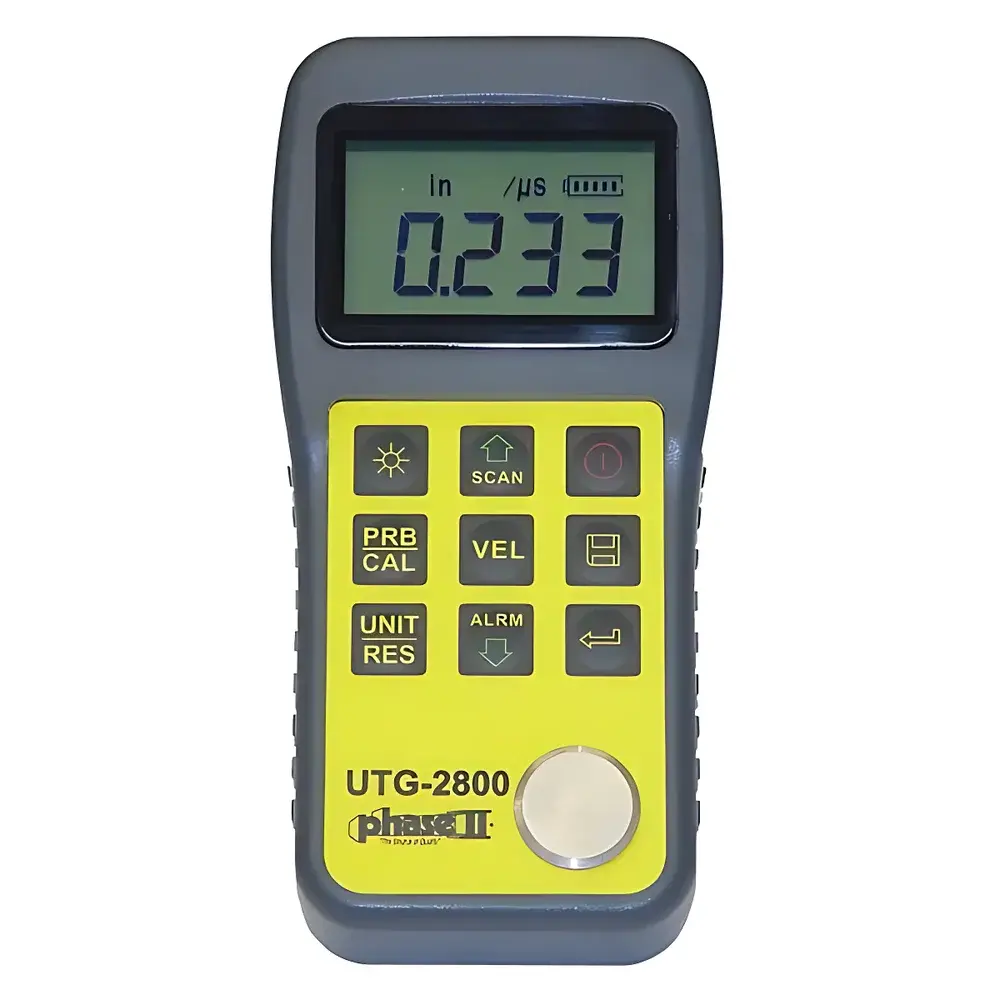
Phase-II UTG-2800 Digital Ultrasonic Thickness Gauge
| Origin | USA |
|---|---|
| Manufacturer Type | Authorized Distributor |
| Origin Category | Imported |
| Model | UTG-2800 |
| Price Range | USD 720 – 1,430 (est. based on ¥5000–9999 at 1 USD ≈ ¥6.95) |
| Measurement Range | 0.5–305 mm (0.02–12 in) |
| Resolution | 0.01 mm (0.001 in) |
| Accuracy | ±(0.5% of thickness + 0.025 mm) |
| Sound Velocity Range | 1000–9999 m/s (3280–32,805 ft/s) |
| Transducer Frequency | 5 MHz dual-element |
| Power Supply | 2 × AA batteries |
| Interface | USB 2.0 |
| Data Storage | Internal memory with expandable logging capability |
| Standard Accessories | 5 MHz dual-element transducer, couplant gel, USB cable, PC software, carrying case, calibration certificate |
Overview
The Phase-II UTG-2800 Digital Ultrasonic Thickness Gauge is an entry-level yet technically robust instrument engineered for precision thickness measurement of solid materials using pulse-echo ultrasonic principles. It operates on the time-of-flight (TOF) method: a short ultrasonic pulse is transmitted into the material via a dual-element transducer; the elapsed time between the initial pulse and the echo reflected from the back surface is measured and converted to thickness using the known acoustic velocity of the material. This principle enables non-destructive, single-sided measurement of metals, plastics, composites, ceramics, and other ultrasonically conductive materials—provided they exhibit parallel front and back surfaces and uniform acoustic impedance. Designed for field and workshop environments, the UTG-2800 delivers repeatable results across a broad thickness range (0.5–305 mm), making it suitable for quality control in manufacturing, corrosion monitoring in piping systems, and incoming inspection of sheet stock or cast components.
Key Features
- Dual-element 5 MHz transducer optimized for high signal-to-noise ratio and improved near-surface resolution, especially critical for thin-wall measurements and coarse-grained materials.
- Adjustable sound velocity calibration (1000–9999 m/s), enabling accurate thickness readings across diverse material classes—from aluminum (6300 m/s) to polyethylene (1900 m/s) and glass (5200 m/s).
- User-selectable resolution modes: 0.01 mm (0.001 in) standard, with optional display scaling for engineering unit consistency in mixed-metric workflows.
- Real-time scanning mode with peak-hold and minimum-thickness capture functions—ideal for rapid survey of corroded or eroded surfaces.
- USB 2.0 interface compliant with CDC (Communication Device Class) protocols, allowing direct data streaming and firmware updates without proprietary drivers.
- Battery-powered operation (2 × AA alkaline cells) with >100 hours of continuous use and low-battery indication—designed for extended field deployment without external power dependency.
- IP54-rated enclosure providing protection against dust ingress and water splashes during industrial handling.
Sample Compatibility & Compliance
The UTG-2800 is validated for use on homogeneous, isotropic materials with smooth, parallel surfaces and minimal internal scattering. It meets ASTM E797-22 “Standard Practice for Measuring Thickness by Manual Ultrasonic Pulse-Echo Contact Method” for general-purpose thickness verification. While not certified for ASME B31.4/B31.8 pipeline integrity assessment or API RP 570 corrosion monitoring without additional procedural qualification, its measurement repeatability (±0.025 mm typical under controlled lab conditions) supports GLP-aligned documentation when used with traceable calibration standards. The included NIST-traceable calibration certificate (per ISO/IEC 17025 accredited provider) validates baseline accuracy at 3.0 mm and 25.4 mm steel references. Couplant compatibility extends to standard glycerin-based gels and water-based alternatives; no hazardous solvents are required.
Software & Data Management
Bundled Windows-compatible software (v3.2+) provides raw data export in CSV and XML formats, supporting integration into LIMS and SPC platforms. Each logged reading includes timestamp, transducer ID, velocity setting, and operator-defined batch tag. Audit trail functionality records calibration events, parameter changes, and firmware version history—supporting basic FDA 21 CFR Part 11 compliance when deployed with user-access controls and electronic signature configuration. Internal memory stores up to 10,000 readings; USB transfer enables batch synchronization with enterprise QA databases. No cloud dependency or mandatory subscription is required—data sovereignty remains fully under end-user control.
Applications
- Corrosion mapping of carbon steel piping, tanks, and pressure vessels in petrochemical and power generation facilities.
- Incoming inspection of rolled metal sheets, extruded profiles, and forged billets per ASTM A480/A6/A240 dimensional tolerances.
- Quality assurance of plastic injection-molded housings, composite laminates, and ceramic substrates in electronics and aerospace supply chains.
- Educational laboratory use for teaching ultrasonic wave propagation, acoustic impedance matching, and material property interrelationships.
- Maintenance & reliability programs requiring trending of wall thickness loss over time—compatible with common CMMS platforms via exported CSV reports.
FAQ
What materials can the UTG-2800 measure accurately?
It measures metals (steel, aluminum, copper), rigid plastics (PVC, ABS), glass, ceramics, and fiberglass—provided surfaces are parallel, smooth, and acoustically coupled. Porous, highly attenuative, or multi-layered composites require empirical velocity calibration and may yield reduced accuracy.
Is the transducer interchangeable with other Phase-II models?
Yes—the 5 MHz dual-element transducer uses the standard BNC coaxial interface compatible with all Phase-II UTG-series gauges (UTG-2200, UTG-2600, UTG-2800), enabling probe sharing across instrument fleets.
Does the device support temperature compensation?
No—temperature-induced velocity drift must be addressed manually by adjusting the sound velocity value per published material tables or reference block calibration at operating temperature.
Can measurement data be integrated into automated reporting systems?
Yes—CSV exports include structured metadata (date, time, location tag, velocity setting) and are directly ingestible by Python/Pandas, MATLAB, or commercial SPC tools such as Minitab or InfinityQS.
What is the warranty and service coverage outside the U.S.?
Phase-II provides a 2-year limited warranty globally through authorized distributors; repair turnaround is typically 10 business days with return shipping covered under warranty terms. Calibration services follow ISO/IEC 17025 procedures with documented uncertainty budgets.



