
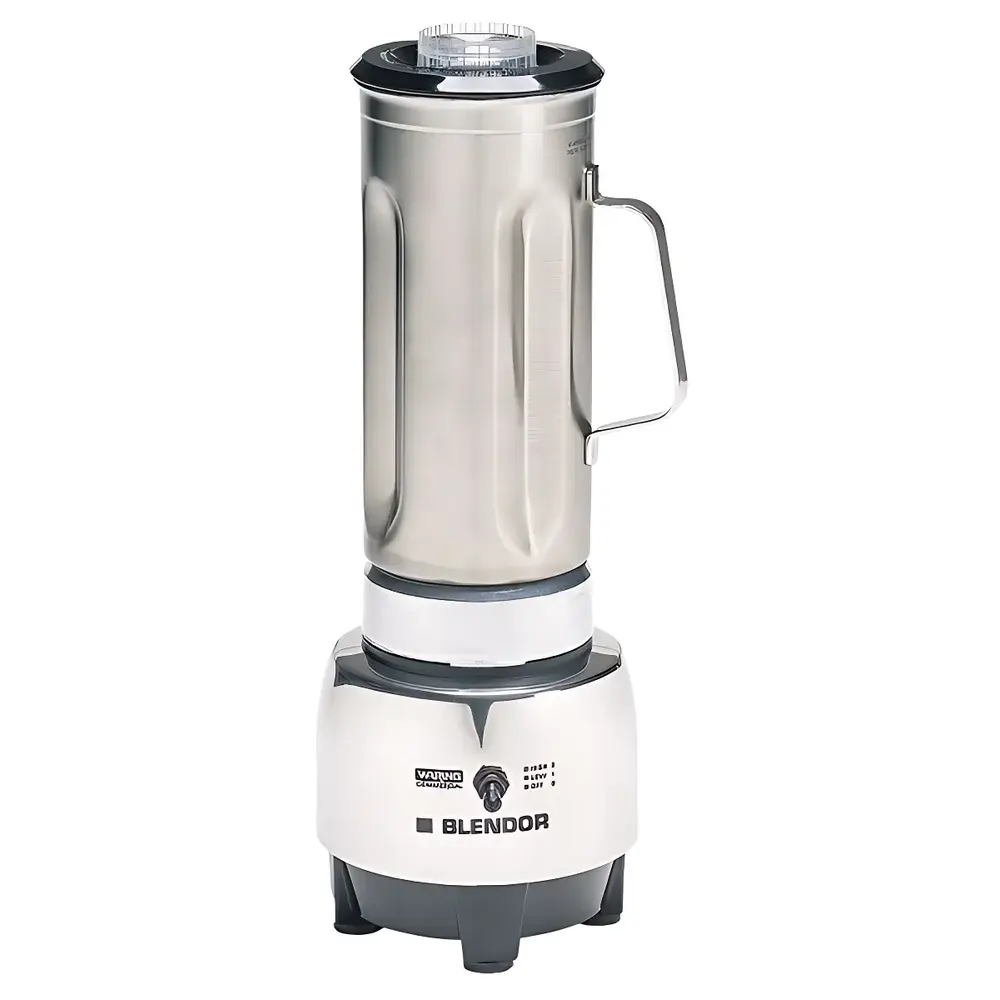
Waring HGB550 Dual-Speed High-Performance Tissue Homogenizer
| Brand | Waring |
|---|---|
| Origin | USA |
| Model | HGB550 / HGB500 |
| Capacity | 2 L |
| Speed Settings | Off–Low–High |
| Rotational Speeds | 0–19,000–23,000 rpm |
| Vessel Options | Stainless Steel (HGB550) or Polycarbonate (HGB500), both with ergonomic handle |
| Lid | Dual-layer polyethylene/polystyrene |
| Motor Base | Stainless steel housing with gray epoxy coating |
| Power Supply | 230 V, 50/60 Hz, single-phase AC, 3.75 A |
| Cord Length | 183 cm, UL-listed No. 14 AWG, 3-prong grounded plug |
| Overall Height | 48.26 cm |
| Net Weight | 6.53 kg (HGB550), 6.26 kg (HGB500) |
| Drive Connector | Metal shaft with rubberized outer sleeve |
| Accessories Compatibility | SS810, SS715, CAC59, CAC21, AD2 |
Overview
The Waring HGB550 Dual-Speed High-Performance Tissue Homogenizer is an engineered solution for rapid, reproducible mechanical homogenization of biological, pharmaceutical, food, and chemical samples. Utilizing high-torque rotor-stator shear principles, the unit generates intense fluidic turbulence and localized cavitation within the sample vessel—enabling efficient cell lysis, tissue disruption, emulsification, and suspension stabilization. Designed for routine laboratory use in regulated environments, the HGB550 operates at two fixed high-speed settings (19,000 rpm and 23,000 rpm), delivering consistent energy input across batch volumes up to 2 L. Its robust stainless-steel motor base, precision-machined drive coupling, and thermally stable motor winding support sustained operation under variable load conditions—critical for applications requiring repeatable particle size reduction or phase dispersion without thermal runaway.
Key Features
- Dual-speed operation (19,000 rpm / 23,000 rpm) with intuitive three-position switch (Off–Low–High), enabling precise control over shear intensity and processing time.
- 2 L capacity vessel options: HGB550 includes a corrosion-resistant stainless-steel beaker with integrated ergonomic handle; HGB500 features a transparent, impact-resistant polycarbonate beaker—both equipped with dual-layer polyethylene/polystyrene lids to minimize aerosol generation and ensure secure sealing during operation.
- Heavy-duty induction motor with stainless-steel housing and gray epoxy coating provides mechanical durability, electrical safety, and resistance to laboratory cleaning agents and incidental spills.
- Metal drive shaft with rubberized outer sleeve ensures positive torque transfer while dampening vibration and reducing harmonic resonance during high-RPM operation.
- UL-listed power cord (183 cm, 14 AWG, grounded 3-prong plug) complies with IEC 61010-1 safety standards for laboratory electrical equipment.
- Compact footprint (48.26 cm height) and low center-of-gravity design enhance stability on standard lab benches—even during aggressive homogenization cycles.
Sample Compatibility & Compliance
The HGB550 accommodates a broad range of sample matrices including soft animal tissues (liver, spleen, brain), plant material (leaves, roots), cultured cells, dairy products (cheese, yogurt), meat emulsions, polymer dispersions, and viscous pharmaceutical suspensions. Vessel materials are selected for compatibility with common solvents (e.g., ethanol, chloroform, aqueous buffers) and sterilization methods—including autoclaving (stainless-steel vessel) and chemical disinfection (polycarbonate vessel per manufacturer guidelines). The system supports GLP-aligned workflows through traceable operation (no electronic logging built-in, but manual logbook integration is standard practice), and its mechanical design conforms to ISO 13485-relevant construction principles for medical device ancillary equipment. While not intrinsically compliant with FDA 21 CFR Part 11, the unit may be validated as part of a broader instrument qualification protocol (IQ/OQ/PQ) when deployed in GMP-regulated bioprocessing or QC labs.
Software & Data Management
The HGB550 is a standalone electromechanical instrument with no embedded microprocessor, firmware, or digital interface. All operational parameters—including speed selection, run duration, and vessel type—are manually controlled and recorded externally. This analog architecture eliminates software validation requirements and ensures long-term functional consistency without firmware updates or cybersecurity dependencies. Users maintain process documentation via paper-based or LIMS-integrated electronic logs, noting vessel lot numbers, sample identifiers, speed setting, total run time, and post-homogenization observations (e.g., temperature rise, foaming, viscosity change). Optional accessories such as the AD2 adapter enable method scalability across vessel sizes (1 L and below), supporting standardized SOP development across multi-volume protocols.
Applications
- Life Sciences Research: Preparation of subcellular fractions from mammalian tissues; extraction of nucleic acids and proteins from fibrous or lipid-rich samples; homogenization of plant biomass for metabolite profiling.
- Biopharmaceutical Manufacturing: Disruption of microbial pellets (E. coli, yeast) prior to inclusion body isolation; blending of vaccine adjuvants with antigen suspensions; preparation of cell lysates for downstream chromatography.
- Food & Agriculture Testing: Homogenization of composite food samples (meat, dairy, grains) for mycotoxin, pesticide residue, or pathogen analysis per AOAC and ISO 17025 methods.
- Clinical Diagnostics: Rapid lysis of biopsy specimens for histopathological embedding or molecular testing; preparation of whole-blood homogenates for hemoglobin variant analysis.
- Materials Science: Dispersion of nanoparticles in polymer melts; deagglomeration of ceramic powders in solvent carriers; stabilization of colloidal suspensions for rheological characterization.
FAQ
What is the difference between the HGB550 and HGB500 models?
The HGB550 is supplied with a 2 L stainless-steel vessel; the HGB500 uses a 2 L polycarbonate vessel. Both share identical motor specifications, speed settings, base assembly, and lid configuration.
Can the HGB550 be used for sterile applications?
Yes—the stainless-steel vessel (SS810) and metal drive components are autoclavable at 121 °C for 20 minutes. Polycarbonate vessels must be sterilized via ethylene oxide or chemical immersion per manufacturer instructions.
Is continuous operation supported at maximum speed?
Recommended duty cycle is ≤2 minutes per run at 23,000 rpm, followed by ≥1 minute cooldown. Extended runs require intermittent cycling to prevent motor overheating and maintain bearing longevity.
Which accessories are required for processing 1 L samples?
The AD2 adapter enables secure mounting of 1 L or smaller vessels onto the HGB550/HGB500 drive shaft. Compatible vessels include CAC21 (1.4 L polycarbonate) and SS715 (stainless-steel variants).
Does Waring provide calibration certificates or maintenance services?
Waring does not supply factory calibration certificates for rotational speed, as the unit employs fixed-ratio gear-driven motors with no adjustable speed electronics. Preventive maintenance (e.g., blade sharpening, bearing inspection) is recommended annually or after 500 operating hours, per Waring Technical Bulletin TB-HGB-01.



