
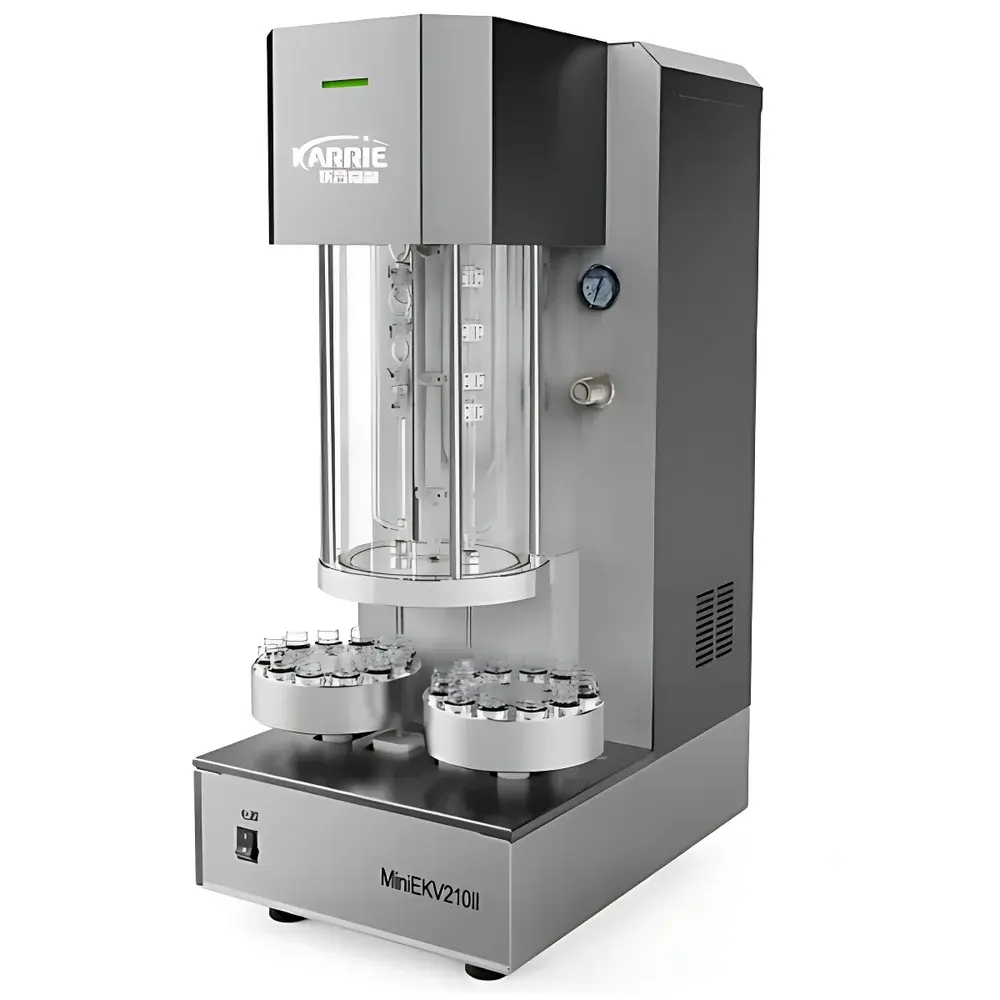
ETN200 Karrie Automated Intrinsic Viscosity Tester for Polymer and Fiber Applications
| [Brand | Karrie |
|---|---|
| Model | ETN200 |
| Origin | Guangdong, China |
| Compliance | GB/T 14190–2008, GB/T 17931–2008, GB/T 17932–1999 |
| Sample Capacity | 2 × 12 positions |
| Temperature Range | 20–100 °C |
| Temp. Stability | ±0.01 °C |
| Temp. Resolution | 0.01 °C |
| Detection Method | Photocell or thermistor timing (0.01 s resolution) |
| Bath Medium | 10# methyl silicone oil (standard) |
| Viscometer Type | Modified Ubbelohde capillary |
| Calibration | Pre-calibrated with certified viscosity standards |
| Power Supply | AC 220 V, 50 Hz |
| Total Power | 1500 W |
| Dimensions | 500 × 360 × 800 mm |
| Weight | 20 kg] |
Overview
The ETN200 Karrie Automated Intrinsic Viscosity Tester is a precision laboratory instrument engineered for the determination of intrinsic viscosity ([η]) in synthetic polymers, man-made fibers (e.g., polyester, nylon, acrylic), and other high-molecular-weight organic materials. It operates on the principle of capillary flow viscometry using a modified Ubbelohde viscometer, where solution viscosity is measured under gravity-driven laminar flow conditions. Intrinsic viscosity—calculated via extrapolation of reduced and inherent viscosities to zero concentration—is a fundamental rheological parameter directly correlated with polymer molecular weight and chain conformation in dilute solution. The ETN200 complies fully with Chinese national standards GB/T 14190–2008 (for fiber-grade PET), GB/T 17931–2008 (for polyester filament yarn), and GB/T 17932–1999 (for viscose staple fiber), ensuring traceable, auditable, and methodologically consistent results required in QC/QA laboratories, R&D centers, and third-party certification facilities serving the textile, petrochemical, and synthetic materials industries.
Key Features
- Dual-layer constant-temperature bath system with ±0.01 °C stability over 20–100 °C range, utilizing high-purity 10# methyl silicone oil as primary thermal medium—enabling extended operational life without frequent fluid replacement.
- Modular hardware architecture integrating ARM-based real-time controller for precise temperature regulation and timing acquisition, coupled with Windows 7–based PC interface for comprehensive data visualization, method storage, and report generation.
- Automated sample handling with optional 2×12-position auto-sampler: supports unattended sequential analysis of up to 24 samples per batch, including automatic aspiration, efflux timing, solvent rinsing, and nitrogen-assisted drying of both capillary viscometer and sample cups.
- Redundant detection options: high-resolution photocell sensor or thermistor-based timing module—both delivering 0.01-second temporal resolution for efflux time measurement, critical for accurate kinematic viscosity (ν) derivation.
- Factory-calibrated Ubbelohde viscometers (0.88 mm capillary bore) supplied with NIST-traceable viscosity standard oils; integrated software calibration routine allows end-user verification and adjustment under lab-specific solvent systems (e.g., phenol/1,1,2,2-tetrachloroethane for PET).
- Full GLP-supporting firmware: audit trail logging, user access levels, electronic signature capability, and timestamped raw data export compliant with FDA 21 CFR Part 11 requirements when deployed in regulated environments.
Sample Compatibility & Compliance
The ETN200 is validated for transparent and opaque liquid polymer solutions—including PET, PA6, PTT, and cellulose derivatives—in common solvents such as concentrated sulfuric acid (for cellulose), o-chlorophenol (for polyolefins), and phenol/tetrachloroethane mixtures (for aromatic polyesters). Its design accommodates variable solution densities and refractive indices without optical interference. All test procedures align with ISO 1628-1 (plastics – determination of viscosity number), ASTM D4603 (for PET intrinsic viscosity), and USP (viscosity of polymeric excipients), making it suitable for regulatory submissions, supplier qualification, and internal specification release testing. The instrument’s mechanical and thermal architecture meets IEC 61010-1 safety standards for laboratory electrical equipment.
Software & Data Management
The proprietary ETN200 Control Suite runs natively on Windows 7 (upgradable to Windows 10 LTSB) and provides intuitive graphical workflow configuration—users define sample IDs, positions, solvent sequences, rinse cycles, and calculation models (Huggins, Kraemer, or Schulz–Blaschke) prior to run initiation. All raw efflux times, temperature logs, and derived values ([η], IV, IVR) are stored in encrypted SQLite databases with immutable timestamps. Export formats include CSV, PDF analytical reports (with embedded calibration certificates), and XML-compatible structured data for seamless ingestion into LIMS platforms via RS-232, USB virtual COM, or TCP/IP Ethernet (RJ-45). Audit trail records capture operator ID, parameter changes, calibration events, and error flags—fully retrievable for GMP/GLP inspections.
Applications
- Quality control of melt-spun synthetic fibers during production: rapid IV screening of PET chip batches prior to extrusion.
- Molecular weight monitoring in polymer synthesis labs: correlation of [η] with Mw using Mark–Houwink–Sakurada constants.
- Stability assessment of polymer solutions during storage or processing: detecting degradation-induced viscosity shifts.
- Regulatory compliance testing for ISO/IEC 17025-accredited laboratories issuing test certificates for textile raw materials.
- Method validation studies supporting pharmaceutical excipient characterization per USP monographs.
FAQ
What types of polymers can be tested on the ETN200?
The instrument is optimized for synthetic fibers (PET, PA6, PTT, acrylic) and cellulose derivatives dissolved in standard solvents specified in GB/T and ISO methods.
Is the Ubbelohde viscometer included and pre-calibrated?
Yes—each unit ships with two factory-calibrated 0.88-mm Ubbelohde capillaries, verified against certified viscosity standards; full calibration documentation is provided.
Can the system operate without a PC?
No—the ARM controller handles real-time timing and thermal control, but all method setup, data review, and reporting require the Windows-based host computer.
Does the ETN200 support network connectivity for centralized lab management?
Yes—via built-in RJ-45 port, enabling remote status monitoring, batch queue management, and secure data upload to enterprise LIMS or cloud archives.
What maintenance is required for long-term reliability?
Routine cleaning of sample cups and capillary junctions; annual verification of PT100 sensor accuracy and timing module drift using reference standards—no consumable parts beyond solvents and nitrogen gas.





