
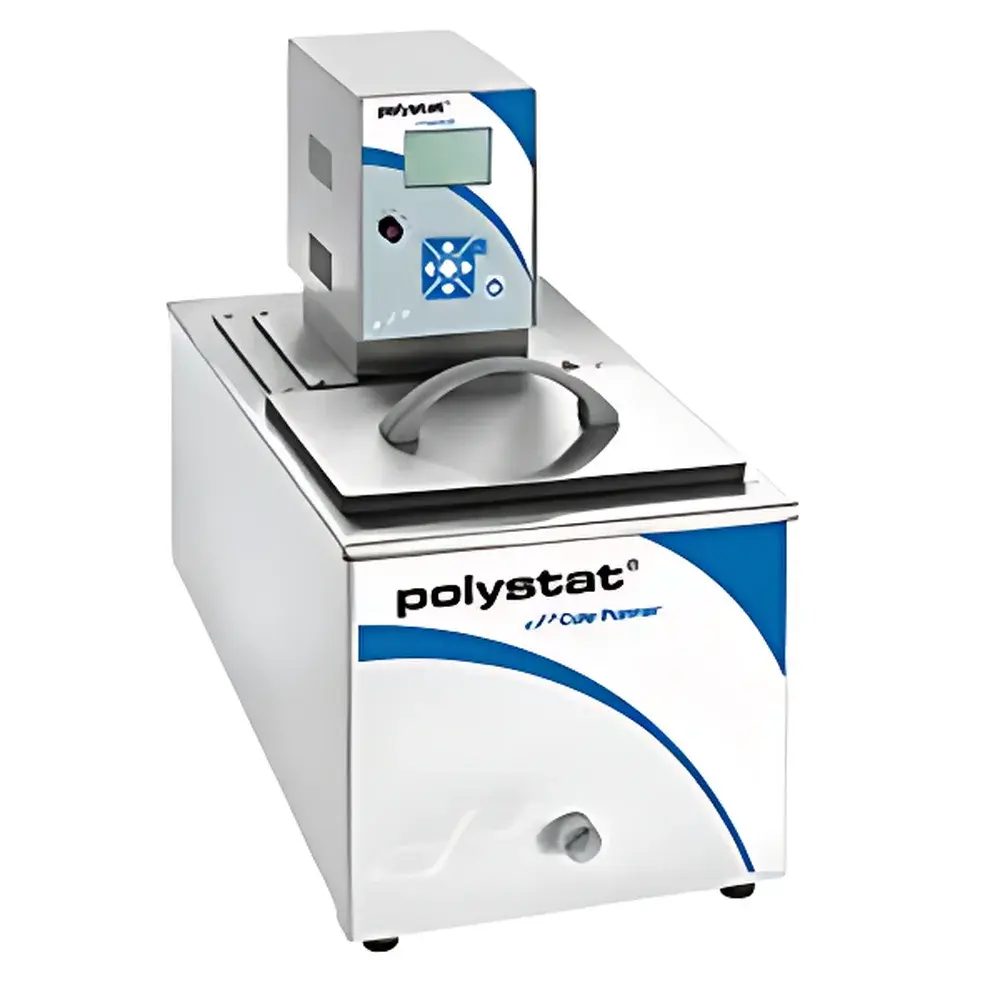
Polystat 12134-62 Stainless Steel Heated Circulating Bath
| Brand | Polystat |
|---|---|
| Origin | USA |
| Model | 12134-62 |
| Bath Capacity | 6 L and 15 L options |
| Temperature Range | Ambient +13°C to 200°C |
| Temperature Stability | ±0.01°C |
| Circulation Type | Internal and External |
| Pump Type | Dual-Speed (Standard) / Pressure-Suction Dual-Mode (Advanced Digital Controller) |
| Max Flow Rate | 17–21 L/min |
| Max Pressure | 4.5 psi (310 mbar) / 10.8 psi (750 mbar) |
| Controller | PID with Moisture-Resistant LCD Display (0.01°C resolution), Programmable Setpoints, Adjustable High-Temp Cutoff, User-Defined Min/Max Limits |
| Safety Features | Over-Temperature Cut-Off, Audible Alarm |
| Compliance | Designed for GLP/GMP environments |
Overview
The Polystat 12134-62 Stainless Steel Heated Circulating Bath is a precision-engineered thermal management system designed for laboratory applications requiring stable, uniform, and controllable temperature environments. Utilizing a robust stainless steel bath chamber and a high-efficiency immersion heater, the unit maintains setpoint accuracy through advanced PID feedback control—ensuring minimal thermal drift across extended operational cycles. Its core function is to provide consistent heat transfer via forced convection, either internally within the bath reservoir or externally through connected apparatus such as reactors, viscometers, spectrophotometers, or analytical columns. With a maximum operating temperature of 200°C and stability of ±0.01°C at steady state, it meets stringent requirements for kinetic studies, calibration traceability, and method validation in regulated settings.
Key Features
- Stainless steel construction for chemical resistance, durability, and ease of cleaning in multi-user lab environments
- Moisture-resistant LCD display with 0.01°C resolution, supporting °C, °F, and Kelvin readouts
- Dual-speed pump (standard model) or pressure/suction dual-mode pump (advanced digital controller) enabling flexible external loop integration
- Five programmable temperature setpoints with ramp/soak profiles for automated thermal protocols
- User-configurable high-temperature cutoff and min/max operational limits to prevent thermal excursions
- Integrated safety system featuring automatic over-temperature shutdown and audible alarm notification
- USB interface (advanced controller) for data logging, remote parameter adjustment, and firmware updates
- Compliant power input options: 115 VAC, 60 Hz or 230 VAC, 50/60 Hz — suitable for global laboratory infrastructure
Sample Compatibility & Compliance
The Polystat 12134-62 accommodates a wide range of sample containers and external devices via standardized 1/4″ NPT or barbed fittings for fluid interconnection. It supports aqueous, ethylene glycol, silicone oil, and other compatible heat-transfer media—enabling use across temperature ranges from ambient +13°C up to 200°C without degradation of thermal performance. The unit is engineered to meet ISO/IEC 17025 requirements for equipment qualification and is routinely deployed in laboratories adhering to USP , ASTM E2877, and ICH Q5C guidelines for temperature-controlled stability testing. When operated with validated software and electronic records, its digital controller supports compliance with FDA 21 CFR Part 11 for audit trails, user authentication, and electronic signatures.
Software & Data Management
While the standard Polystat 12134-62 operates via front-panel controls, the advanced digital controller variant includes USB connectivity for integration with third-party data acquisition platforms. This allows real-time temperature logging, export of time-stamped CSV files, and synchronization with LIMS or ELN systems. All controller configurations support full audit trail functionality—including timestamped entries for setpoint changes, alarm events, and system resets—essential for GLP and GMP documentation. No proprietary software license is required; raw serial communication protocols are documented for custom integration into existing laboratory informatics ecosystems.
Applications
- Calibration of temperature-sensitive instrumentation (e.g., thermocouples, RTDs, infrared sensors)
- Thermal conditioning of samples prior to rheological, spectroscopic, or chromatographic analysis
- Temperature-controlled reaction monitoring in synthetic chemistry and enzymology
- Stability testing of pharmaceutical formulations per ICH guidelines
- Viscosity measurement using rotational or capillary viscometers requiring precise thermal control
- Environmental simulation for material testing (e.g., polymer softening point, glass transition behavior)
- Heat transfer coefficient determination in engineering education and research labs
FAQ
What is the difference between the standard and advanced digital controller models?
The advanced digital controller adds USB connectivity, a two-stage pressure/suction pump (higher flow and backpressure capability), and enhanced programmability—including ramp/soak sequences—while retaining all safety and stability features of the standard version.
Can this bath be used with silicone oil or other non-aqueous fluids?
Yes—provided the fluid is chemically compatible with stainless steel and the pump seals, and its viscosity remains within the operational envelope of the selected pump configuration (up to 21 L/min at ≤100 cSt).
Is the ±0.01°C stability specification achievable across the full 200°C range?
Stability of ±0.01°C is verified at nominal operating points near setpoint equilibrium; actual performance may vary slightly at extremes due to ambient load and fluid properties—but remains within ±0.025°C across the entire range per manufacturer validation reports.
Does the unit include external temperature sensor input for jacketed vessel control?
No—the Polystat 12134-62 regulates based on internal bath temperature only. For external probe feedback, integration with an external PID controller or process automation system is recommended.
What maintenance is required to ensure long-term accuracy and reliability?
Routine inspection of pump seals, periodic cleaning of the bath chamber to prevent scale or residue buildup, and annual verification against NIST-traceable reference thermometers are advised per ISO/IEC 17025 calibration intervals.



