
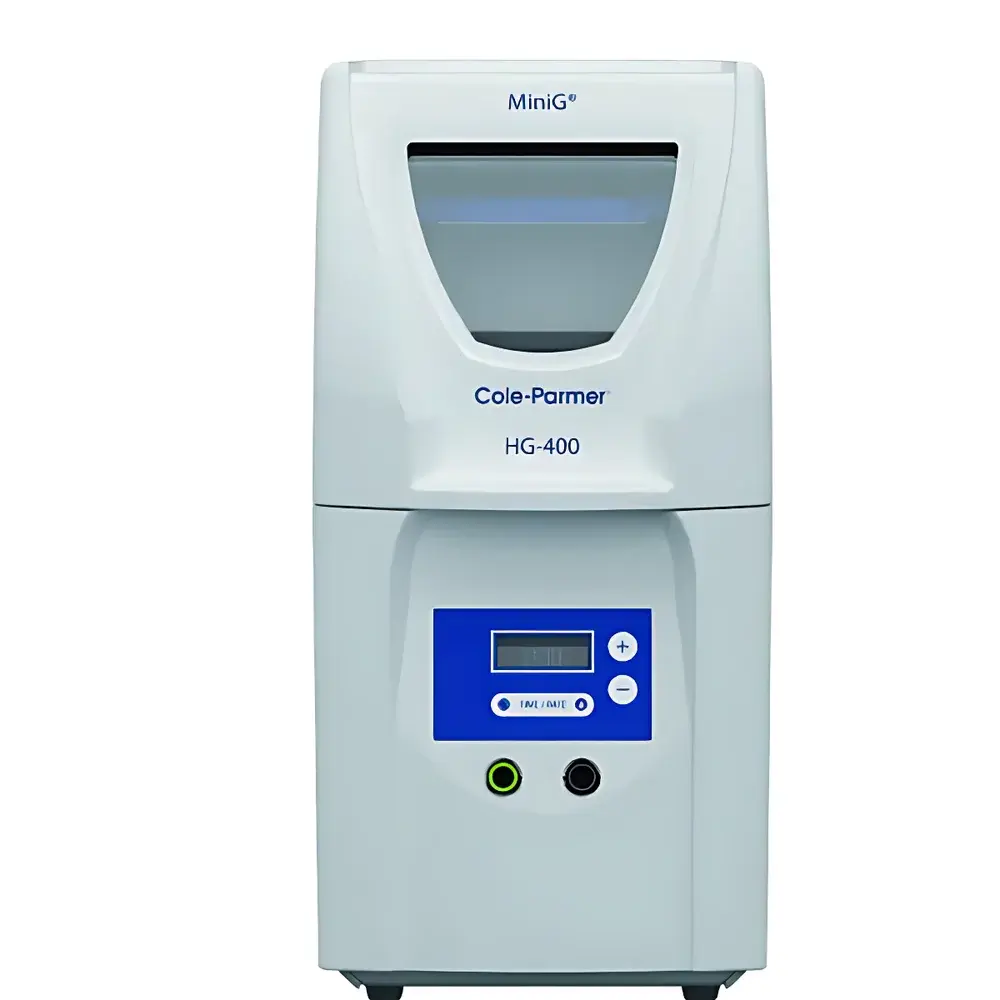
Cole-Parmer HG-400 MiniG® High-Throughput Tissue Grinder
| Brand | Cole-Parmer |
|---|---|
| Origin | USA |
| Manufacturer Type | Authorized Distributor |
| Origin Category | Imported |
| Model | HG-400 |
| Price | Upon Request |
| Dimensions (W×D×H) | 28.6 × 43.2 × 54.6 cm |
| Weight | 22 kg |
| Power Supply | 230 V AC |
| Power Consumption | 105 W |
| Oscillation Amplitude | 3.2 cm |
| Frequency Range | 500–1500 cycles/min |
| Compatible Holders | Two 96-well deep-well plates |
Overview
The Cole-Parmer HG-400 MiniG® High-Throughput Tissue Grinder is an engineered solution for rapid, reproducible mechanical lysis of biological samples via high-frequency vertical oscillation. Based on the principle of bead-beating—where kinetic energy from rapid reciprocating motion transfers to grinding media (e.g., stainless steel or ceramic beads) immersed in sample-containing vessels—the instrument achieves efficient cell wall and membrane disruption across diverse tissue types. Unlike manual homogenization or rotor-stator systems, the HG-400 MiniG® delivers uniform energy input across all wells or tubes simultaneously, minimizing inter-sample variability and eliminating operator-dependent bias. Its design targets laboratories performing routine nucleic acid isolation (DNA/RNA), protein extraction, metabolite profiling, or microbial lysis where throughput, consistency, and contamination control are critical.
Key Features
- Vertical oscillation architecture with adjustable frequency (500–1500 cycles/min) and fixed 3.2 cm amplitude ensures robust mechanical energy transfer without lateral shear forces that may compromise macromolecular integrity.
- Modular holder system supports multiple configurations: dual 96-well deep-well plates (standard for high-throughput screening), or interchangeable racks for 2–50 mL centrifuge tubes—enabling flexibility across sample volume and throughput requirements.
- Compact footprint (28.6 × 43.2 × 54.6 cm) and low power draw (105 W at 230 V AC) make it suitable for benchtop deployment in shared core facilities, QC labs, or biosafety cabinets.
- Interlocked safety lid prevents operation unless fully closed, meeting IEC 61010-1 electrical safety standards for laboratory equipment.
- Simple interface with digital timer and speed dial allows precise control over run duration (typically <120 seconds) and oscillation intensity—no software installation or calibration required for routine use.
- Robust cast-aluminum frame and vibration-dampened base minimize transmission to adjacent instrumentation and enhance long-term operational stability.
Sample Compatibility & Compliance
The HG-400 MiniG® accommodates a broad spectrum of sample matrices, including plant tissues (seeds, leaves, stems, roots), soft animal tissues (liver, spleen, muscle), cultured cells, yeast, and bacterial pellets. Dry grinding of desiccated seeds is feasible using 1–2 stainless steel beads per well, leveraging the high-energy vertical impact regime. All compatible consumables—including deep-well plates and centrifuge tubes—are commercially available in certified DNase/RNase-free formats. While the instrument itself does not carry ISO 13485 or FDA 21 CFR Part 11 certification (as it is a general-purpose sample preparation tool), its consistent performance supports GLP-compliant workflows when integrated into validated nucleic acid extraction protocols aligned with ISO/IEC 17025 or CLIA guidelines.
Software & Data Management
The HG-400 MiniG® operates as a standalone hardware platform with no embedded firmware, network connectivity, or data logging capability. This design prioritizes reliability, ease of maintenance, and regulatory simplicity—particularly advantageous in GMP environments where software validation burdens must be minimized. All operational parameters (time, speed) are set manually and are not recorded or exportable. Users intending to document runs must implement external logbooks or integrate the device into a LIMS-controlled workflow via timestamped procedural records. No driver installation, OS compatibility constraints, or cybersecurity patches are required.
Applications
- Routine genomic DNA and total RNA isolation from plant and animal tissues prior to qPCR, NGS library prep, or microarray analysis.
- Protein extraction for Western blotting or mass spectrometry, especially from fibrous or lipid-rich tissues resistant to enzymatic lysis alone.
- Microbial cell disruption for plasmid purification, endotoxin removal, or whole-cell lysate generation.
- High-throughput sample homogenization in drug discovery pipelines involving botanical extracts or tissue-based phenotypic assays.
- Pre-analytical standardization in biobanking operations where inter-operator variability must be eliminated during initial tissue processing.
FAQ
Can the HG-400 MiniG® be used with cryogenic grinding?
No—it is not designed for sub-zero operation. Samples and beads must be at ambient or refrigerated (4 °C), but not frozen, to avoid condensation-induced mechanical stress or lid seal failure. Pre-chilled tubes and cold buffers are recommended for thermolabile analytes.
Is the oscillation frequency programmable in increments smaller than 100 cycles/min?
The analog speed dial provides continuous adjustment across the full 500–1500 cycles/min range; however, no digital readout or fine-step calibration is provided. For applications requiring ±5 cycles/min repeatability, external tachometer verification is advised.
Does Cole-Parmer supply validated cleaning protocols for cross-contamination prevention?
While no formal cleaning SOP is included, the absence of internal fluid pathways and accessible stainless-steel surfaces permit standard lab decontamination: 70% ethanol wipe-down followed by UV-C exposure (if cabinet-mounted) or 0.5% sodium hypochlorite rinse for heavy organic residue.
What is the expected service life under daily high-throughput use?
Based on manufacturer durability testing and field reports, the motor and drive mechanism maintain nominal performance for ≥5 years at ≤10 cycles/day, assuming adherence to routine visual inspection and bearing lubrication per the maintenance schedule in the user manual.



