
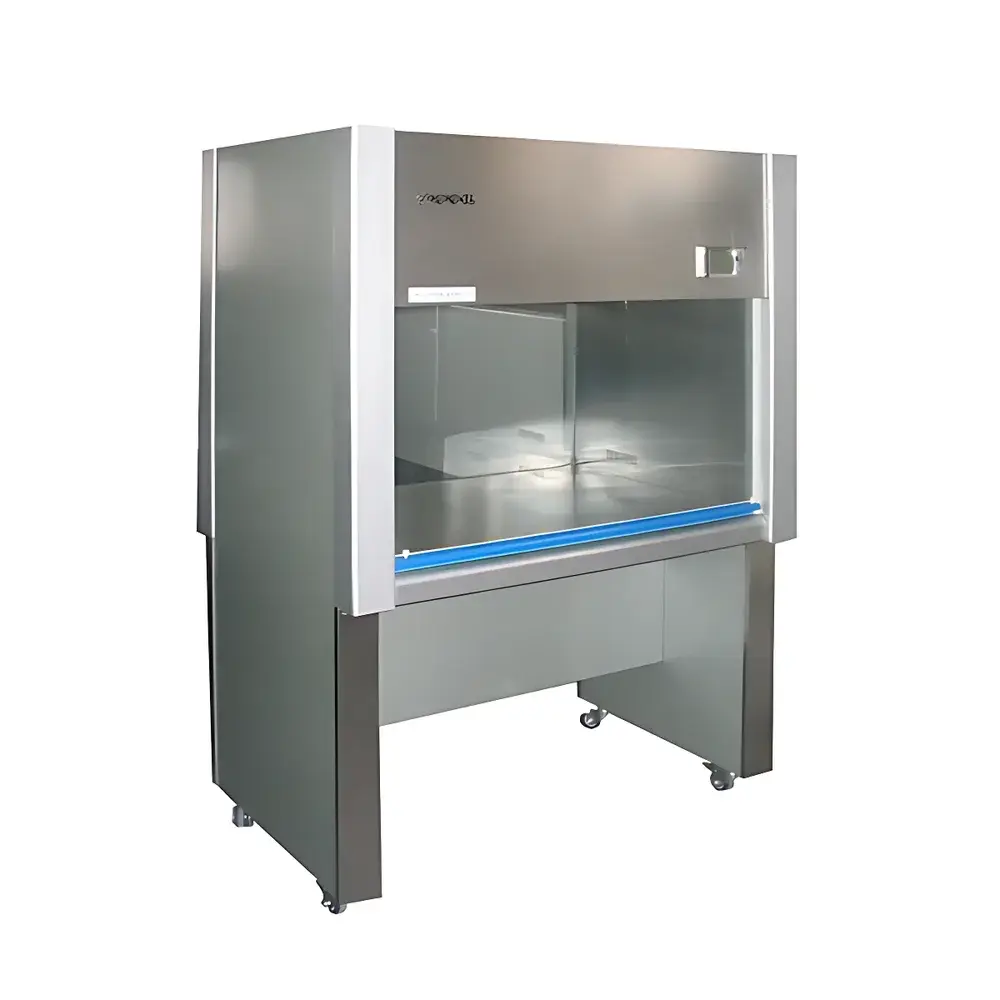
HJ SW-CJ-1F Single-User Dual-Access Vertical Laminar Flow Clean Bench
| Brand | HJ Purification |
|---|---|
| Origin | Shanghai, China |
| Manufacturer Type | Direct Manufacturer |
| Instrument Category | Vertical Laminar Flow Clean Bench |
| Cleanliness Class | ISO Class 5 (100 @ ≥0.5 µm, Fed. Std. 209E) |
| Noise Level | ≤62 dB(A) |
| User Capacity | Single-user, dual-access configuration |
| Airflow Pattern | Vertical downward laminar flow |
| Average Air Velocity | 0.25–0.45 m/s (3-speed adjustable) |
| Illumination | ≥300 lx |
| UV Lamp | 20 W, timer-programmable |
| Power Supply | AC 220 V / 50 Hz |
| Max. Power Consumption | 400 W |
| Net Weight | 100 kg |
| Work Area Dimensions (W×D×H) | 870 × 580 × 515 mm |
| Overall Dimensions (W×D×H) | 1030 × 650 × 1600 mm |
| Vibration | ≤5 µm (peak-to-peak, XYZ axes) |
| Microbial Recovery | ≤0.5 CFU/plate·hr (Φ90 mm settle plate) |
Overview
The HJ SW-CJ-1F is a vertically oriented laminar flow clean bench engineered for ISO Class 5 (Federal Standard 209E Class 100) particle control in non-sterile but contamination-sensitive laboratory operations. It employs a unidirectional vertical airflow system, where air is drawn through a pre-filter and conditioned through a certified HEPA filter (≥99.99% efficiency at 0.3 µm), then delivered uniformly downward across the work surface at a controlled velocity of 0.25–0.45 m/s. This laminar flow establishes a protective aerodynamic barrier—effectively isolating the work area from ambient room air intrusion while minimizing turbulence-induced cross-contamination. Designed for single-operator use with dual-side access, the SW-CJ-1F supports routine aseptic techniques in cell culture preparation, media dispensing, reagent handling, and microbiological assay setup—where personnel protection is not required but product/process integrity must be preserved.
Key Features
- Vertically integrated laminar airflow architecture with precision-calibrated blower and digitally regulated fan speed control (low/medium/high)
- Full-height, counterbalanced sash window with smooth, tool-free positional locking—enabling ergonomic access and consistent airflow stability during operation
- Monocoque enclosure fabricated from pre-painted steel panels; work surface constructed from brushed AISI 304 stainless steel for corrosion resistance, chemical compatibility, and cleanability under ISO 14644-compliant wiping protocols
- Interlocked lighting and UV germicidal irradiation system: UV lamp (20 W, low-pressure mercury) automatically de-energizes when sash is raised above safe threshold, and fluorescent lighting (20 W) remains operational during UV cycles
- Digital LCD controller with real-time display of operating mode, fan speed, UV timer countdown, and system status indicators
- Pre-filter stage upstream of HEPA filter extends service life by capturing coarse particulates (>5 µm); HEPA filter conforms to EN 1822-1:2019 classification H14
- Vertical quasi-enclosed work chamber geometry enhances containment via downward-flowing air curtain, reducing lateral ingress of environmental contaminants
Sample Compatibility & Compliance
The SW-CJ-1F is intended for non-hazardous, non-toxic, non-volatile materials requiring particulate-controlled environments—not for biohazardous or volatile organic compound (VOC) applications. It complies with IEC 61010-1:2010 for electrical safety in laboratory equipment and meets structural requirements per GB/T 25915.1–2021 (Chinese adoption of ISO 14644-1). While not classified as a biosafety cabinet (BSC), its design aligns with ISO 14644-3:2019 testing methodologies for airflow uniformity, particle count validation, and recovery testing. Microbial performance is verified using settle plate methodology (Φ90 mm TSA plates, 1-hour exposure), achieving ≤0.5 CFU/plate·hr—consistent with GLP-aligned environmental monitoring expectations for Class 100 clean zones.
Software & Data Management
The SW-CJ-1F operates via embedded microcontroller firmware without external software dependency. All operational parameters—including fan speed selection, UV exposure duration (programmable up to 99 minutes), and real-time status feedback—are managed through the front-panel LCD interface. No data logging, network connectivity, or audit trail functionality is provided, as the unit is classified as a Class I standalone physical containment device per ISO/IEC 17025:2017 Annex A.3 guidance. For laboratories implementing 21 CFR Part 11 compliance, manual logbook entries—including daily UV cycle verification, airflow visual checks (smoke test), and periodic HEPA integrity testing (via DOP/PAO scan)—are recommended and supported by built-in status indicators.
Applications
- Preparation of sterile culture media and buffer solutions in academic and industrial microbiology labs
- Aseptic transfer of microbial cultures, plant tissue explants, or primary mammalian cells prior to BSC-based manipulation
- Weighing and dispensing of high-purity standards, reference materials, and analytical reagents in QC/QA settings
- Assembly and inspection of optical components, microfluidic devices, or semiconductor packaging substrates requiring low-particulate staging
- Support function in ISO Class 7 or Class 8 cleanrooms where localized Class 5 workspaces are needed without full-room renovation
FAQ
Is the SW-CJ-1F suitable for handling pathogenic organisms?
No. This is a clean bench—not a biosafety cabinet—and provides no personnel or environmental protection against aerosolized biological hazards.
What HEPA filter standard does the unit meet?
The installed filter is rated H14 per EN 1822-1:2019 (≥99.995% @ 0.3 µm MPPS), validated during factory commissioning.
Can the UV lamp be operated simultaneously with the laminar flow fan?
No. The UV circuit is interlocked with the sash position sensor and fan power relay; UV activation requires the sash to be fully closed and fan to be off.
How often should the pre-filter be replaced?
Under typical lab conditions (8 hrs/day, ISO Class 8 ambient), inspect monthly and replace every 3–6 months—or when pressure drop exceeds 250 Pa across the pre-filter.
Does the unit include certification documentation for ISO Class 5 validation?
Factory-issued Certificate of Conformance includes initial airflow velocity mapping and particle count report (per ISO 14644-1:2015 Annex B); third-party certification is available upon request.



