
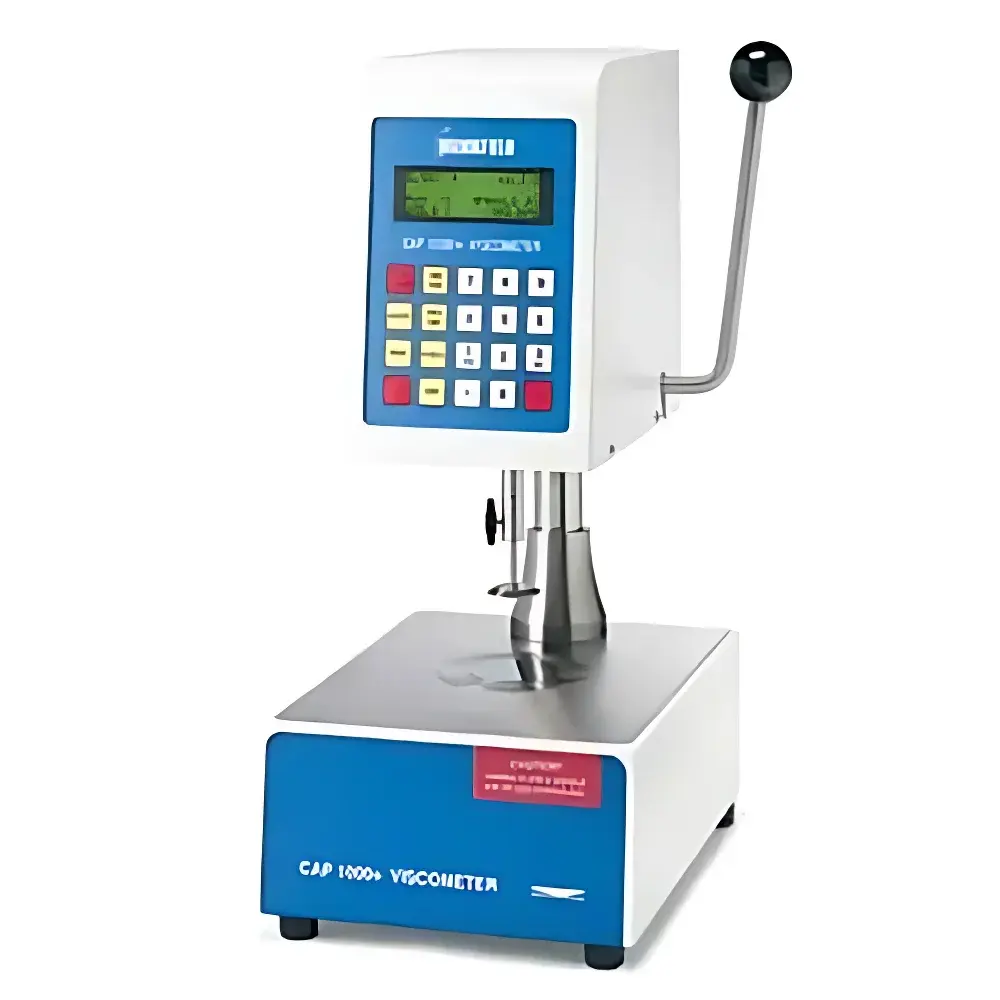
Brookfield CAP1000+ Cone-Plate Viscometer
| Brand | Brookfield |
|---|---|
| Origin | USA |
| Model | CAP1000+ |
| Viscosity Range | 1–2,000,000 cP (mPa·s) |
| Shear Rates | 100–10,000 s⁻¹ (configurable via cone geometry and rotational speed) |
| Rotational Speeds | 100, 400, 750, or 900 rpm (fixed-speed operation) |
| Sample Volume | 13–1700 µL (dependent on cone rotor selection) |
| Temperature Control | Peltier-integrated sample plate, range selectable as 5–75 °C (L-type) or 50–235 °C (H-type) |
| Compliance | ASTM D4287, ISO 2884, BS 3900 |
Overview
The Brookfield CAP1000+ Cone-Plate Viscometer is an engineered solution for high-precision, single-point viscosity measurement under controlled shear conditions. Operating on the fundamental principle of cone-and-plate rheometry—where a precisely angled conical rotor rotates over a flat, thermostatically regulated sample plate—the instrument generates a uniform shear field across the entire sample gap. This geometry eliminates edge effects and ensures Newtonian and non-Newtonian fluid behavior is captured with high reproducibility. Designed specifically for production floor and QC laboratory environments, the CAP1000+ delivers rapid, operator-independent measurements without requiring advanced rheological training. Its compact footprint, robust mechanical architecture, and integrated thermal management make it suitable for routine pass/fail testing, batch release verification, and in-process monitoring where traceability, repeatability, and minimal sample consumption are critical.
Key Features
- Fixed-speed operation at 100, 400, 750, or 900 rpm—optimized for standardized QC workflows requiring consistent shear history
- Peltier-based temperature control embedded directly into the sample plate, enabling rapid thermal equilibration and stable isothermal measurement
- Minimal sample requirement: as low as 13 µL (CAP-04 cone), reducing material cost and waste—particularly valuable for high-value or hazardous formulations
- Interchangeable cone rotors (CAP-01 through CAP-10) calibrated to deliver defined shear rates (2.0–13.3 × 10³ s⁻¹) and viscosity ranges spanning 0.2–2 × 10⁶ cP
- Dual torque capability: high-torque mode (181,000 dyne·cm) for viscous pastes and gels; low-torque mode (7,970 dyne·cm) for low-viscosity liquids and dilute polymer solutions
- Front-panel interface with real-time viscosity readout in cP or mPa·s; optional parallel printer output for audit-ready hardcopy records
- IP54-rated enclosure construction for resistance to dust and incidental splashes in industrial settings
Sample Compatibility & Compliance
The CAP1000+ accommodates a broad spectrum of Newtonian and shear-thinning fluids—including coatings, inks, adhesives, pharmaceutical suspensions, food emulsions, and lubricants—provided they remain stable under defined shear and thermal conditions. Sample volume constraints necessitate homogeneous, particle-free preparations; particulates >10% of the nominal gap height (e.g., >5 µm for CAP-02) may compromise measurement fidelity. The instrument meets essential regulatory benchmarks: ASTM D4287 (high-shear viscosity of paints and related materials), ISO 2884-1 (determination of apparent viscosity using cone-plate geometry), and BS 3900-A6. While not inherently 21 CFR Part 11 compliant in standalone mode, when paired with CapCalc32 software and validated PC infrastructure, full electronic record integrity—including user authentication, audit trail, and data immutability—can be established per GLP/GMP requirements.
Software & Data Management
CapCalc32 software serves as the primary interface for extended functionality beyond front-panel operation. It enables automated test sequencing, multi-speed profiling (when used with CAP2000+), real-time curve plotting (viscosity vs. time or temperature), and export of raw torque/time data in CSV or Excel-compatible formats. All measurement metadata—including rotor ID, speed, temperature setpoint, timestamp, operator ID, and calibration certificate traceability—is embedded within exported files. Software-configured validation protocols support IQ/OQ documentation, and configurable report templates facilitate alignment with internal SOPs or external auditor expectations. Data storage adheres to ALCOA+ principles (Attributable, Legible, Contemporaneous, Original, Accurate, Complete, Consistent, Enduring, Available) when deployed on networked, backed-up systems.
Applications
- QC release testing of industrial coatings and printing inks per ASTM D4287 specifications
- Batch-to-batch consistency verification of silicone gels, dental composites, and topical pharmaceutical ointments
- Stability assessment of shear-thinning cosmetic emulsions during accelerated aging studies
- Process troubleshooting of extrusion-grade polymer melts where high-shear viscosity correlates with die swell behavior
- Routine monitoring of catalyst slurries in fine chemical synthesis to detect agglomeration onset
- Raw material qualification of thickeners (e.g., xanthan gum, fumed silica) in aqueous and non-aqueous media
FAQ
What is the minimum required sample volume for the CAP1000+?
Sample volume depends on cone rotor selection—ranging from 13 µL (CAP-04) to 1700 µL (CAP-07). Lower volumes reduce material cost and improve throughput but require precise dispensing to avoid air entrapment.
Can the CAP1000+ measure yield stress?
No. As a fixed-speed, single-point viscometer, it reports apparent viscosity at discrete shear rates. Yield stress determination requires controlled-stress ramping or oscillatory testing, available on advanced rheometers such as the Brookfield DVNext or Rheo3000 series.
Is temperature calibration traceable to NIST standards?
Yes. Brookfield provides optional NIST-traceable temperature calibration certificates for both L-type and H-type sample plates, performed using calibrated platinum RTD probes and certified reference fluids.
How often should rotor calibration be performed?
Annual recalibration is recommended for GMP-regulated environments; biannual verification suffices for general QC use. Calibration includes geometric verification (cone angle, gap height) and torque sensor linearity assessment using certified reference oils.
Does the CAP1000+ support automatic gap setting?
No. Gap height is mechanically fixed by the cone rotor design and verified during factory calibration. Users must select the appropriate cone geometry based on expected viscosity and shear rate requirements prior to measurement.



