
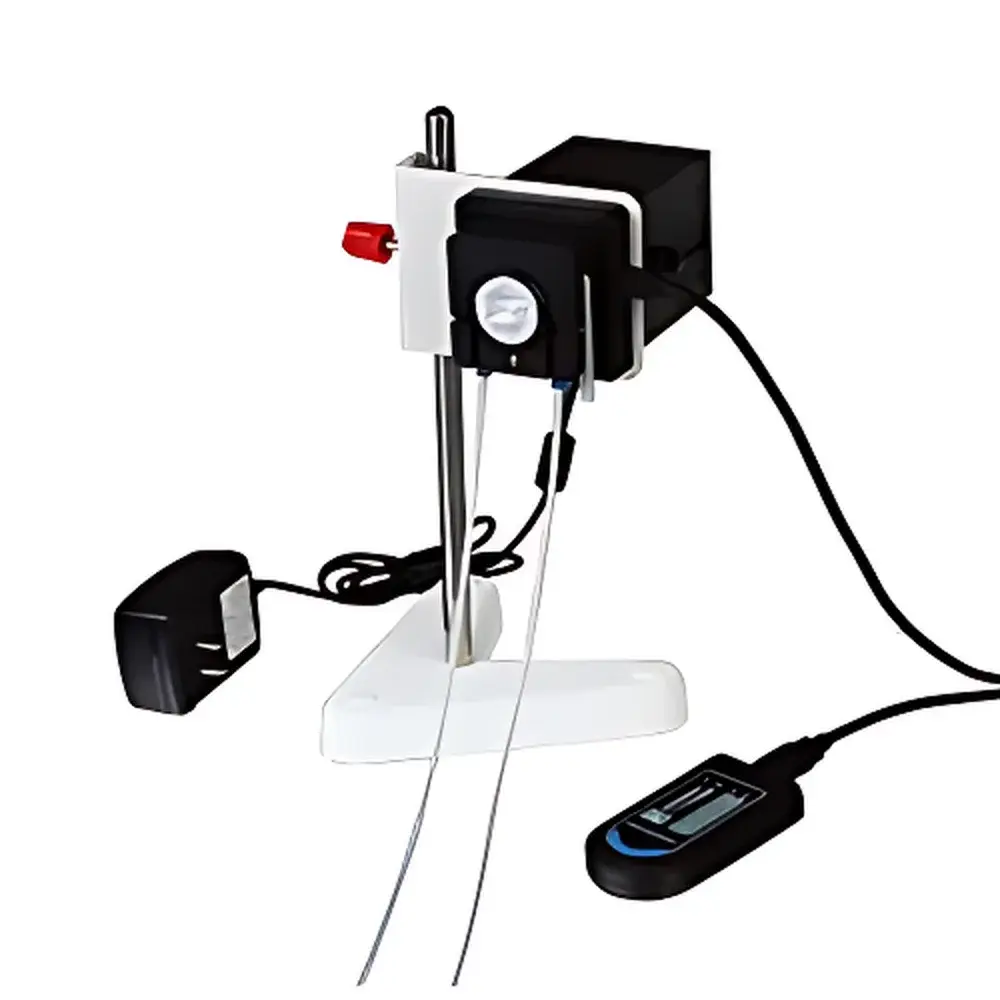
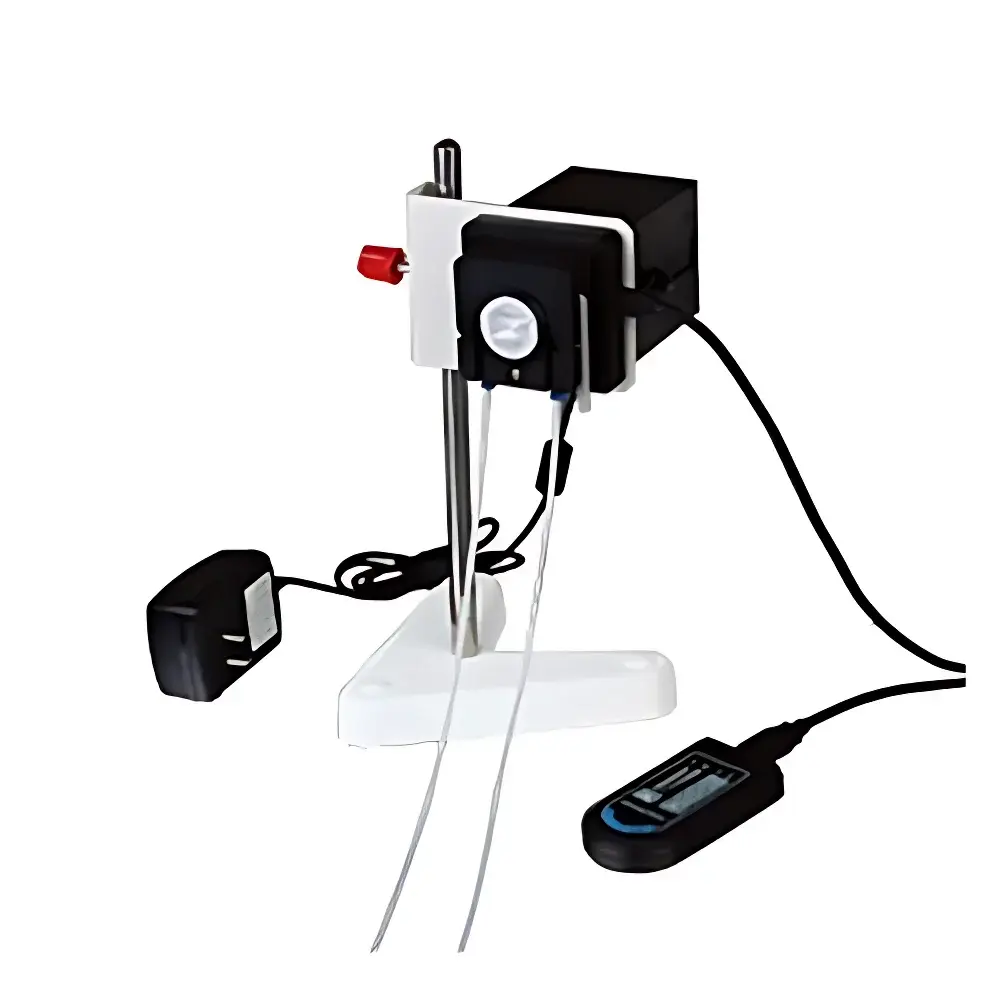
Longer BQ50-1J Micro-Flow Peristaltic Pump
| Brand | LongerPump |
|---|---|
| Origin | Hebei, China |
| Model | BQ50-1J |
| Flow Rate Range | 0.006–24 mL/min |
| Speed Range | 1–50.0 rpm |
| Control Interface | Handheld Controller, 4–20 mA / 0–5 V / 0–10 V / 0–10 kHz Analog Input, RS485 Serial Communication |
| Power Supply | DC 12 V / 10 W (Adapter: AC 90–260 V) |
| Dimensions (Driver + Pump Head) | 135 × 72 × 72 mm |
| Weight | 0.5 kg |
| IP Rating | IP31 |
| Compliance | CE-certified variants available (BQ50-1J-A/E/G/J) |
Overview
The Longer BQ50-1J is a compact, precision-engineered micro-flow peristaltic pump designed for low-volume fluid handling in analytical laboratories, OEM instrumentation, and microfluidic process integration. Based on the positive displacement principle of peristalsis—where rollers compress elastomeric tubing to generate unidirectional flow—the BQ50-1J delivers high repeatability and pulse-free delivery across its full operational range. Its ultra-low minimum flow rate of 0.006 mL/min enables precise dosing in applications such as reagent delivery for HPLC sample introduction, cell culture media perfusion, electrochemical sensor calibration, and micro-scale chemical synthesis. The pump’s modular architecture supports both embedded integration into custom equipment enclosures and benchtop mounting via optional brackets or V-mount bases, making it suitable for regulated environments where space, reliability, and controllability are critical.
Key Features
- Micro-flow capability with calibrated flow range of 0.006–24 mL/min, optimized for sub-milliliter dispensing accuracy
- Motor speed control from 1.0 to 50.0 rpm with 0.1 rpm resolution under analog or RS485 command—enabling fine-grained volumetric tuning
- Dual-directional rotation with programmable forward/reverse operation for bidirectional priming, backflushing, or recirculation protocols
- Integrated power management with non-volatile memory: retains last operating state (speed, direction, run status) after power interruption and resumes automatically on restart
- Front-panel handheld controller with LCD display and tactile membrane keys; supports real-time parameter adjustment without external software
- Flexible external control options including 4–20 mA, 0–5 V, 0–10 V, and 0–10 kHz analog signals, plus Modbus RTU over RS485 for system-level automation and SCADA integration
- Compact footprint (135 × 72 × 72 mm) and lightweight design (0.5 kg) facilitate installation in confined instrument cavities or portable analytical platforms
- IP31-rated enclosure provides protection against vertically falling drips and solid objects ≥2.5 mm—suitable for standard laboratory ambient conditions (0–40 °C, <80% RH)
Sample Compatibility & Compliance
The BQ50-1J accommodates a range of chemically resistant tubing materials—including silicone, POM, and PVDF—with inner diameters up to 3.17 mm and wall thicknesses between 0.8–1.0 mm. Pump head variants (WX10-14-A/B/C/D) are selected based on tubing compatibility and chemical exposure requirements; for example, PVDF-head configurations support aggressive solvents commonly used in pharmaceutical QC workflows. All CE-certified models (BQ50-1J-A/E/G/J) comply with EU Machinery Directive 2006/42/EC and EMC Directive 2014/30/EU. While not intrinsically rated for hazardous locations, the pump meets general safety requirements for Class I, Division 2 environments when installed per manufacturer guidelines. It supports GLP-compliant operation through deterministic start/stop behavior, audit-ready external control logging, and deterministic flow reproducibility traceable to rotational speed calibration.
Software & Data Management
No proprietary PC software is required for basic operation; however, the RS485 interface enables seamless integration with third-party control systems using standard Modbus RTU protocol (function codes 03h, 06h, 10h). Users may implement time-stamped flow event logging, multi-pump synchronization, and closed-loop feedback control (e.g., pairing with flow sensors for adaptive rate correction). The analog input channels accept industry-standard industrial signals, allowing direct interfacing with PLCs, DAQ modules, or PID controllers without signal conditioning. All control commands—including start/stop, direction toggle, speed setpoint, and full-speed activation—are digitally addressable and support error-checking mechanisms (CRC-16 for RS485), ensuring robust communication integrity in electrically noisy lab environments.
Applications
- Automated reagent dispensing in benchtop analyzers and point-of-care diagnostic platforms
- Continuous perfusion of 3D cell cultures and organ-on-chip systems requiring stable, low-shear flow
- Calibration fluid delivery in ion chromatography and capillary electrophoresis instruments
- Controlled additive injection in small-scale polymerization reactors and microreactors
- Waste aspiration and wash buffer circulation in automated ELISA and immunoassay workstations
- OEM integration into environmental monitoring sensors (e.g., nutrient analyzers, pH titrators) where long-term unattended operation is essential
FAQ
What tubing sizes are compatible with the BQ50-1J?
The pump supports tubing with inner diameters ≤3.17 mm and wall thicknesses of 0.8–1.0 mm. Specific pump head variants (e.g., WX10-14-A for POM, WX10-14-B for PVDF) must be matched to tubing material and chemical resistance requirements.
Does the BQ50-1J support FDA 21 CFR Part 11 compliance?
While the pump itself does not include electronic signature or audit trail functionality, its deterministic control behavior, repeatable flow output, and external command logging capabilities enable integration into Part 11–compliant systems when deployed with validated host software and procedural controls.
Can multiple BQ50-1J units be synchronized?
Yes—via RS485 daisy-chaining under Modbus RTU master-slave architecture, up to 32 units can share a single bus with individually addressed registers for coordinated start/stop and speed modulation.
Is the full-speed function programmable via external control?
Yes—the “full speed” mode (maximum 50 rpm) can be triggered via digital input signal or Modbus register write, enabling rapid fill/empty cycles without manual intervention.
What is the expected service life of the pump head rollers and tubing?
Roller lifespan exceeds 10,000 hours under continuous operation at nominal load; tubing life depends on material, pressure, and duty cycle—typical replacement intervals range from 100–500 hours for silicone tubing at 20 rpm, extendable with PVDF or fluorosilicone alternatives.



