
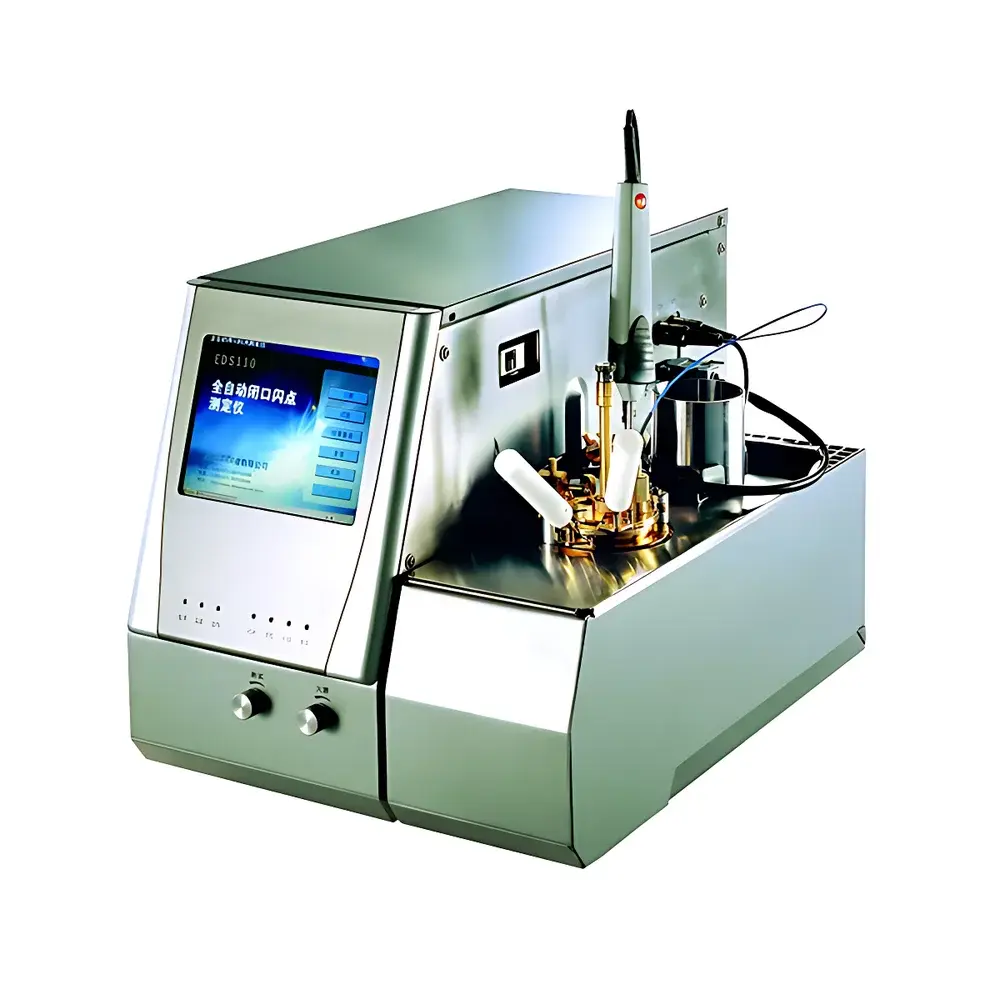
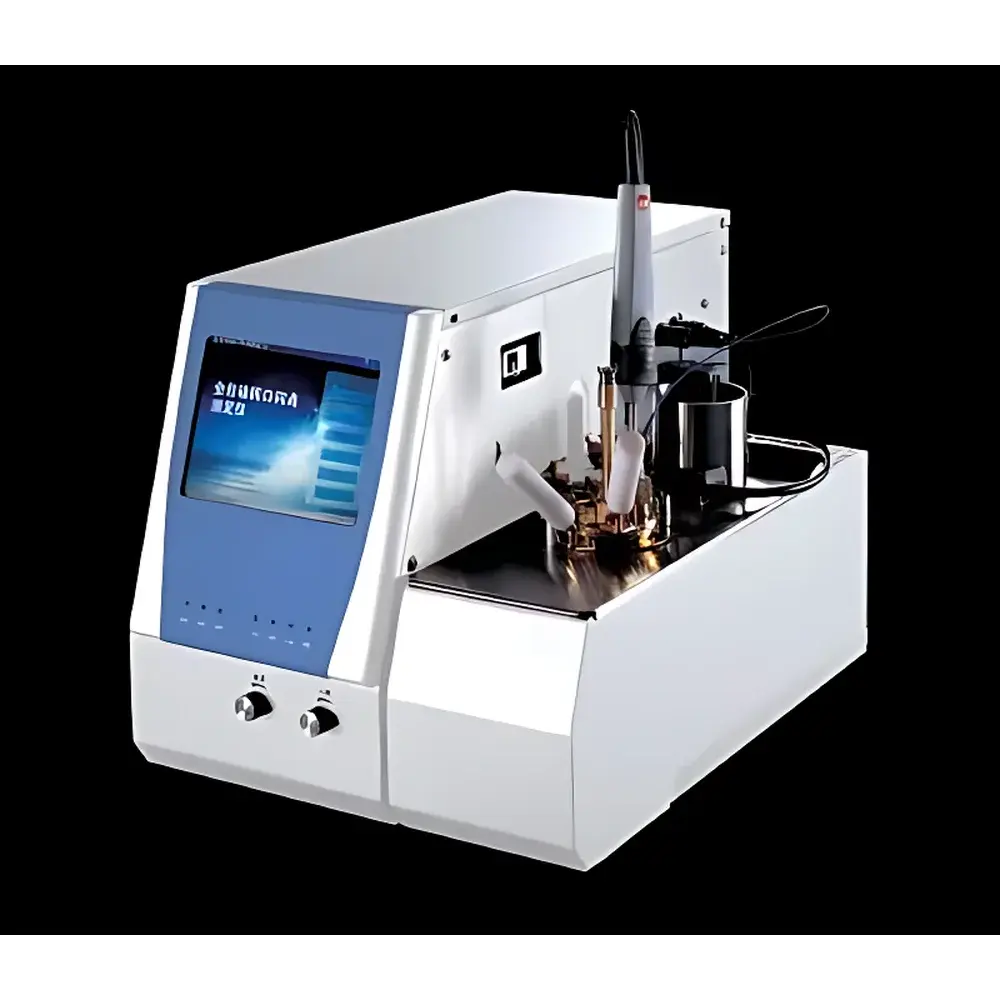
Karrie EFP110 Fully Automated Closed-Cup Flash Point Tester
| Brand | Karrie |
|---|---|
| Model | EFP110 |
| Detection Method | Closed-Cup (ASTM D93 / ISO 2719 / GB/T 261 compliant) |
| Temperature Range | Ambient to 370 °C |
| Safety Cut-off Temperatures | Pre-alarm at EFP+10 °C, Alarm & Continue at EFP+20 °C, Auto-Stop & Forced Cooling at 400 °C |
| Heating Power | 630 W |
| Total Power Consumption | 750 W |
| Display | 6.4″ Color TFT LCD (640×480), Touchscreen + Optional Mouse/Keyboard |
| Weight | 25 kg |
| Dimensions (L×W×H) | 478 × 319 × 322 mm |
| Operating Environment | 0–40 °C, Storage: −20–50 °C |
| Power Supply | AC 220 V, 50 Hz |
| Ignition Options | Electronic or Gas Flame |
| Temperature Sensor | Imported German Pt100 |
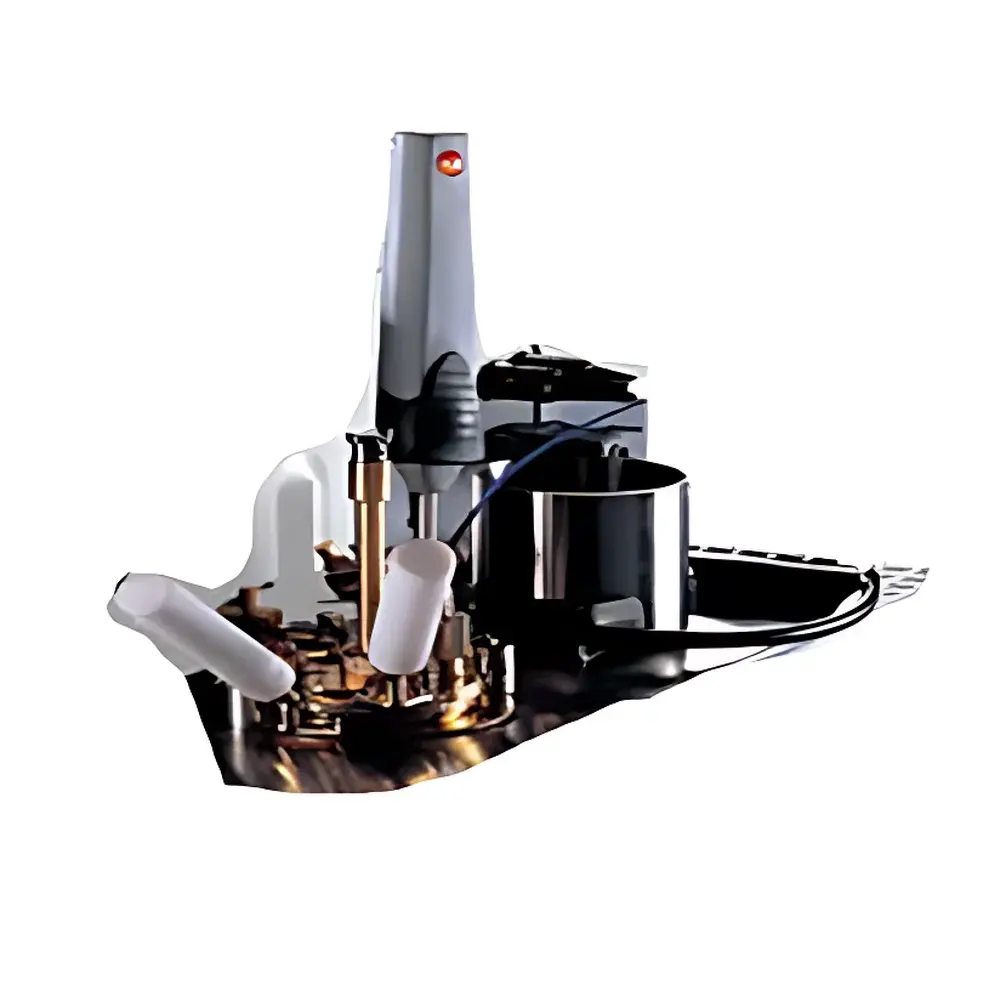
| Sample Cup | Gold-Plated Brass |
| Data Interfaces | RS-232, USB 2.0, RJ-45 (LAN), LPT (Parallel Printer) |
| OS | Windows CE 5.0 (Embedded, Isolated File System) |
| Storage Capacity | >10,000 Test Records with Time/Oil Sample/Operator Filtering |
Overview
The Karrie EFP110 Fully Automated Closed-Cup Flash Point Tester is an ASTM D93, ISO 2719, and GB/T 261–compliant instrument engineered for precise, repeatable flash point determination of petroleum products, lubricants, biodiesel blends, and other flammable liquids with initial boiling points above 40 °C. It operates on the Pensky-Martens closed-cup principle, where a sample is heated at a controlled rate in a sealed test cup, and ignition is applied at defined temperature intervals via either electronic spark or regulated gas flame. The flash point—the lowest temperature at which vapors above the liquid ignite momentarily upon exposure to an ignition source—is determined under strictly standardized thermal ramping profiles (1–1.6 °C/min for low-volatility samples; 5–6 °C/min for routine distillates). Designed for QC laboratories in refineries, petrochemical plants, and third-party testing facilities, the EFP110 delivers metrological integrity through traceable temperature control, dual-redundant sensor validation, and embedded hardware-level safety interlocks.
Key Features
- Dual-control architecture: A dedicated microcontroller manages real-time heating regulation and sensor signal acquisition (Pt100 oil temperature, flash detection), while a rugged industrial PC (256 MB RAM, 2 GB flash storage) handles system orchestration, data logging, and UI rendering—ensuring deterministic response and long-term stability.
- True-color 6.4″ TFT touchscreen interface with optional mouse and keyboard support, running Windows CE 5.0—an embedded, partitioned OS that eliminates vulnerability to desktop malware and ensures deterministic boot and runtime behavior.
- Two independent ignition modes: User-selectable electronic spark or propane-butane gas flame, both calibrated to deliver identical ignition energy per ASTM D93 Annex A1; no statistical deviation in flash point results between methods.
- Gold-plated brass test cup and lid assembly: Enhances thermal uniformity, resists oxidation up to 400 °C, and simplifies cleaning without compromising surface emissivity or cup geometry tolerance.
- Modular sensor design: Flash detector, Pt100 temperature probe, and cup lid mechanism are physically decoupled—enabling field-replaceable component service without system recalibration.
- Comprehensive self-diagnostic sequence at power-on: Validates flash sensor continuity, Pt100 resistance range, electronic igniter output, thermal fuse integrity, stirrer motor function, and heater relay status; faults trigger audible alert + on-screen diagnostic code (e.g., “Flash Sensor Open Circuit — Check Connector J3”).
- Multi-stage thermal safety protocol: Pre-alarm activation at EFP+10 °C, sustained audible/visual warning at EFP+20 °C, and automatic test termination plus forced-air cooling initiation at 400 °C—fully compliant with IEC 61010-1 safety requirements for laboratory equipment.
Sample Compatibility & Compliance
The EFP110 is validated for use with diesel fuel, jet fuel (Jet A/A-1), heating oil, transformer oil, hydraulic fluids, and base oils meeting ASTM D975, D1655, D396, D877, and D1124 specifications. It supports all six standard test programs defined in ASTM D93 Method A (manual mode), Method B (automated ramp), and Method C (low-flash variant), as well as user-defined protocols with configurable ramp rates, hold times, and ignition frequency. All measurements are automatically corrected for ambient barometric pressure (80–106 kPa range) using an integrated digital pressure sensor. Instrument compliance documentation includes factory calibration certificates traceable to NIM (China National Institute of Metrology) and optional UKAS-accredited verification reports. The system architecture supports GLP/GMP environments via audit-trail-enabled software (optional 21 CFR Part 11 add-on module available).
Software & Data Management
Data handling is performed via the embedded Windows CE application, supporting CSV export via USB, direct printing via LPT-connected laser printers, and network transmission via TCP/IP (RJ-45) to LIMS or enterprise QA databases. Test records store full metadata—including operator ID, sample ID, atmospheric pressure, observed flash temperature, ramp profile log (time-stamped every 5 seconds), ignition attempt count, and final pass/fail flag. Search functionality enables filtering by date range, sample batch number, or operator name; stored records exceed 10,000 entries with no performance degradation. Firmware updates are performed over USB without external tools; configuration backups can be saved to removable storage for disaster recovery.
Applications
- Refinery QC: Routine flash point verification of finished distillate fuels prior to pipeline transfer or marine bunkering.
- Lubricant manufacturing: Stability assessment of turbine oils and gear oils after thermal aging or additive depletion studies.
- Biodiesel quality control: Monitoring flash point drift during FAME (fatty acid methyl ester) oxidation or glycerin contamination events.
- Regulatory compliance testing: Generating auditable reports for EPA, CNPC, or Sinopec internal specifications requiring closed-cup flash data.
- Research laboratories: Screening novel bio-derived solvents or synthetic esters where flash behavior correlates with volatility and fire hazard classification (UN GHS Category 2/3).
FAQ
Is the EFP110 certified for use in hazardous locations (e.g., Class I Div 2)?
No—the instrument is rated for general laboratory use only (IEC 61010-1, Pollution Degree 2). It must be operated in ventilated, non-classified areas away from open solvent storage.
Can the instrument be integrated into a central LIMS using HL7 or ASTM E1384?
Yes—via its native TCP/IP stack and configurable ASCII-based data export format; middleware translation to HL7 or ASTM E1384 is supported through standard LIMS interface engines.
Does the gold-plated cup require special cleaning agents or polishing?
No—standard laboratory-grade acetone or isopropanol suffices; abrasive cleaners or metal polishes must be avoided to preserve plating integrity and dimensional accuracy.
What is the calibration interval recommendation per ISO/IEC 17025?
Annual verification against NIST-traceable reference standards (e.g., n-decane, n-dodecane) is recommended; interim checks using certified check standards every 30 operational days are advised for high-throughput labs.
Is remote firmware update possible over LAN?
Firmware updates require local USB connection for security isolation; however, configuration files and test logs may be uploaded/downloaded remotely via FTP or SMB protocols.






