
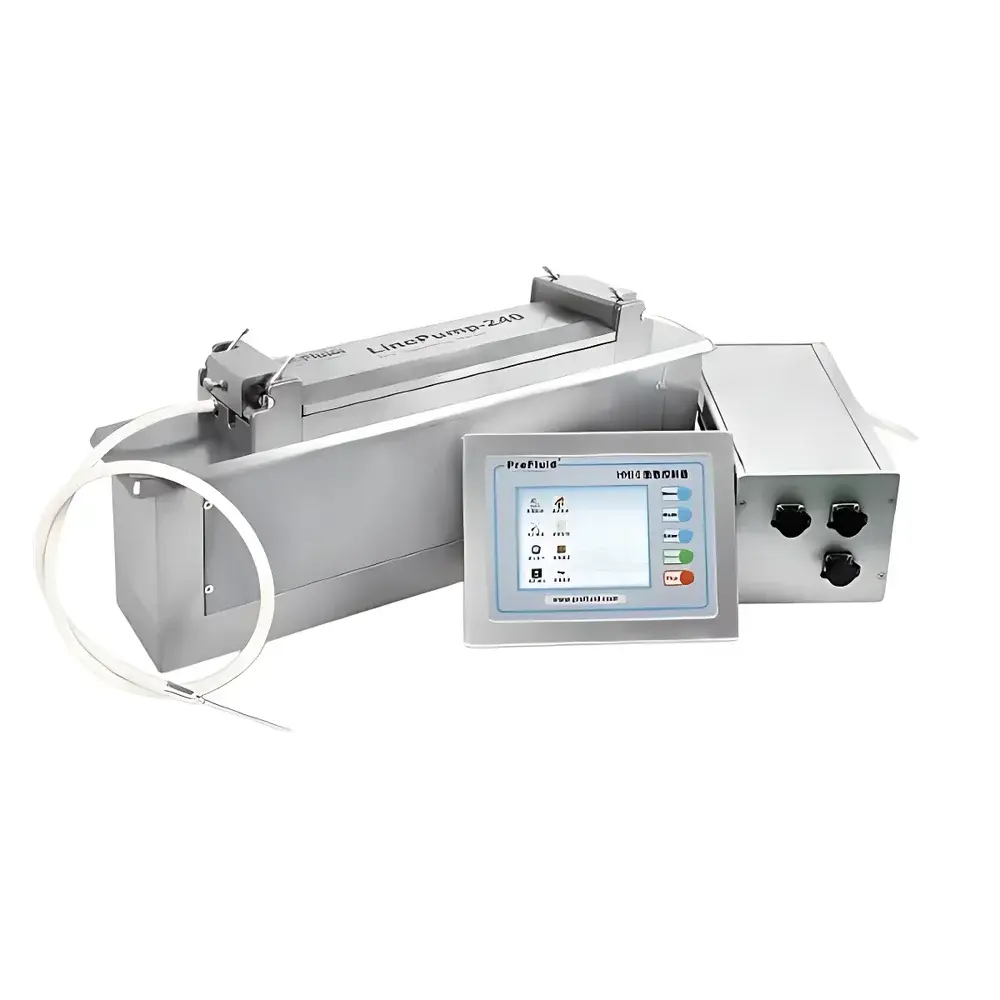
PreFluid LP240 Linear Peristaltic Pump
| Brand | PreFluid |
|---|---|
| Origin | Jiangsu, China |
| Manufacturer Type | Authorized Distributor |
| Country of Origin | China |
| Model | LP240 |
| Instrument Type | Linear Peristaltic Pump |
| Housing Material | Aerospace-Grade Aluminum Alloy |
| Drive Mechanism | Precision Linear Servo Motor with Linear Rail Guidance |
| Control Interface | 7-inch TFT Touchscreen HMI |
| Flow Control Features | Programmable Pre-Clamp/Post-Clamp, Aspirate-Back Function, Soft Start/Stop Ramp Profiles |
| Sterilization Compatibility | SIP (Steam-in-Place) and CIP (Clean-in-Place) Ready |
| Typical Tubing Life | ≥500 hours under continuous operation at rated flow |
| Accuracy | ≤±0.5% volumetric repeatability (per ISO 8599 and ASTM D1298 reference protocols) |
| Shear Sensitivity | Low-shear, low-pulsation delivery suitable for shear-sensitive biologics (e.g., mAbs, viral vectors, cell suspensions) |
| Regulatory Alignment | Designed to support GMP-compliant environments |
Overview
The PreFluid LP240 Linear Peristaltic Pump is an engineered solution for high-precision, low-shear fluid handling in regulated life science and pharmaceutical manufacturing environments. Unlike conventional rotary peristaltic pumps that rely on rotating rollers or shoes to compress tubing circumferentially, the LP240 implements a linear actuation principle: a precisely guided servo-driven carriage applies uniform axial compression along a straight segment of tubing. This eliminates torsional stress, reduces cyclic fatigue, and extends tubing service life—critical for applications requiring extended run times and repeatable volumetric dispensing. The pump’s core architecture supports sterile process integration, including full compatibility with steam-in-place (SIP) cycles up to 135 °C and clean-in-place (CIP) protocols using caustic or acidic solutions. Its aluminum alloy chassis provides structural rigidity, thermal stability, and corrosion resistance—essential for cleanroom deployment and washdown environments.
Key Features
- Linear compression mechanism minimizes tubing deformation and wear—achieving ≥500 hours of operational life with platinum-cured silicone tubing under nominal load conditions.
- 7-inch industrial-grade touchscreen HMI enables intuitive programming of dispensing volume, speed ramp profiles (soft start/stop), pre-clamp delay, post-dispense aspirate-back, and real-time flow monitoring.
- Modular control architecture supports daisy-chained multi-pump synchronization via RS-485 Modbus RTU or optional EtherNet/IP interface—enabling coordinated operation in automated fill-finish lines.
- Aerospace-grade aluminum housing meets ISO 14644-1 Class 5–7 cleanroom compatibility requirements and resists degradation during repeated SIP/CIP exposure.
- Volumetric accuracy of ≤±0.5% (measured per ISO 8599 Annex B using gravimetric verification at 1–10 mL dispense volumes) ensures compliance with USP Analytical Instrument Qualification standards.
- Low-pulsation output (<2% peak-to-peak amplitude measured at 100 rpm equivalent flow rate) preserves integrity of fragile biologics, including exosomes, primary cells, and protein therapeutics.
Sample Compatibility & Compliance
The LP240 is compatible with a broad range of USP Class VI-certified elastomeric tubing—including platinum-cured silicone (e.g., Saint-Gobain Pharmed® BPT, Cole-Parmer Masterflex® L/S®), fluoropolymer-reinforced silicone, and thermoplastic elastomers—selected based on chemical resistance, extractables profile, and sterilization endurance. Tubing inner diameters from 1.6 mm to 9.6 mm are supported, enabling dispensing ranges from 0.1 mL to 10 mL per stroke with calibrated repeatability. The system adheres to ISO 13485:2016 design controls for medical device accessories and incorporates mechanical safeguards aligned with IEC 61000-6-2 (EMC immunity) and IEC 61000-6-4 (EMC emissions). When deployed within validated manufacturing execution systems (MES), the LP240 supports 21 CFR Part 11 compliance through configurable audit trails, electronic signature workflows, and data integrity logging.
Software & Data Management
The embedded firmware supports CSV export of batch logs—including timestamped dispense events, motor position feedback, clamp status, and error codes—via USB or network interface. Optional integration with LabVantage LIMS or Siemens Desigo CC allows traceable linkage between pump operations and electronic batch records (EBRs). All parameter changes are recorded with user ID, timestamp, and reason-for-change fields—satisfying ALCOA+ principles (Attributable, Legible, Contemporaneous, Original, Accurate, Complete, Consistent, Enduring, Available). Firmware updates follow a controlled change management process compliant with ICH Q9 Quality Risk Management guidelines.
Applications
- Pharmaceutical aseptic filling of vials, syringes, and cartridges containing monoclonal antibodies, vaccines, and gene therapy vectors.
- In-process sampling and reagent delivery in bioreactor and purification skid systems operating under GMP conditions.
- Automated media preparation and buffer exchange in upstream and downstream bioprocessing workflows.
- Precision dosing in diagnostic assay development, including ELISA plate filling and lateral flow strip loading.
- Controlled nutrient delivery in perfusion-based cell culture platforms and organ-on-chip microfluidic systems.
FAQ
What tubing sizes are validated for use with the LP240?
The LP240 has been verified with seven standard inner diameter configurations: 1.6×2.4 mm, 2.4×2.4 mm, 3.1×2.4 mm, 4.8×2.4 mm, 6.4×2.4 mm, 7.9×2.4 mm, and 9.6×2.4 mm—each matched to specific volumetric targets from 0.1 mL to 10 mL.
Can the LP240 be integrated into a PLC-controlled production line?
Yes—the pump supports Modbus RTU over RS-485 as standard, with optional EtherNet/IP or PROFINET modules available for seamless integration into Rockwell Automation, Siemens S7, or Beckhoff control architectures.
Is the LP240 suitable for sterile filtration inline applications?
While the LP240 itself is not a filter, its low-shear, pulse-free output makes it ideal for post-filtration metering where maintaining particle integrity and minimizing bubble generation are critical—commonly deployed upstream of 0.22 µm sterilizing-grade filters.
Does the system include validation documentation?
PreFluid provides Factory Acceptance Test (FAT) reports, IQ/OQ protocol templates, and a Design Qualification (DQ) summary aligned with GAMP 5 guidance—supporting customer-led validation under ISO 13485 or EU Annex 11 frameworks.



