
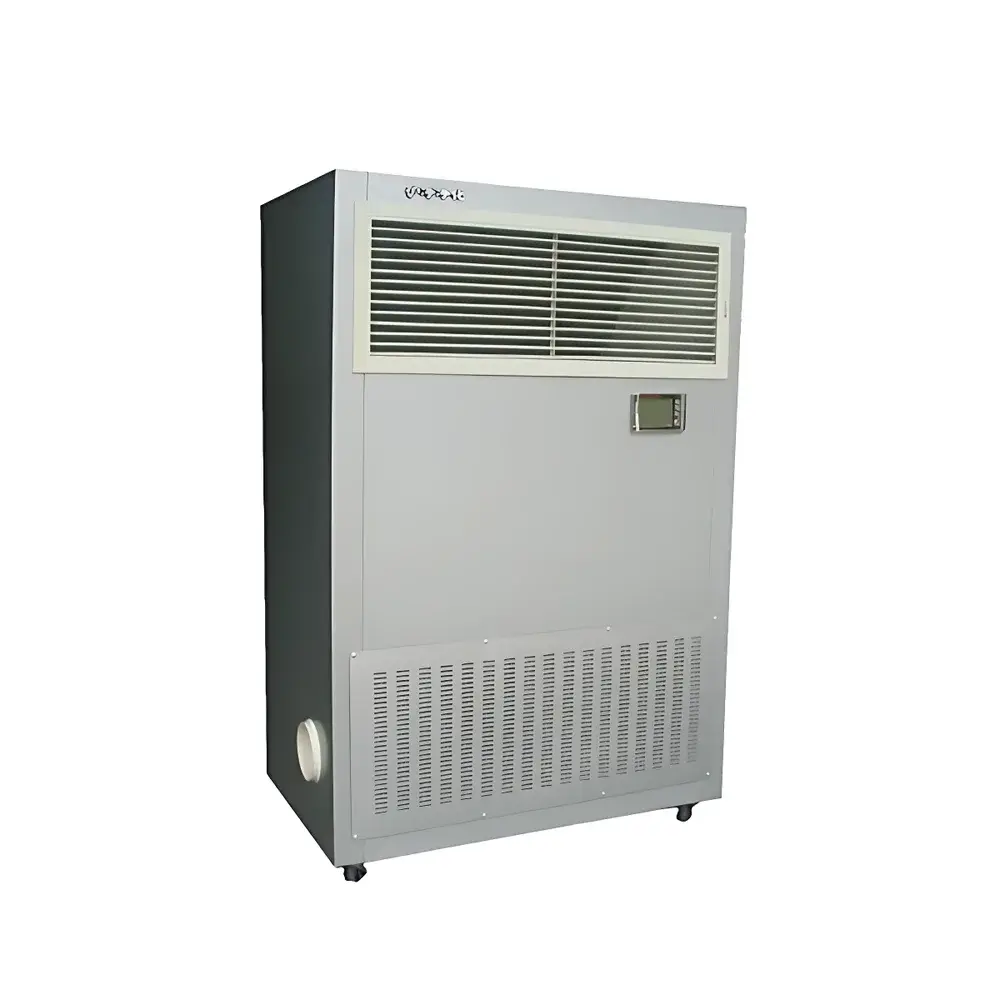
HJ PAU-1000 Mobile Air Self-Cleaning Unit
| Brand | HJ |
|---|---|
| Origin | Shanghai, China |
| Manufacturer Type | Direct Manufacturer |
| Country of Origin | China |
| Model | PAU-1000 |
| Price | USD 570 (approx. based on ¥4000 @ 1 USD = ¥7.0) |
| Filtration Efficiency | ≥99.97% @ ≥0.5 µm |
| Airflow | 1000 m³/h (adjustable) |
| Noise Level | ≤62 dB(A) |
| Average Face Velocity | 1.5–2.0 m/s (adjustable) |
| Power Supply | AC 220 V / 50 Hz |
| Power Consumption | 200 W |
| Net Weight | <1000 kg |
| Dimensions (W×D×H) | 850 × 550 × 1330 mm |
| HEPA Filter Size & Quantity | 760 × 610 × 38 mm × 1 |
Overview
The HJ PAU-1000 Mobile Air Self-Cleaning Unit is an engineered local air purification system designed to establish and maintain controlled particulate environments in non-ducted or dynamically reconfigurable laboratory and production spaces. It operates on the principle of unidirectional airflow filtration: ambient air is drawn in through a pre-filter, accelerated by a variable-speed centrifugal fan, and then passed through a certified high-efficiency particulate air (HEPA) filter (class H14 per EN 1822-1:2019, ≥99.97% efficiency at 0.5 µm), delivering laminar, low-turbulence airflow toward the work surface. Unlike fixed cleanroom infrastructure, the PAU-1000 functions as a self-contained, portable clean air module—requiring no structural integration, ductwork, or ceiling suspension. Its design targets ISO Class 7 (10,000) to ISO Class 8 (100,000) environments, with localized performance achieving ISO Class 6 (1,000) at the outlet and sustained ISO Class 7 conditions across the working plane (≤10,000 particles ≥0.5 µm per cubic foot). This makes it suitable for applications where spatial flexibility, rapid deployment, and cost-effective compliance are critical.
Key Features
- Modular mobility: Equipped with heavy-duty swivel casters and adjustable leveling jacks for precise positioning and stable operation on uneven floors.
- Variable airflow control: Multi-step fan speed selector enables real-time adjustment of face velocity (1.5–2.0 m/s) to match procedural requirements and room dynamics.
- Integrated HEPA filtration: Single 760 × 610 × 38 mm H14-grade filter with validated retention efficiency ≥99.97% at 0.5 µm particle size—certified per EN 1822 and compatible with integrity testing (e.g., DOP/PAO scanning).
- Rugged enclosure: Cold-rolled color-coated steel housing with baked enamel finish; corrosion-resistant, static-dissipative, and compliant with UL 61010-1 electrical safety standards.
- Low operational footprint: 200 W nominal power draw, noise emission ≤62 dB(A) at 1 m—suitable for shared lab corridors and QC laboratories without acoustic isolation.
- Scalable configuration: Units may operate independently or be arranged in linear or L-shaped arrays to extend laminar coverage—no inter-unit synchronization required.
Sample Compatibility & Compliance
The PAU-1000 does not process samples directly but provides a validated air environment for sample handling, preparation, and packaging operations. It supports workflows requiring particulate control per ISO 14644-1:2015 (Cleanrooms and associated controlled environments), particularly in settings where full cleanroom certification is impractical. Its filtration performance aligns with FDA Guidance for Industry: Sterile Drug Products Produced by Aseptic Processing (2004) for background environmental control in Grade C/D areas. The unit’s construction materials meet USP and requirements for non-shedding, non-porous surfaces. While not intrinsically rated for hazardous location use (e.g., Class I Div 2), its electrical architecture conforms to IEC 61000-6-3 (EMC emission limits) and CE marking directives for equipment placed on the EU market.
Software & Data Management
The PAU-1000 is a hardware-only, analog-controlled device with no embedded microprocessor, firmware, or digital interface. Fan speed selection is performed manually via a rotary switch; no data logging, remote monitoring, or audit trail functionality is provided. As such, it requires external documentation for operational qualification (OQ) and periodic maintenance records—consistent with GLP and GMP Annex 15 expectations for non-automated utilities. Users are advised to implement manual logbooks tracking filter replacement dates (recommended every 12–18 months under continuous operation), pre-filter cleaning intervals, and face velocity verification (per ISO 14644-3:2019 Annex B) using calibrated anemometry.
Applications
- Microbiological sampling prep in food & beverage QA labs (e.g., ready-to-eat product swabbing, media pouring).
- Non-sterile pharmaceutical compounding zones requiring ISO Class 7 air quality (USP ).
- Water quality testing stations in purified water distribution loop monitoring points.
- Small-scale aseptic filling buffers in dairy or juice bottling lines during line clearance verification.
- Field-deployable clean air support for mobile analytical labs conducting on-site environmental microbiology.
- Supplemental protection in ISO Class 8 cleanrooms during maintenance or temporary capacity expansion.
FAQ
Does the PAU-1000 meet FDA or EU GMP requirements for clean air devices?
Yes—when deployed within defined environmental classifications (e.g., background ISO Class 8 supporting ISO Class 7 work zones), it satisfies baseline air quality expectations outlined in EU GMP Annex 1 (2022) and FDA Aseptic Processing Guidance, provided users perform and document routine filter integrity testing and velocity mapping.
Can the unit be integrated into a Building Management System (BMS)?
No—the PAU-1000 has no analog/digital output signals, Modbus interface, or network connectivity. Integration requires external relay-based control or standalone operation.
What is the recommended interval for HEPA filter replacement?
Under continuous 24/7 operation in typical laboratory particulate load, replace the HEPA filter every 12–18 months; extend to 24 months in low-dust environments. Always verify pressure drop across the filter (≥250 Pa indicates end-of-life) prior to scheduled change.
Is the unit suitable for use in explosive atmospheres?
No—it is not certified for Class I, II, or III hazardous locations and must not be operated in environments with flammable vapors, combustible dusts, or ignitable fibers.
Does the PAU-1000 include validation documentation?
The unit ships with a Factory Acceptance Test (FAT) report confirming airflow, noise, and electrical safety. Site-specific IQ/OQ documentation must be generated by the end user per ISO 14644-4 and GAMP 5 principles.



