
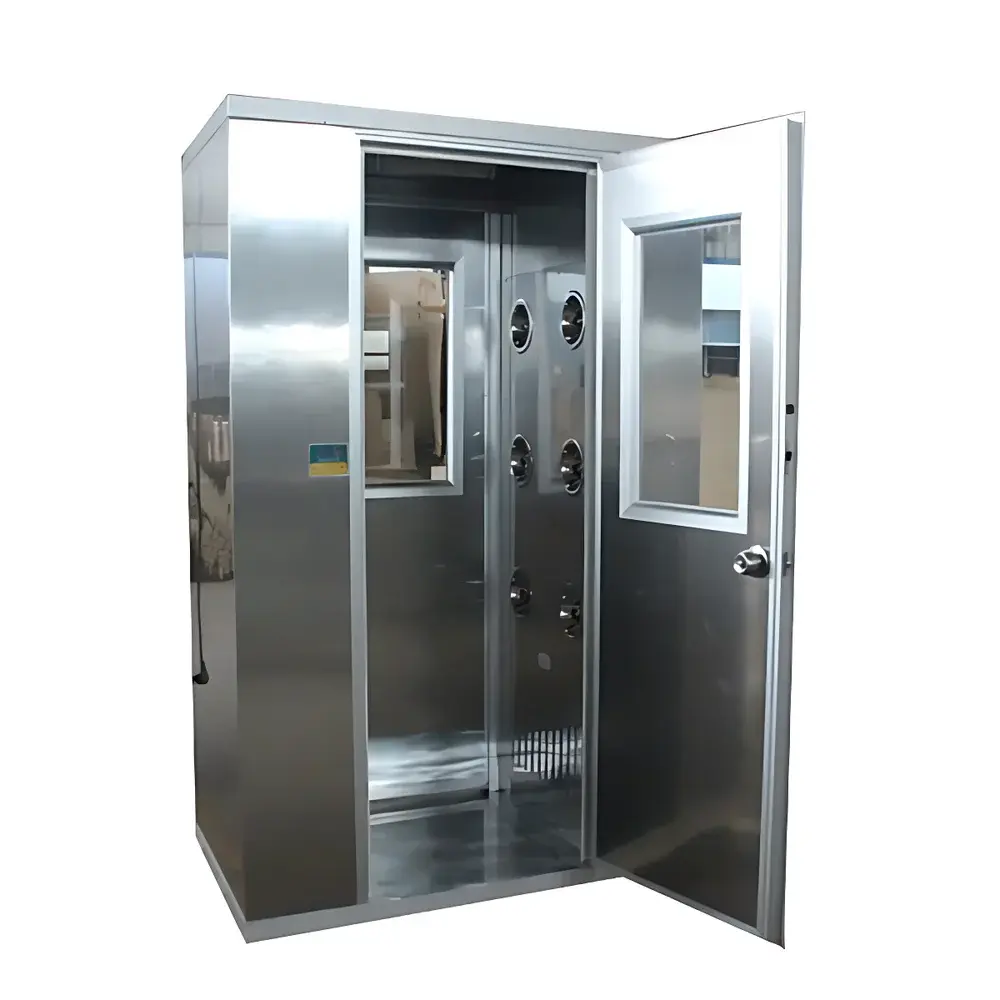
HJ FLB-1C Dual-Person Single-Door Air Shower
| Brand | HJ Purification |
|---|---|
| Origin | Shanghai, China |
| Manufacturer Type | Direct Manufacturer |
| Country of Origin | China |
| Model | FLB-1C |
| Price | USD 980 (FOB Shanghai) |
| Filter Efficiency | ≥99.7% @ ≥0.5 µm (Sodium Flame Test) |
| Adjustable Air Shower Duration | 0–60 s |
| Nozzle Count | 9 |
| Nozzle Diameter | Φ30 mm |
| Nozzle Material | Stainless Steel |
| Air Velocity at Nozzle Exit | 15–20 m/s |
| Power Supply | AC 220 V, 50 Hz |
| Max. Power Consumption | 800 W |
| Personnel Capacity | 2 persons (single-side blow) |
| Internal Chamber Dimensions (W×D×H) | 700 × 1150 × 1900 mm |
| External Dimensions (W×D×H) | 1050 × 1200 × 2050 mm |
Overview
The HJ FLB-1C Dual-Person Single-Door Air Shower is an entry-level, CE-compliant personnel air shower system engineered for controlled environments requiring ISO Class 5–8 (Class 100–100,000) cleanroom integrity. Installed at the interface between non-classified and classified zones, it serves as a critical first-line particulate control barrier—removing loose particles from clothing, footwear, and surface contaminants carried by personnel before entry into sensitive manufacturing, pharmaceutical compounding, or microelectronics assembly areas. Its operation follows the principle of high-velocity, HEPA-filtered laminar airflow directed tangentially across the human form to dislodge and evacuate airborne and adherent particulates >0.5 µm. The unit employs a dual-fan, dual-filter configuration with prefilter + main HEPA filter (H13 grade per EN 1822), ensuring sustained filtration performance and compliance with ISO 14644-1 airflow uniformity requirements for localized air showers.
Key Features
- Compact footprint (1050 × 1200 × 2050 mm external) enables integration into constrained corridor spaces without compromising structural rigidity or acoustic isolation.
- Intelligent interlocked door logic: outer door opening automatically initiates fan activation and initiates the air shower cycle; inner door remains mechanically inhibited until cycle completion.
- Precisely adjustable shower duration (0–60 seconds) via digital timer with LED display—calibrated and traceable to internal quartz oscillator for repeatable process validation.
- Nine stainless-steel nozzles (Φ30 mm) arranged in staggered vertical/horizontal arrays ensure uniform coverage across two standing operators with minimal dead zones.
- Robust 800 W total power budget supports continuous duty cycling under ambient temperatures up to 35 °C and relative humidity ≤80% RH (non-condensing).
- Integrated pressure differential monitoring (optional upgrade) allows real-time verification of ≥10 Pa positive pressure offset between chamber and adjacent cleanroom—meeting ISO 14644-3 Annex B recommendations.
Sample Compatibility & Compliance
The FLB-1C is designed exclusively for personnel decontamination—not for cart, tote, or equipment pass-through. It accommodates individuals wearing standard cleanroom garments (e.g., bouffant caps, coveralls, booties) and supports GMP-aligned gowning protocols. All materials comply with UL 94 V-0 flame-retardant standards for electrical enclosures and meet RoHS Directive 2011/65/EU restrictions on hazardous substances. Filter media is certified per EN 1822-3:2019 for H13 classification (≥99.95% efficiency at MPPS ~0.12–0.25 µm). The unit conforms to IEC 60335-1 safety requirements for household and similar electrical appliances and includes IP54-rated motor housings for dust and splash resistance. Documentation package includes Factory Acceptance Test (FAT) report, filter certificate of conformance, and electrical safety test records—supporting FDA 21 CFR Part 11 readiness when paired with optional audit-trail-capable PLC controllers.
Software & Data Management
The FLB-1C operates via embedded microcontroller firmware (no external PC dependency). Cycle logs—including date/time stamp, duration setting, door open/close events, and fan runtime—are stored internally for ≥10,000 cycles and exportable via RS-485 Modbus RTU to SCADA or MES platforms (e.g., Siemens Desigo, Rockwell FactoryTalk). Optional firmware upgrade adds password-protected parameter lockout, electronic signature capability for SOP adherence, and CSV-formatted log export compatible with 21 CFR Part 11 audit trail requirements. All firmware revisions undergo version-controlled release testing per ISO/IEC 17025-accredited procedures.
Applications
- Pharmaceutical aseptic processing suites (ISO 5 buffer rooms and anterooms)
- Biotechnology cell culture preparation labs requiring low bioburden ingress control
- Semiconductor front-end packaging cleanrooms (Class 1000–10,000) for wafer handling staging
- Medical device Class II/III assembly lines subject to ISO 13485:2016 environmental controls
- Research laboratories performing nanomaterial synthesis where operator-derived particle shedding exceeds ambient background
FAQ
Is the FLB-1C suitable for use in sterile manufacturing environments?
Yes—when installed with validated HEPA filters, maintained per ISO 14644-3, and integrated into a documented gowning procedure, it meets EU GMP Annex 1 (2022) Section 4.35 requirements for personnel airlocks.
Can the unit be upgraded to support dual-side (360°) blow configuration?
No—the FLB-1C is structurally optimized for single-side airflow. For full-perimeter coverage, consider the FLB-1200 or FLB-2400 series models.
What maintenance intervals are recommended for filter replacement?
Prefilters: every 3 months under continuous 8-hr/day operation; HEPA filters: every 12–18 months or after 10,000 operational hours—whichever occurs first—as verified by upstream/downstream particle counters per ISO 14644-3 Annex D.
Does the unit include validation documentation for IQ/OQ protocols?
Standard delivery includes FAT report and filter CoA. Full IQ/OQ protocol templates and execution services are available as a separate engineering service engagement.
Is remote monitoring via Ethernet or Wi-Fi supported?
Not natively—but RS-485 Modbus output enables seamless integration with building management systems (BMS) or centralized cleanroom monitoring platforms using industry-standard gateways.



