
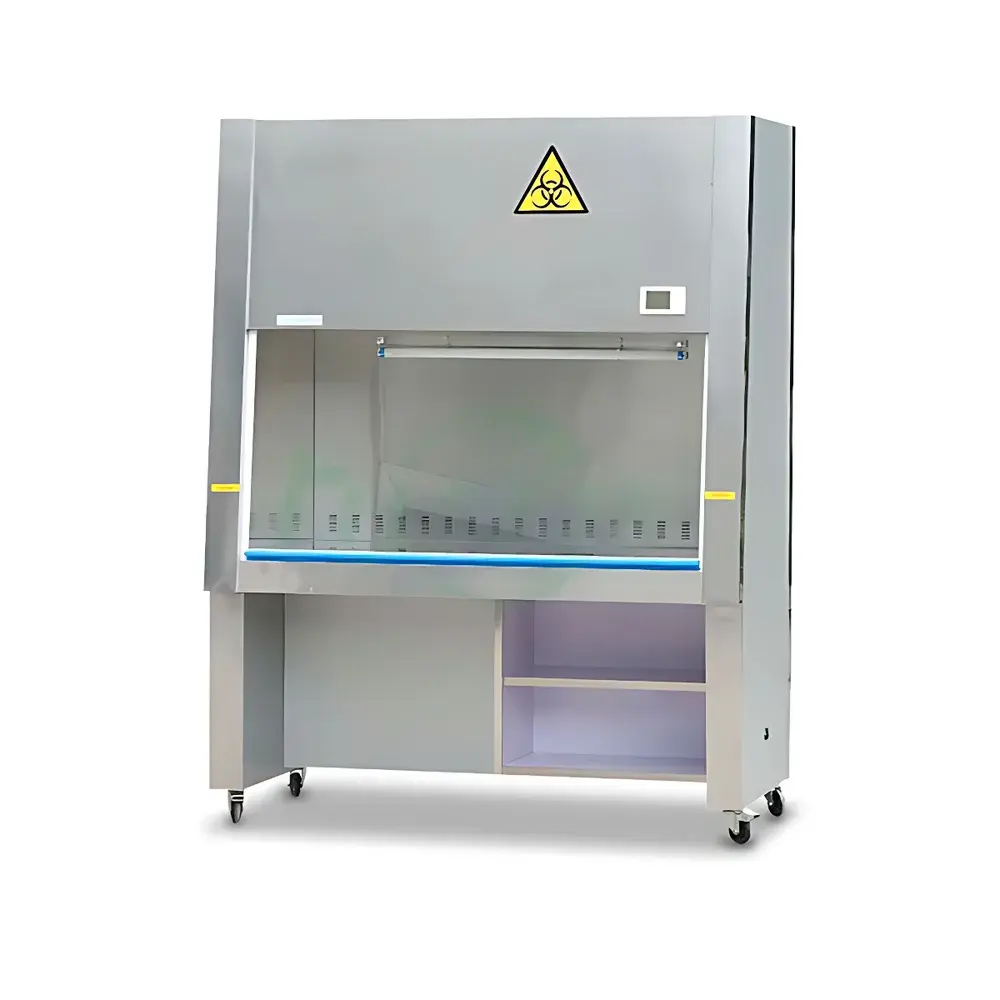
HJ BSC-1600IIB2 Class II Type B2 Full-Exhaust Biological Safety Cabinet
| Brand | HJ |
|---|---|
| Origin | Shanghai, China |
| Manufacturer Type | Direct Manufacturer |
| Model | BSC-1600IIB2 |
| External Dimensions (L×W×H) | 1200×750×1950 mm |
| Internal Work Area Dimensions (L×W×H) | 1000×650×580 mm |
| Filter Capture Efficiency | ≥99.999% @ 0.3 µm (HEPA H14 per EN 1822) |
| Average Inflow Velocity | 0.55 ± 0.025 m/s |
| Downflow Velocity (Center) | 0.26 ± 0.025 m/s |
| Downflow Velocity (Rear) | 0.27 ± 0.025 m/s |
| Downflow Velocity (Front) | 0.38 ± 0.025 m/s |
| Noise Level | ≤62 dB(A) |
| Vibration Peak-to-Peak | ≤6 µm |
| Power Supply | AC 220 V, 50 Hz |
| Max. Power Consumption | 1000 W |
| Net Weight | 250 kg |
| Lighting | 30 W LED Fluorescent Lamp ×1 |
| UV Lamp | 30 W ×1 |
| Work Surface Material | 304 Stainless Steel |
| Compliance | NSF/ANSI 49-2022, GB 50346-2011, ISO 14644-1 Class 5 (ISO Class 5 equivalent to Fed Std 209E Class 100) |
Overview
The HJ BSC-1600IIB2 is a certified Class II, Type B2 full-exhaust biological safety cabinet engineered for maximum personnel, product, and environmental protection in high-risk microbiological, molecular biology, and pharmaceutical applications. Unlike recirculating or partially recirculating cabinets, the B2 configuration ensures 100% of the air drawn into the work area is exhausted externally via a dedicated ducted system—eliminating any internal recirculation and preventing cross-contamination between samples and operators. Its aerodynamic design employs a unidirectional downward laminar flow (0.26–0.38 m/s) across the work surface, combined with a robust inward inflow velocity (0.55 m/s at the sash opening), maintaining strict containment under dynamic operational conditions. The cabinet meets the stringent performance and safety requirements of NSF/ANSI 49-2022, the globally recognized benchmark for biological safety cabinet certification, and complies with Chinese national standard GB 50346-2011 for biosafety laboratories. It operates within ISO 14644-1 Class 5 cleanroom conditions (equivalent to Fed Std 209E Class 100), ensuring particulate concentration ≤3,520 particles/m³ for ≥0.5 µm particles—critical for sterile cell culture, recombinant DNA work, and handling of Risk Group 2–3 agents.
Key Features
- True Type B2 full-exhaust architecture with zero air recirculation—100% of intake air is expelled through an external exhaust system after passing through dual-stage filtration (pre-filter + H14 HEPA).
- Motorized or manual vertical sliding sash with adjustable positioning and mechanical height-limiting mechanism; integrated sash position sensor triggers audible/visual alarm if opened beyond safe operating range.
- 10° ergonomic work surface tilt minimizes operator fatigue during extended procedures while optimizing airflow integrity and splash containment.
- Electropolished 304 stainless steel work surface and interior chamber—weld-free, seamless construction with radiused corners for complete decontamination via liquid disinfectants or vaporized hydrogen peroxide (VHP).
- Dual independent alarm system: real-time monitoring of HEPA filter pressure drop (indicating filter saturation or breach) and inward airflow velocity deviation (±10% threshold); both trigger local LED alerts and relay outputs for building management integration.
- Integrated LED control panel with intuitive icon-based interface, displaying real-time airflow velocity, UV lamp status, filter life estimation, and fault diagnostics.
- Dedicated utility services: two GFCI-protected 30 VAC/10 A power outlets (IPX4-rated), one drain port with sealed valve, and optional gas inlet ports for inert atmosphere purging.
Sample Compatibility & Compliance
The BSC-1600IIB2 supports a broad spectrum of biosafety-critical workflows—including human primary cell isolation, lentiviral vector production, mycobacterial culture, and cytotoxic drug compounding—where simultaneous protection of operator, sample, and environment is non-negotiable. Its full-exhaust configuration eliminates risk of solvent vapor accumulation, making it suitable for use with low-flashpoint reagents when connected to a properly balanced exhaust system. All structural materials comply with ISO 10993-5 (cytotoxicity) and ISO 10993-10 (irritation/sensitization) biocompatibility standards. Certification documentation includes third-party test reports for containment (KI-Discus smoke visualization), airflow uniformity (ISO 14644-3 Annex B), and filter integrity (EN 1822-5 DOP/PAO scanning). Validated for GLP and GMP environments, it supports 21 CFR Part 11-compliant data logging when paired with optional audit-trail-enabled controllers.
Software & Data Management
While the base model features a microprocessor-based embedded controller with non-volatile memory for event logging (sash position history, alarm timestamps, runtime hours), optional firmware upgrades enable RS-485 Modbus RTU or Ethernet TCP/IP connectivity. This permits integration into centralized laboratory infrastructure management systems (LIMS/LabVantage) for automated calibration tracking, preventive maintenance scheduling, and electronic record retention aligned with FDA 21 CFR Part 11 requirements. All logged parameters—including inflow/downflow velocities, filter differential pressure, UV exposure time, and door status—are timestamped, user-ID tagged, and cryptographically signed to ensure data integrity and audit readiness.
Applications
- Containment of infectious agents classified under WHO Risk Group 2 and 3 (e.g., Salmonella, Mycobacterium tuberculosis, SARS-CoV-2 in diagnostic settings).
- Aseptic processing of stem cells, hybridomas, and therapeutic monoclonal antibodies under ISO Class 5 conditions.
- Handling of open radioactive isotopes (e.g., 32P, 125I) when used with appropriate shielding and exhaust scrubbing.
- Preparation of cytotoxic chemotherapy agents compliant with USP and standards.
- Genetic engineering workflows involving CRISPR-Cas9 ribonucleoprotein complexes where aerosolized nucleic acid contamination must be prevented.
FAQ
Does the BSC-1600IIB2 require external ductwork?
Yes. As a Type B2 cabinet, it must be hard-ducted to a dedicated exhaust system capable of sustaining a minimum static pressure loss of −150 Pa at rated airflow. Rooftop fans or variable-air-volume (VAV) exhaust interfaces are recommended.
Can this cabinet be installed in a room without a dedicated exhaust system?
No. Installation without compliant external exhaust violates NSF/ANSI 49-2022 and voids certification. Recirculation is physically impossible due to its sealed plenum and zero-recirculation design.
What is the expected service life of the H14 HEPA filter under typical usage?
Under continuous operation (8 h/day, 5 days/week) with standard lab particulate loading, the filter typically remains effective for 5–7 years. Filter replacement intervals must be validated per site-specific challenge testing and documented in the facility’s biosafety management plan.
Is UV irradiation sufficient for decontaminating the interior before filter replacement?
No. UV-C exposure alone does not replace chemical decontamination. Prior to maintenance, the cabinet must undergo validated sporicidal treatment (e.g., 2% glutaraldehyde or vaporized hydrogen peroxide) with biological indicator verification per ISO 14644-3 Annex C.
Does the unit support remote monitoring via network protocols?
Yes—via optional firmware upgrade supporting Modbus TCP or HTTP RESTful API endpoints for real-time parameter retrieval and alarm notification via SNMP traps or email alerts.
Related Products



