
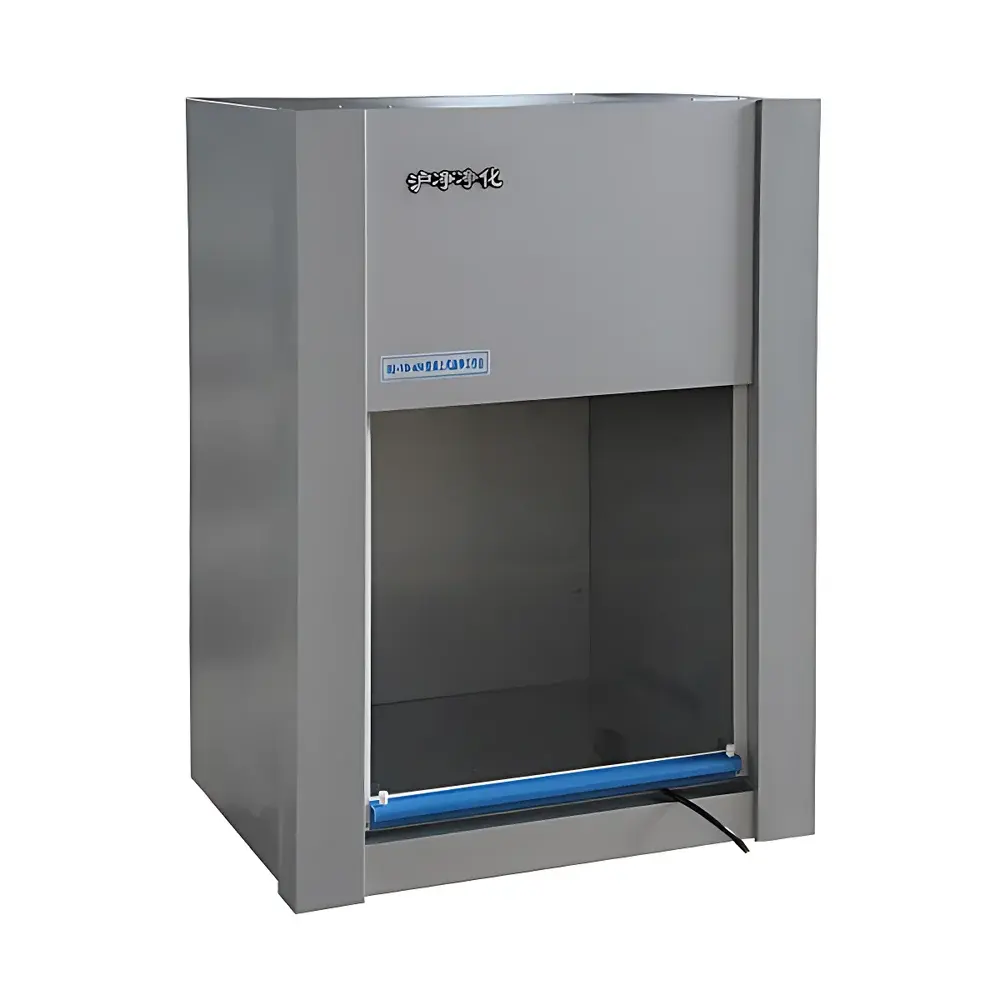
HJ VD-650 Desktop Vertical Laminar Flow Clean Bench
| Brand | HJ Purification |
|---|---|
| Origin | Shanghai, China |
| Manufacturer Type | Direct Manufacturer |
| Product Category | Domestic |
| Model | VD-650 |
| Instrument Type | Vertical Laminar Flow Clean Bench |
| Cleanliness Class | Class 100 @ ≥0.5 µm (Fed. Std. 209E) |
| Noise Level | ≤62 dB(A) |
| User Capacity | Single-user, front-access |
| Airflow Pattern | Vertical Downflow |
| Average Air Velocity | 0.25–0.45 m/s (dual-speed control) |
| Microbial Contamination | ≤0.5 CFU/plate·hr (Φ90 mm settle plate) |
| Vibration Peak-to-Peak | ≤5 µm (X/Y/Z axes) |
| Illuminance | ≥300 lx |
| Power Supply | AC 220 V, 50 Hz |
| Work Area Dimensions (W×D×H) | 485 × 475 × 455 mm |
| Overall Dimensions (W×D×H) | 640 × 530 × 845 mm |
| HEPA Filter Specification | 480 × 460 × 38 mm × 1 unit |
| Lighting | 10 W fluorescent lamp × 1 |
| UV Lamp | 10 W × 1 |
Overview
The HJ VD-650 Desktop Vertical Laminar Flow Clean Bench is an ISO Class 5 (Fed. Std. 209E Class 100) local purification system engineered for aseptic handling of sensitive biological, pharmaceutical, and microelectronic samples. It operates on the principle of vertical unidirectional laminar airflow: ambient air is drawn through a prefilter, then forced downward through a certified HEPA filter (≥99.99% efficiency at 0.3 µm), delivering particle-free air across the work surface at a controlled, uniform velocity. This airflow forms a protective barrier that sweeps airborne contaminants—including viable microorganisms, dust, and aerosols—away from the operator and sample zone, minimizing cross-contamination risk during critical manipulations. Designed for benchtop integration, the VD-650 delivers full ISO 5 performance without requiring dedicated HVAC infrastructure or floor space, making it ideal for small laboratories, QC labs, teaching facilities, and pilot-scale R&D environments where spatial constraints and operational flexibility are paramount.
Key Features
- Compact desktop footprint (640 × 530 × 845 mm) enables placement on standard lab benches or mobile carts without structural modification.
- Vertically oriented laminar flow with adjustable dual-speed fan control (0.25–0.45 m/s) ensures optimal velocity for both delicate cell culture work and robust particulate clearance.
- Front-mounted, semi-enclosed tempered glass sash provides ergonomic access while maintaining aerodynamic integrity and operator safety.
- Integrated 10 W UV-C germicidal lamp (254 nm) and 10 W fluorescent lamp support decontamination cycles and high-contrast visual inspection under uniform illumination (≥300 lx).
- Low-noise operation (≤62 dB[A]) and minimal mechanical vibration (≤5 µm peak-to-peak in all axes) preserve sample stability during extended procedures such as micromanipulation or weighing.
- Single HEPA filter (480 × 460 × 38 mm) with validated retention efficiency meets ISO 14644-1 requirements for Class 5 clean zones and supports routine filter integrity testing per IEST-RP-CC001.
Sample Compatibility & Compliance
The VD-650 is routinely deployed in applications requiring protection of product and process from environmental particulates and microbiological load—including sterile media preparation, microbial isolation, tissue dissociation, and non-hazardous reagent dispensing. It is not designed for containment of hazardous agents (i.e., does not meet NSF/ANSI 49 biosafety cabinet standards). The unit complies with Fed. Std. 209E Class 100 (equivalent to ISO 14644-1 Class 5) for airborne particle concentration (≤3,520 particles/m³ ≥0.5 µm). Performance validation includes microbial challenge testing using settle plates (≤0.5 CFU/plate·hr, Φ90 mm), confirming suitability for GLP-compliant microbiological assays and USP compounding support when used within defined procedural controls. All electrical components conform to IEC 61010-1 for laboratory equipment safety.
Software & Data Management
As a manually operated, non-automated laminar flow system, the VD-650 does not incorporate embedded firmware, data logging, or network connectivity. However, its operational parameters—including fan speed setting, UV exposure duration, and maintenance intervals—are documented in the included user manual and align with standard laboratory quality management systems. Institutions implementing ISO/IEC 17025 or FDA 21 CFR Part 11 compliance frameworks may record usage logs, filter replacement dates, and periodic certification reports (e.g., airflow velocity mapping, particle count verification) in their electronic lab notebook (ELN) or LIMS. Routine validation protocols—including annual HEPA filter integrity testing and biannual airflow visualization—support audit readiness for GMP, GLP, and CAP-accredited facilities.
Applications
- Aseptic transfer of bacterial/fungal cultures and mammalian cell lines in academic and industrial microbiology labs.
- Preparation of sterile culture media, buffers, and reagents prior to autoclaving or filtration.
- Handling of low-risk pharmaceutical intermediates and excipients during formulation development.
- Assembly and inspection of microfluidic devices and MEMS components requiring particulate-free environments.
- Supporting ISO 13485-certified medical device manufacturing for non-sterile component staging and packaging line sampling.
- Teaching laboratories conducting foundational techniques in sterile technique, colony isolation, and antibiotic susceptibility testing.
FAQ
Does the VD-650 meet ISO 14644-1 Class 5 requirements?
Yes — certified performance confirms ≤3,520 particles/m³ ≥0.5 µm under steady-state operation, fully aligned with ISO 14644-1:2015 Class 5.
Can this unit be used for handling BSL-2 organisms?
No — it provides product protection only, not personnel or environmental protection; biosafety cabinets meeting NSF/ANSI 49 are required for BSL-2 work.
What is the recommended HEPA filter replacement interval?
Typically every 12–18 months under continuous use; actual service life depends on ambient air quality and prefilter maintenance frequency.
Is UV lamp calibration traceable to NIST standards?
UV intensity is not calibrated per NIST; users should verify germicidal efficacy annually via biological indicators (e.g., Bacillus atrophaeus spores) per ISO 15189 Annex A.5.
Does the unit include documentation for regulatory audits?
Yes — factory test reports (airflow velocity, particle count, noise, illumination), CE-marked electrical certification, and full maintenance log templates are supplied with shipment.
Related Products



