
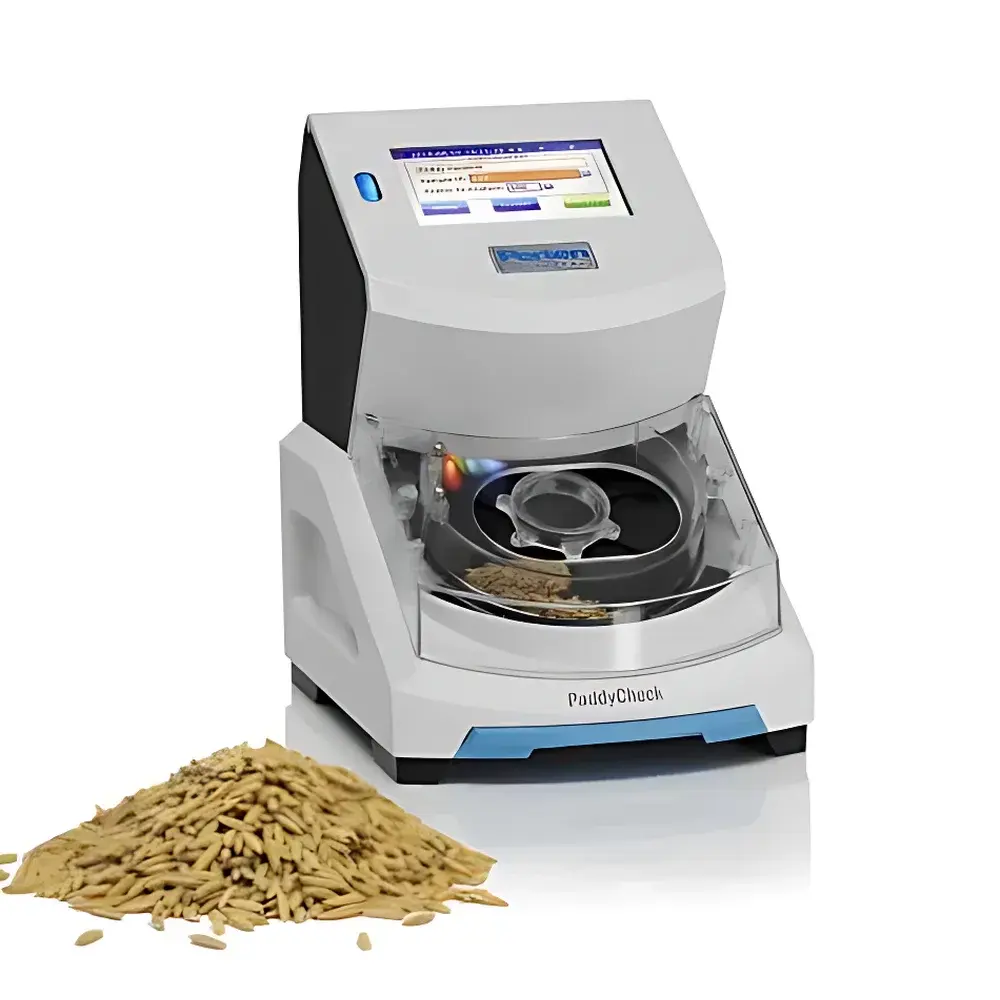
PerkinElmer Perten® PaddyCheck™ PC 6800 Paddy Quality Analyzer
| Brand | Perten |
|---|---|
| Origin | Sweden |
| Model | PaddyCheck™ PC 6800 |
| Compliance | AACCI Method No. 61-10.01 |
| Power | Rechargeable battery (3 h analysis / 8 h standby) |
| Dimensions | Compact, portable design |
| Sensor Suite | Polarized light sensor, visible-light RGB sensor, precision force sensor (17 N max load) |
Overview
The PerkinElmer Perten® PaddyCheck™ PC 6800 Paddy Quality Analyzer is a field-deployable, non-destructive optical and mechanical measurement system engineered for rapid, standardized assessment of paddy rice quality parameters—most critically, Head Rice Yield (HRY)—directly from unhusked paddy grains. Unlike conventional milling-based methods requiring dehusking, polishing, and manual grain sorting, the PC 6800 employs a multi-sensor fusion architecture grounded in polarized light transmission, high-resolution visible-spectrum imaging, and controlled mechanical compression. This integrated approach enables quantitative evaluation of internal grain integrity (e.g., translucency, chalkiness), external morphology (length, width, color uniformity), and mechanical resilience (thickness, hardness, crack susceptibility) without physical milling. The instrument operates on the principle that internal structural defects—including fissures, chalky endosperm regions, and density gradients—alter both light polarization behavior and mechanical response under calibrated loading. As such, it delivers HRY prediction with statistical correlation to official milled-reference data, while eliminating operator bias, inter-laboratory variability, and time-intensive sample preparation.
Key Features
- Direct paddy analysis: No dehusking, milling, or sorting required—grains are analyzed in their native state.
- Triple-sensor measurement platform: Simultaneous acquisition of polarized-light transmission images (for internal translucency and chalk detection), visible-light RGB images (for length, width, aspect ratio, and surface color), and force-displacement curves (at 17 N axial load for thickness, hardness, and microfracture identification).
- Automated rotational sample presentation: Motorized sample disc rotates individual grains sequentially beneath each sensor, optimized for indica and japonica varieties via interchangeable disc configurations.
- Integrated touchscreen interface: Menu-driven operation with real-time visualization of per-grain metrics, batch summary statistics, and pass/fail flagging against user-defined thresholds.
- Portable, battery-powered architecture: Compact footprint and rechargeable lithium-ion battery support up to 3 hours of continuous analysis or 8 hours of standby—enabling use in mills, farms, elevators, and border inspection points.
- Regulatory alignment: Fully compliant with AACCI Approved Method No. 61-10.01 (“Determination of Head Rice Yield Using the Perten PaddyCheck Instrument”), supporting traceable, auditable quality reporting.
Sample Compatibility & Compliance
The PaddyCheck™ PC 6800 accepts whole, unhusked paddy rice kernels across major commercial cultivars—including long-grain indica, medium-grain japonica, and aromatic varieties—without pre-conditioning. Grain moisture content range: 12–16% w.b. Sample throughput: 50–100 grains per 5–10 minute assay cycle. All measurements adhere to the procedural rigor defined in AACCI Method 61-10.01, which specifies calibration protocols, sensor validation criteria, and statistical acceptance limits for HRY prediction accuracy. The system supports GLP-aligned documentation: each analysis session logs timestamp, operator ID, instrument serial number, firmware version, and raw sensor outputs—ensuring full auditability for regulatory review or third-party certification (e.g., ISO/IEC 17025-accredited labs).
Software & Data Management
SingulatorPlus™ software—developed exclusively for the PaddyCheck platform—provides comprehensive post-acquisition analysis and data governance. It enables granular review of individual grain records, including synchronized side-by-side display of visible-light image, polarized-light image, and force-deformation curve. Statistical modules generate batch-level reports for HRY distribution, chalk area percentage, average grain dimensions, and mechanical failure incidence. Data export formats include CSV, PDF, and XML, compatible with LIMS integration. Audit trails comply with FDA 21 CFR Part 11 requirements, featuring electronic signatures, immutable log files, and role-based access control. Software updates are delivered via secure HTTPS, with version history and change logs maintained for GMP environments.
Applications
- Pre-harvest yield forecasting and variety selection trials
- In-line quality monitoring at rice mills and parboiling facilities
- Grading and pricing decisions at procurement centers and cooperatives
- Research into genotype–phenotype correlations for breeding programs
- Border phytosanitary inspections and import/export compliance verification
- Extension services delivering rapid feedback to farmers on harvest quality
FAQ
Does the PaddyCheck™ PC 6800 require reference calibration with milled rice standards?
No—calibration is performed using certified geometric and optical reference artifacts; method validation against milled HRY remains part of AACCI 61-10.01 but is not required for daily operation.
Can the instrument differentiate between surface discoloration and internal chalk?
Yes—polarized light transmission detects subsurface starch voids and air pockets characteristic of chalkiness, while visible-light imaging identifies surface blemishes, husk residues, or mold stains.
Is the 17 N compression force adjustable?
No—the force is fixed and validated per AACCI specifications to ensure repeatability across instruments and laboratories.
How is grain orientation controlled during rotation?
The sample disc features precision-machined grooves and gentle pneumatic leveling to minimize tumbling; orientation is statistically randomized across hundreds of grains to ensure representative sampling.
What maintenance is required?
Routine cleaning of optical windows and sensor apertures with lint-free wipes and isopropyl alcohol; annual factory recalibration recommended for metrological traceability.





