
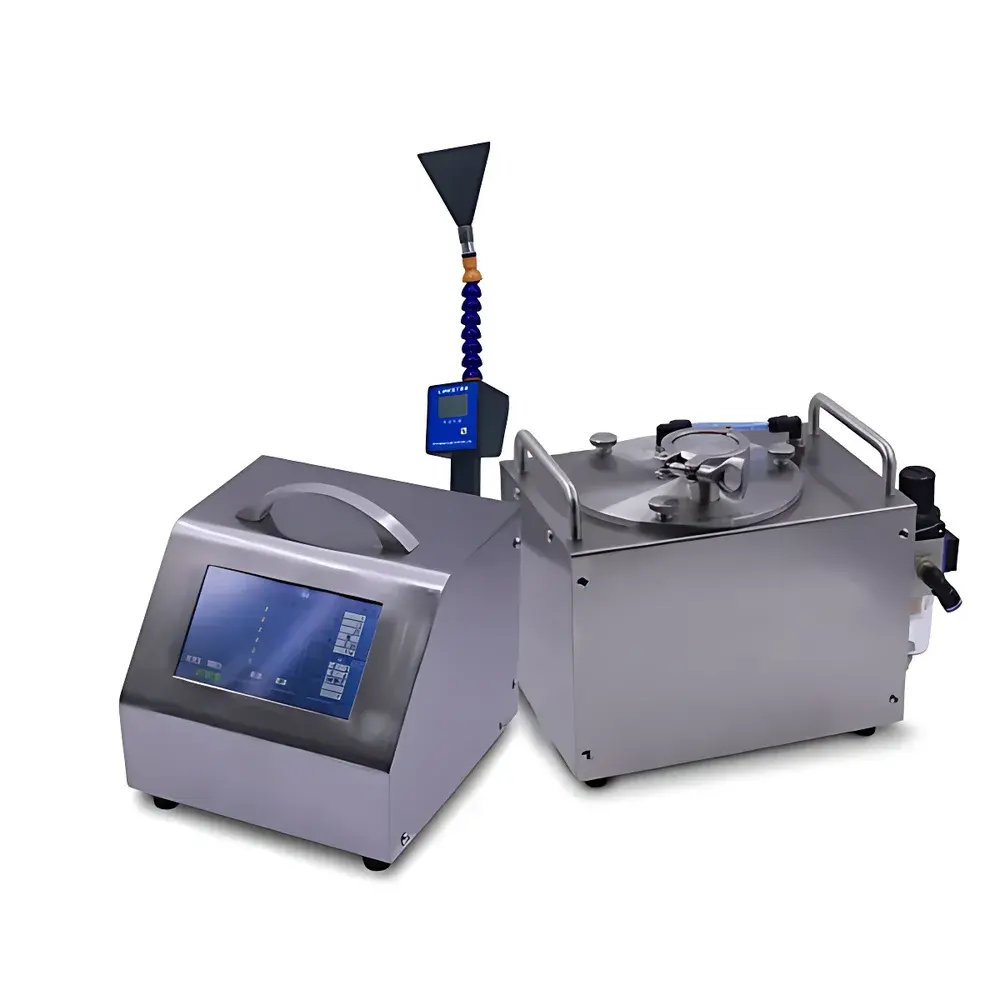
HJ ZJSJ-G High-Efficiency Filter Leak Tester
| Brand | HJ (Hujing Purification) |
|---|---|
| Origin | Shanghai, China |
| Manufacturer Type | Direct Manufacturer |
| Regional Category | Domestic (China) |
| Model | ZJSJ-G |
| Instrument Type | Laboratory-Grade |
| Flow Rate Range | High-Flow |
| Flow Rate Accuracy | ≤ ±5% |
| Timing Accuracy | ≤ ±1 s over 6-min sampling |
| Repeatability | ≤ ±10% FS |
| Particle Size Distribution Accuracy | ≤ ±30% |
| Indication Accuracy | ≤ ±30% FS |
| Test Aerosol | DEHS (standard) |
| Max. Detectable Concentration | 1.5 × 10⁴ particles/L |
| Sampling Flow Rate | 28.3 L/min |
| Recommended Scan Speed | 3–5 cm/s |
| Recommended Probe-to-Filter Distance | 2–4 cm |
| Dimensions (L×W×H) | 240 × 330 × 280 mm |
| Weight | 7 kg |
| Power Supply | AC 220 V, 50 Hz / DC 17 V (dual-mode) |
Overview
The HJ ZJSJ-G High-Efficiency Filter Leak Tester is a laboratory-grade, manually operated aerosol photometer-based leak detection system engineered for quantitative integrity verification of HEPA and ULPA filters in cleanroom HVAC systems, laminar flow hoods, isolators, and pharmaceutical manufacturing environments. It operates in accordance with the scanning probe methodology defined in ISO 14644-3 Annex B.6, which specifies upstream challenge with polydisperse aerosol and downstream real-time particle counting at defined linear scan velocities. Unlike passive visual or qualitative methods, the ZJSJ-G delivers traceable, numeric concentration data—enabling pass/fail determination against user-defined leak thresholds (e.g., 0.01% of upstream concentration). Its core measurement principle relies on light scattering detection of airborne particles within five discrete size channels (0.3, 0.5, 1.3, 5, and 10 µm), with signal processing optimized for high-dynamic-range aerosol concentration monitoring under turbulent flow conditions typical of filter face scanning.
Key Features
- Integrated high-flow particle counter (28.3 L/min) compliant with ISO 21501-4 calibration requirements for optical particle counters;
- Backlit blue LCD display with real-time downstream particle concentration trending and multi-channel size-resolved readout;
- Dedicated handheld scanning probe with ergonomic grip, fixed 2–4 cm standoff distance guidance, and tactile feedback controls (↑/↓/Scan-Hold key) for on-the-fly threshold entry and leak confirmation;
- Modular architecture: consists of main counter unit, detachable probe, aerosol generator (DEHS standard), and dilution module—each calibrated as a traceable subsystem;
- Dual-mode power supply (AC 220 V / DC 17 V) ensures uninterrupted operation during mobile field audits or backup battery deployment;
- Engineered mechanical stability: aluminum alloy chassis, vibration-damped internal optics, and temperature-compensated photodetector array to maintain ≤±10% full-scale repeatability across ambient ranges of 15–30 °C.
Sample Compatibility & Compliance
The ZJSJ-G is validated for use with di(2-ethylhexyl) sebacate (DEHS) as the primary test aerosol, meeting the refractive index and volatility criteria specified in EN 1822-1 for fractional efficiency testing. Alternative challenge agents—including polyalphaolefin (PAO-4) and dioctyl phthalate (DOP)—are supported via pre-configured optical gain adjustment and require formal revalidation per IEST-RP-CC001.3 Section 5.3. The system satisfies functional equivalence to ISO 14644-3 B.6 scanning protocols and supports audit readiness for EU GMP Annex 1 (2022), FDA CGMP 21 CFR Part 211, and WHO TRS 961 Annex 2. All firmware and calibration records adhere to ALCOA+ principles, with timestamped event logs suitable for GLP/GMP-compliant documentation packages.
Software & Data Management
While the ZJSJ-G operates in standalone mode without embedded PC software, it generates time-stamped ASCII log files via RS-232 serial output (optional USB adapter). Each record includes: UTC timestamp, channel-specific counts, scan velocity estimate, operator ID field, and leak flag status. These logs are compatible with common laboratory data management systems (LIMS) and qualify for 21 CFR Part 11-compliant archiving when paired with validated third-party acquisition software. Internal memory retains ≥1,000 scan events with full metrological traceability to NIM (National Institute of Metrology, China) certified reference standards. Calibration certificates include uncertainty budgets per ISO/IEC 17025:2017 Annex A.3.
Applications
- Pre-qualification and periodic requalification of HEPA/ULPA filters in Grade A/B cleanrooms per EU GMP Annex 1 §4.37;
- Leak mapping of terminal filters in aseptic processing lines, including RABS and isolator glove ports;
- Verification of filter installation integrity following maintenance or replacement activities;
- Root cause analysis of nonviable particle excursions during environmental monitoring investigations;
- Supporting risk-based qualification strategies aligned with ICH Q9 and ISO 14644-1:2015 classification protocols;
- Training and competency assessment for cleanroom technicians under ISO 14644-3 Annex D.
FAQ
What aerosol types are supported, and how is calibration affected?
DEHS is the factory-default and metrologically characterized challenge agent. PAO and DOP require recalibration of photometric gain and size-response curves; formal validation documentation must accompany such configuration changes.
Is the ZJSJ-G suitable for ULPA filter testing?
Yes—when used with appropriate upstream challenge concentration (≥10⁶ particles/L at 0.3 µm) and validated scan speed (≤3 cm/s), it meets EN 1822-3 sensitivity requirements for H13–H14 class filters.
Does the instrument provide electronic audit trail functionality?
It records operator-initiated events (scan start/stop, threshold entry, leak confirmation) with microsecond timestamps. Full 21 CFR Part 11 compliance requires integration with validated external data acquisition software.
What maintenance intervals are recommended?
Optical chamber cleaning every 200 operational hours; annual full-system calibration against NIST-traceable PSL standards; probe inlet inspection prior to each use per IEST-RP-CC006.2.
Related Products







