
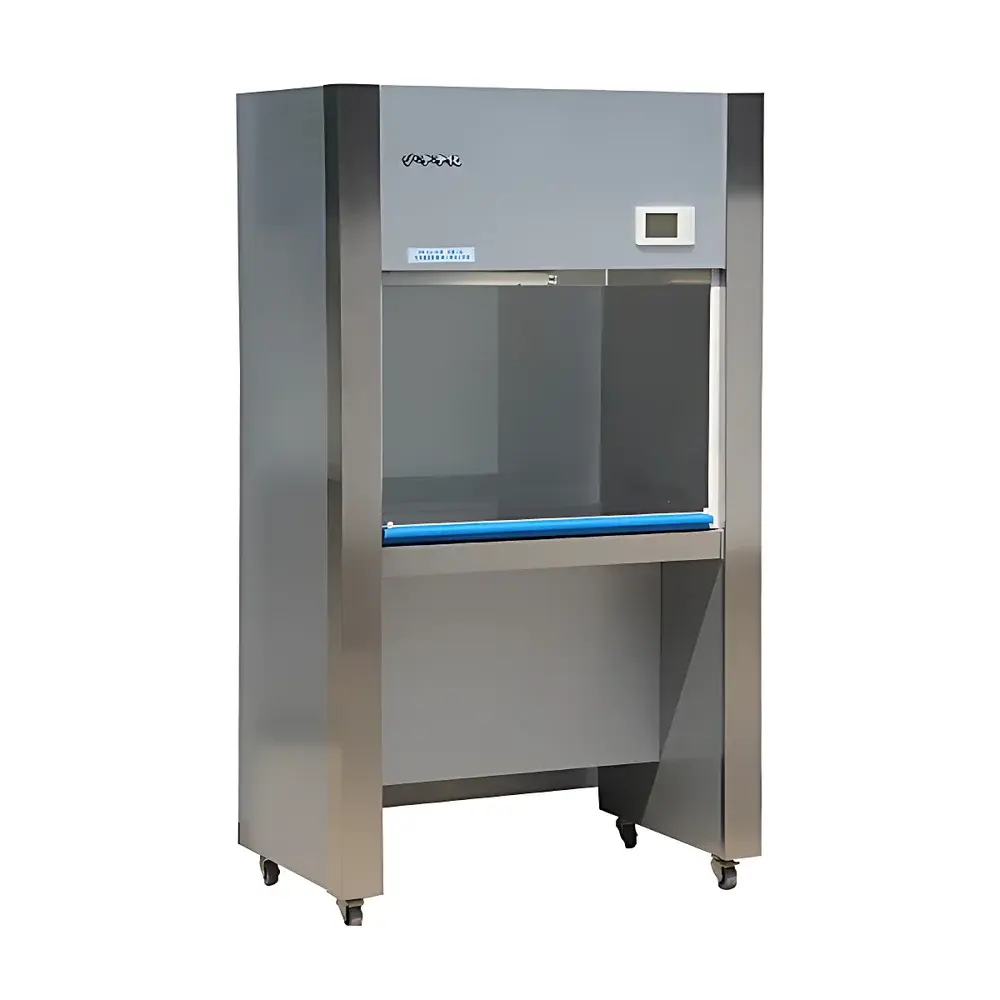
HJ SW-CJ-1D Single-Person Vertical Laminar Flow Clean Bench
| Brand | HJ Purification |
|---|---|
| Origin | Shanghai, China |
| Manufacturer Type | Direct Manufacturer |
| Product Category | Vertical Laminar Flow Clean Bench |
| Model | SW-CJ-1D |
| Cleanliness Class | ISO Class 5 (100 @ ≥0.5 µm, Fed. Std. 209E) |
| Noise Level | ≤62 dB(A) |
| User Capacity | Single Operator, Front-Access Configuration |
| Airflow Pattern | Vertical Downflow |
| Average Air Velocity | 0.25–0.45 m/s (Dual-Speed Control) |
| Microbial Contamination | ≤0.5 CFU/plate·hr (Φ90 mm settle plate) |
| Vibration | ≤5 µm peak-to-peak (X/Y/Z axes) |
| Illumination | ≥300 lux |
| Power Supply | AC 220 V, 50 Hz |
| Max. Power Consumption | 300 W |
| Net Weight | 85 kg |
| Work Area Dimensions (W×D×H) | 700 × 490 × 515 mm |
| Overall Dimensions (W×D×H) | 855 × 550 × 1600 mm |
| HEPA Filter Spec. | 695 × 460 × 38 mm (1 unit) |
| Fluorescent Lamp | 15 W (1 unit) |
| UV Lamp | 15 W (1 unit) |
| Pre-filter | Integrated coarse particulate pre-filter |
| Control Interface | Digital LCD panel with interlocked safety logic |
Overview
The HJ SW-CJ-1D Single-Person Vertical Laminar Flow Clean Bench is an ISO Class 5-certified laminar airflow workstation engineered for routine aseptic procedures in microbiology, cell culture, pharmaceutical quality control, and general laboratory preparation environments. It operates on the principle of vertical unidirectional airflow: ambient air is drawn through a pre-filter to remove large particulates, then passed through a certified HEPA filter (≥99.99% efficiency at 0.3 µm), and delivered as a uniform, low-turbulence downflow across the work surface at a controlled velocity of 0.25–0.45 m/s. This vertical laminar stream establishes a physical barrier—termed a “downflow air curtain”—that isolates the work area from external contaminants while preventing cross-contamination between operator and sample. Unlike horizontal flow hoods, the vertical configuration directs exhaust air downward into the base plenum or recirculated through front grilles (non-recirculating mode per standard installation), minimizing operator exposure to UV or chemical vapors and supporting compliance with biosafety best practices for low-risk applications.
Key Features
- Vertically oriented, fully enclosed work chamber with a motorized, height-adjustable sash system enabling precise ergonomic positioning and consistent airflow integrity across variable operating heights.
- Structural housing fabricated from pre-painted color-coated steel panels; work surface constructed from brushed SUS201 stainless steel—resistant to common laboratory reagents and compatible with frequent disinfection protocols.
- Integrated dual-lamp system featuring a 15 W fluorescent lamp (≥300 lux illumination) and a 15 W germicidal UV-C lamp (254 nm), with hardware-enforced safety interlock: UV emission is automatically disabled when the sash is raised above a defined threshold, and lighting circuits are de-energized during UV activation.
- Digital LCD control panel providing real-time display of operational status, fan speed selection (low/high), UV timer, and fault diagnostics—including filter life estimation based on cumulative runtime and pressure differential trends.
- Optimized aerodynamic design incorporating a vertically aligned, quasi-closed work surface geometry that enhances formation and stability of the downward laminar curtain, reducing turbulence-induced particle resuspension and improving containment efficacy.
- Front-mounted pre-filter assembly upstream of the HEPA module extends service intervals by capturing lint, dust, and larger aerosols—reducing loading on the primary HEPA filter and maintaining rated airflow performance over extended duty cycles.
Sample Compatibility & Compliance
The SW-CJ-1D is validated for use with non-hazardous biological materials, sterile media preparation, tissue handling, and instrumentation calibration where personnel protection is not required (i.e., no toxic, volatile, or pathogenic agents). Its ISO Class 5 performance aligns with Fed. Std. 209E (100 @ ≥0.5 µm) and meets baseline requirements for USP <797> environmental controls in non-hazardous compounding areas. While not a biosafety cabinet (BSC), it satisfies ASTM E2500-13 criteria for equipment qualification in GxP environments when installed in ISO Class 7 or cleaner background spaces. The unit supports GLP-compliant documentation via optional audit-trail-enabled firmware upgrades and adheres to IEC 61000-6-3 (EMC) and IEC 61000-6-2 (immunity) standards. All electrical components conform to GB 4793.1 (equivalent to IEC 61010-1) for laboratory equipment safety.
Software & Data Management
The embedded microcontroller enables local parameter logging—including fan runtime, UV exposure duration, and sash position history—accessible via USB export for internal QA review. Though not cloud-connected, the system supports integration into facility-wide environmental monitoring networks via optional RS-485 Modbus RTU output (add-on module). Calibration certificates for airflow velocity (traceable to NIM or equivalent national metrology institute) and HEPA filter integrity testing (via DOP/PAO scan) are provided with each unit. Firmware updates are performed offline using encrypted firmware packages, ensuring data integrity and regulatory traceability under FDA 21 CFR Part 11 Annex 11 principles where applicable.
Applications
- Aseptic transfer of microbial cultures and fungal spore suspensions in academic and industrial microbiology labs.
- Preparation of sterile culture media, buffers, and reagents for mammalian and insect cell lines.
- Assembly and handling of precision optical or microelectronic components requiring particulate-free environments.
- Pharmaceutical QC tasks including visual inspection of clear parenterals, filter validation setup, and reference standard weighing.
- Plant tissue culture workflows involving meristem isolation and callus propagation under controlled sterility conditions.
- Educational laboratory instruction in fundamental aseptic technique, filtration, and laminar flow physics.
FAQ
What ISO cleanliness class does the SW-CJ-1D achieve, and how is it verified?
It achieves ISO Class 5 (equivalent to Fed. Std. 209E Class 100) at ≥0.5 µm particles, verified by on-site airborne particle counting per ISO 14644-1 using calibrated optical particle counters.
Is this unit suitable for handling hazardous or genetically modified organisms?
No—it provides product protection only, not personnel or environmental protection. For BSL-2 or higher agents, a certified Class II Type A2 or B2 biosafety cabinet is required.
How often should the HEPA filter be replaced?
Under typical usage (6–8 hrs/day), replacement is recommended every 18–24 months or when differential pressure exceeds 250 Pa, whichever occurs first—validated via built-in manometer or external gauge.
Can the unit be integrated into a building management system (BMS)?
Yes, via optional RS-485 Modbus RTU interface for remote status monitoring, alarm signaling, and scheduled UV cycle synchronization.
Does the SW-CJ-1D comply with FDA or EU GMP Annex 1 requirements?
It fulfills the environmental control provisions for Grade C/D background areas per EU GMP Annex 1 when installed and qualified per IQ/OQ/PQ protocols; however, final compliance depends on site-specific risk assessment and facility qualification scope.
Related Products



