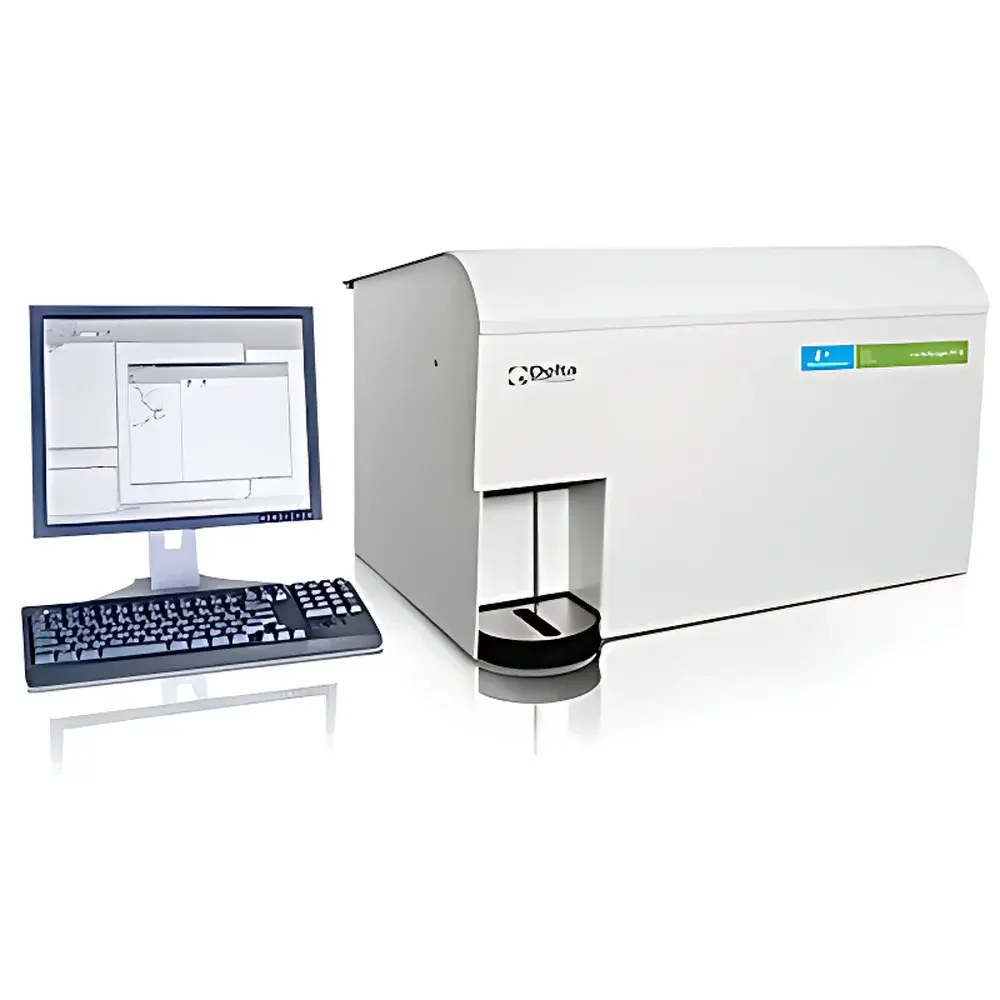
Perten LactoScope FT-B Fourier Transform Infrared Dairy Analyzer
| Brand | Perten |
|---|---|
| Origin | Netherlands |
| Model | LactoScope FT-B |
| Automation Level | Semi-Automatic |
| Analysis Speed | 60–80 samples/hour |
| Detection Range | Fat: 0–40% |
| Protein | 0–15% |
| Lactose | 0–15% |
| Total Solids | 0–45% |
| Repeatability | ≤0.25% CV |
| Accuracy | <1% CV |
| Operating System | Windows-based GUI with localized Chinese interface |
| Calibration Kits | Pre-validated modules for raw milk, cream (up to 40% fat), whey, flavored milk, and yogurt |
| Data Storage | SQL database architecture with backup/recovery support and external storage compatibility |
| Optical System | Dynascan™ interferometer-based FTIR with OpticsGuard™ desiccation and molecular sieve protection |
| Compliance | ISO 9622 / IDF 141, AOAC 972.16, ICAR-certified |
| Sample Volume | 10 mL |
| Sample Temperature Range | 4–42 °C |
| Dimensions (W×D×H) | 49 × 70 × 49 cm |
| Weight | 86 kg |
| Power Supply | 100–120 V, 60 Hz or 220–240 V, 50 Hz |
Overview
The Perten LactoScope FT-B Fourier Transform Infrared Dairy Analyzer is a semi-automated, benchtop FTIR spectrometer engineered for routine compositional analysis of liquid dairy matrices in quality control laboratories, collection centers, and mid-sized processing facilities. It employs a high-stability Dynascan™ Michelson interferometer—originally developed by PerkinElmer—to acquire full mid-infrared spectra (typically 4000–600 cm⁻¹) from unprocessed or thermally standardized samples. Quantitative prediction models for fat, protein, lactose, and total solids are built using partial least squares (PLS) regression against reference methods traceable to AOAC 972.16 and validated per ISO 9622 / IDF 141 protocols. The instrument operates on a temperature-controlled flow cell with integrated sample pre-heating and homogenization to ensure consistent fat globule dispersion prior to measurement—critical for minimizing scattering artifacts and improving reproducibility across heterogeneous raw milk batches.
Key Features
- FTIR optical architecture with patented Dynascan™ interferometer and OpticsGuard™ dry-air purge system, ensuring long-term spectral stability and minimal maintenance of the optical compartment
- Semi-automated sample handling with programmable auto-zeroing and cyclic cleaning cycles to maintain flow-path integrity and reduce carryover between samples
- Integrated sample pre-conditioning module: precise thermal equilibration (4–42 °C) and mechanical homogenization prior to infrared transmission measurement
- Pre-loaded, factory-validated calibration modules for raw milk, cream (≤40% fat), whey, flavored milks, and yogurts—enabling rapid deployment without user-developed calibrations
- Windows-based software with intuitive, icon-driven workflow navigation; password-protected model and spectral libraries compliant with GLP audit requirements
- Native SQL database backend supporting structured query, scheduled backups, database restoration, and direct export to CSV or Excel formats
Sample Compatibility & Compliance
The LactoScope FT-B accepts 10 mL liquid samples across a broad range of dairy products, including but not limited to: raw bovine milk, standardized and pasteurized fluid milk, ultrafiltered and reverse-osmosis concentrated milks, sweet and acid wheys, low-viscosity fermented products (e.g., drinkable yogurts), and creams up to 40% fat content. All quantitative predictions are traceable to primary reference methods: fat by Roese-Gottlieb extraction, protein by Kjeldahl nitrogen determination, lactose by HPLC, and total solids by gravimetric drying. The system meets ISO 9622 / IDF 141 performance criteria for precision (≤0.25% CV for repeatability) and accuracy (<1% CV vs. reference). It is ICAR-certified for on-farm and central laboratory use and complies with EU electromagnetic compatibility (2014/30/EU) and low-voltage safety directives (2014/35/EU). Optional FPD (Freezing Point Depression) module enables ice point measurement via integrated conductivity cell.
Software & Data Management
The embedded Windows application provides role-based access control, configurable user permissions, and full audit trail logging—including operator ID, timestamp, method version, and raw spectral metadata—for compliance with FDA 21 CFR Part 11 and ISO/IEC 17025 documentation requirements. All calibration models and spectral libraries are encrypted and require administrator-level credentials for modification. Data export supports direct integration with LIMS platforms via ODBC drivers or flat-file interfaces (CSV, XML). SQL database schema includes tables for sample records, instrument logs, calibration history, and QC control charts—enabling trend analysis, SPC monitoring, and automated alert generation upon out-of-specification results.
Applications
- Real-time raw milk acceptance testing at dairy collection hubs based on fat, protein, lactose, and total solids specifications
- In-process verification of standardization ratios during UHT and ESL milk production
- QC release testing of whey powders and permeate streams for lactose and protein content
- Contract testing laboratories performing accredited dairy composition analysis under ISO/IEC 17025 scope
- Research applications requiring rapid, non-destructive screening of compositional variability across herd management trials
- Regulatory compliance reporting aligned with national dairy grading standards (e.g., USDA, EU Commission Regulation No. 1234/2007)
FAQ
What reference methods validate the LactoScope FT-B’s calibration models?
All primary calibrations are developed and verified against AOAC 972.16-compliant reference procedures: fat by Roese-Gottlieb, protein by Kjeldahl, lactose by HPLC, and total solids by gravimetric drying.
Does the system support regulatory audit requirements such as 21 CFR Part 11?
Yes—the software implements electronic signatures, audit trails, and data integrity controls meeting FDA 21 CFR Part 11 and ISO/IEC 17025 documentation standards.
Can the instrument analyze high-fat creams without dilution?
Yes—calibration modules include validation up to 40% fat content in cream, eliminating the need for manual dilution prior to analysis.
Is LIMS integration supported natively?
Yes—via ODBC connectivity and structured export formats (CSV/XML), enabling bidirectional data exchange with major LIMS platforms.
What environmental conditions are required for stable operation?
Ambient temperature: 15–30 °C; relative humidity: ≤70% non-condensing; vibration-isolated benchtop surface recommended for optimal interferometer stability.