
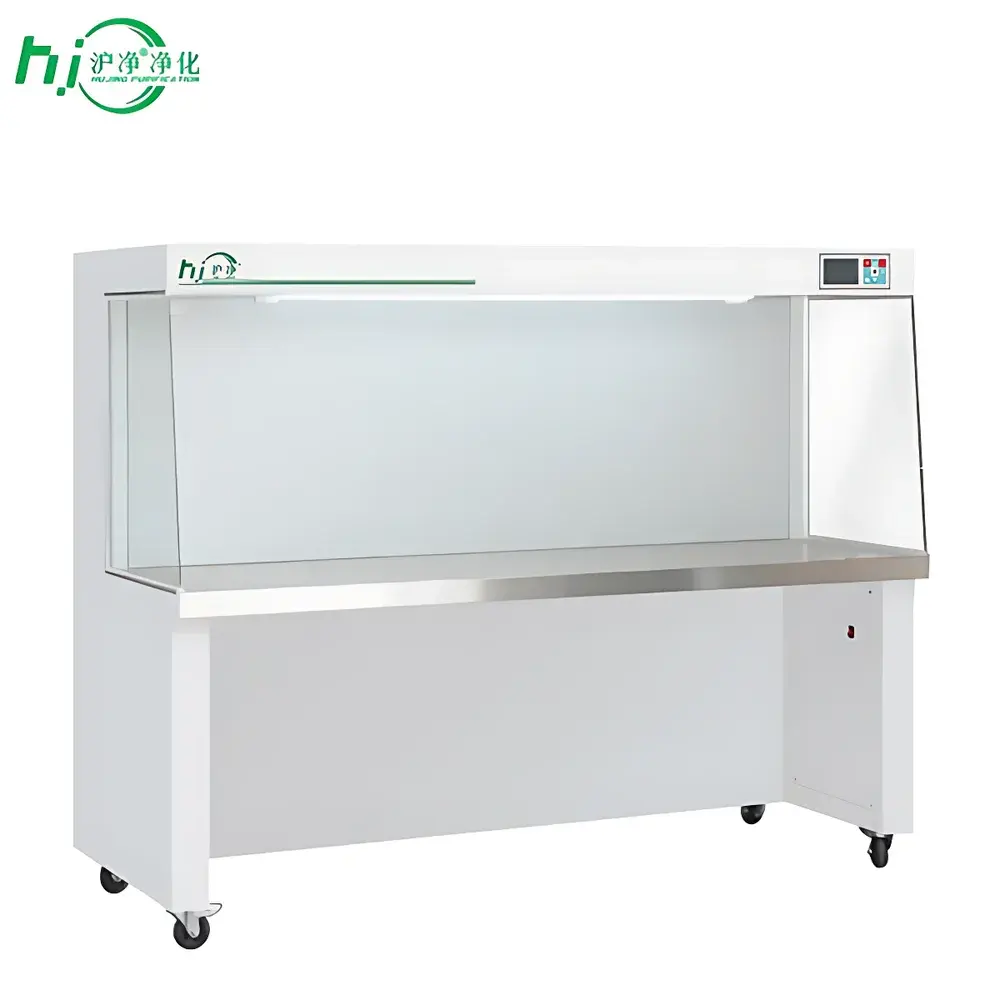
Hujing SW-CJ-1CU Stainless Steel Horizontal Laminar Flow Clean Bench
| Brand | Hujing Purification (HJ) |
|---|---|
| Origin | Shanghai, China |
| Manufacturer Type | Direct Manufacturer |
| Product Category | Domestic |
| Model | SW-CJ-1CU |
| Instrument Type | Horizontal Laminar Flow Clean Bench |
| Cleanliness Class | ISO Class 5 (equivalent to Federal Standard 209E Class 100 @ ≥0.5 µm) |
| Noise Level | ≤62 dB(A) |
| User Capacity | Dual-operator, single-front configuration |
| Airflow Pattern | Horizontal laminar flow |
| Construction | Fully stainless steel (SUS304 work surface), cold-rolled steel housing with electrostatic powder coating |
| HEPA Filter | 1700×560×50 mm, ≥99.995% efficiency at 0.3 µm |
| Pre-filter | Integrated coarse particulate pre-filter |
| Illumination | ≥300 lux (30 W fluorescent lamp) |
| UV Lamp | 20 W, interlocked with lighting and equipped with timer function (excludes SW-CJ-1BU/SW-CJ-1CU variants) |
| Control Interface | Digital LCD display with intuitive parameter settings |
| Operating Wind Speed | 0.25–0.45 m/s |
| Vibration | ≤5 µm peak-to-peak (X/Y/Z axes) |
| Power Supply | AC 220 V, 50 Hz |
| Max Power Consumption | 640 W |
| Net Weight | 160 kg |
| Work Area Dimensions | 1770 × 510 × 600 mm (W×D×H) |
| External Dimensions | 1800 × 740 × 1440 mm (W×D×H) |
Overview
The Hujing SW-CJ-1CU Stainless Steel Horizontal Laminar Flow Clean Bench is an ISO Class 5-certified containment system engineered for routine aseptic procedures in microbiology, cell culture, pharmaceutical quality control, and analytical sample preparation laboratories. It operates on the principle of horizontal unidirectional airflow: ambient air is drawn through a pre-filter to remove coarse particulates, then forced through a certified HEPA filter (≥99.995% efficiency at 0.3 µm), delivering particle-free laminar flow across the work surface at a controlled velocity of 0.25–0.45 m/s. This airflow profile establishes a sterile barrier that sweeps contaminants away from the operator and sample zone—critical for protecting sensitive biological materials from environmental microbial and particulate contamination. Unlike vertical flow hoods, the horizontal configuration directs filtered air parallel to the work surface toward the operator side, minimizing turbulence-induced cross-contamination and enabling stable handling of open Petri dishes or tissue culture flasks without backwash interference.
Key Features
- Fully welded stainless steel construction: Work surface fabricated from SUS304 brushed stainless steel for corrosion resistance, non-porosity, and ease of decontamination using ethanol, isopropanol, or approved sporicidal agents.
- Robust enclosure: Cold-rolled steel chassis with electrostatically applied epoxy-polyester powder coating ensures mechanical durability and chemical resistance in routine lab environments.
- Operator-centric safety design: Interlocked lighting and UV germicidal irradiation system prevents accidental UV exposure; UV timer function enables programmable disinfection cycles (standard on most variants; note SW-CJ-1CU includes UV interlock but omits timer per specification).
- Precision airflow management: Optimized plenum geometry and diffuser plate ensure uniform velocity distribution across the full 1770 mm work width, validated per ISO 14644-3 protocols.
- Human-centered interface: Backlit digital LCD controller displays real-time airflow status, UV operation mode, and service alerts—supporting repeatable setup and GLP-compliant documentation of operational parameters.
- Structural integrity: Reinforced frame and vibration-damped mounting minimize micro-vibrational transfer (<5 µm peak-to-peak), preserving sterility during micromanipulation or pipetting.
Sample Compatibility & Compliance
The SW-CJ-1CU accommodates standard microbiological and cell culture consumables—including 100 mm Petri dishes, T-75 flasks, multi-well plates, and glassware up to 300 mm height—within its 1770 × 510 mm work area. Its ISO Class 5 performance complies with international cleanroom standards including ISO 14644-1 and legacy US Federal Standard 209E (Class 100 @ ≥0.5 µm). While not a biosafety cabinet (BSC), it meets requirements for low-risk, non-hazardous applications where personnel and environmental protection are not mandated—such as media preparation, reagent aliquoting, and non-pathogenic strain handling. The unit supports laboratory adherence to Good Laboratory Practice (GLP) and current Good Manufacturing Practice (cGMP) Annex 1 principles for aseptic processing environments. All electrical components conform to IEC 61010-1 safety standards for laboratory equipment.
Software & Data Management
This clean bench operates as a standalone hardware platform with no embedded software stack or network connectivity. Operational parameters—including UV activation status, lighting state, and airflow readiness—are displayed via the integrated LCD interface. For regulatory traceability, users may manually log operational hours, filter replacement dates, and periodic certification results (e.g., airborne particle counts per ISO 14644-1, microbial settle plate data per ISO 14698-1) in paper-based or LIMS-integrated electronic logs. Optional third-party environmental monitoring systems can be deployed alongside the unit to record ambient temperature, humidity, and differential pressure—facilitating audit-ready documentation aligned with FDA 21 CFR Part 11 expectations for electronic records when paired with appropriate validation protocols.
Applications
- Aseptic transfer of bacterial, fungal, and mammalian cell cultures in academic and industrial research labs.
- Preparation of sterile culture media, buffers, and diluents for QC testing in pharmaceutical and biotechnology manufacturing.
- Handling of non-pathogenic diagnostic reagents and molecular biology kits requiring particulate-free environments.
- Assembly and inspection of precision optical or microfluidic components where sub-5 µm particulate control is essential.
- Supporting ISO/IEC 17025-accredited testing workflows where documented cleanliness class verification is required prior to analysis.
FAQ
Is the SW-CJ-1CU certified to ISO 14644-1 Class 5?
Yes—the unit achieves and maintains ISO Class 5 (formerly Federal Standard 209E Class 100) under static and operational conditions when installed per manufacturer specifications and serviced with certified HEPA filters.
Does it provide personnel or environmental protection?
No. As a horizontal laminar flow device, it protects only the product—not the operator or surrounding environment. It is not suitable for work involving biohazards, volatile chemicals, or radionuclides.
What is the recommended HEPA filter replacement interval?
Under typical usage (6–8 hrs/day), replace the HEPA filter every 18–24 months or sooner if differential pressure exceeds 250 Pa or particle count tests indicate degradation.
Can it be integrated into a building’s HVAC monitoring system?
Not natively. However, external sensors (e.g., airflow meters, particle counters) may be installed upstream/downstream for centralized environmental monitoring with appropriate calibration and validation.
Is UV irradiation time programmable on the SW-CJ-1CU model?
No—the SW-CJ-1CU features UV-light interlock functionality but lacks an onboard timer; manual override is required for UV cycle duration control.



