
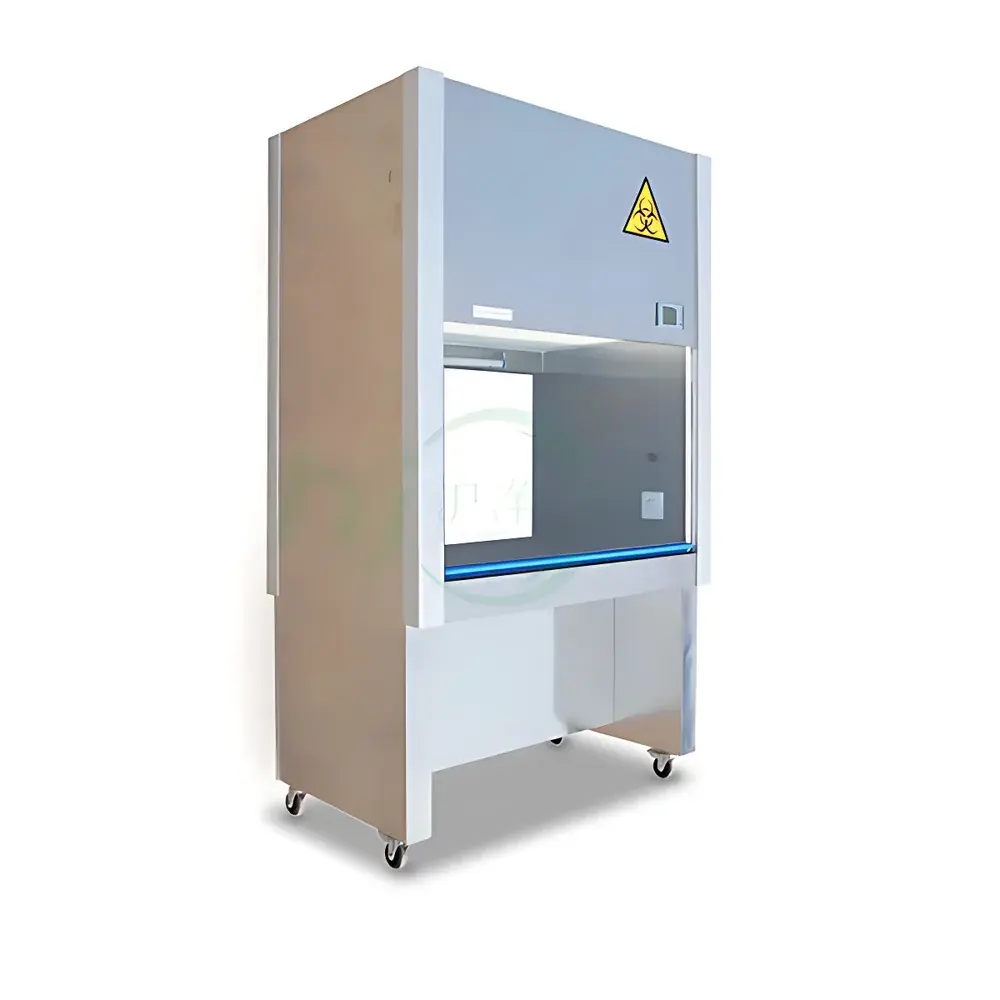
HJ BCM Series Vertical Laminar Flow Biological Safety Workstation
| Brand | HJ |
|---|---|
| Origin | Shanghai, China |
| Manufacturer Type | Direct Manufacturer |
| Product Category | Domestic |
| Model | BCM-1000 / BCM-1300 / BCM-1600 |
| Instrument Type | Vertical Laminar Flow Clean Bench |
| Cleanliness Class | ISO Class 5 (equivalent to Fed. Std. 209E Class 100 @ ≥0.5 µm) |
| Noise Level | ≤62 dB(A) |
| User Capacity | 1 or 2 operators (model-dependent) |
| Airflow Pattern | Vertical Downflow |
| Average Air Velocity | 0.25–0.45 m/s (dual-speed adjustable) |
| Microbial Contamination | ≤0.5 CFU/plate·hr (Φ90 mm settle plate) |
| Vibration | ≤5 µm peak-to-peak (X/Y/Z axes) |
| Illuminance | ≥450 lx |
| Power Supply | AC 220 V, 50 Hz |
| Power Consumption | 800 W (BCM-1000) / 1000 W (BCM-1300) / 1200 W (BCM-1600) |
| Weight | 150 kg / 200 kg / 250 kg |
| Work Area Dimensions (W×D×H) | 1000×700×620 mm / 1300×700×620 mm / 1600×700×620 mm |
| Overall Dimensions (W×D×H) | 1200×740×1950 mm / 1500×740×1950 mm / 1800×740×1950 mm |
| HEPA Filter Specification | 995×640×50 mm ×1 / 1295×640×50 mm ×1 / 1795×640×50 mm ×1 |
| Lighting | 20 W fluorescent ×1 + 20 W UV ×1 / 30 W fluorescent ×1 + 30 W UV ×1 (model-dependent) |
Overview
The HJ BCM Series Vertical Laminar Flow Biological Safety Workstation is an ISO Class 5-certified clean bench engineered for aseptic handling of biological samples, cell cultures, pharmaceutical preparations, and sensitive reagents in research, clinical, and quality control laboratories. Unlike horizontal flow units, the BCM series employs a unidirectional vertical downflow architecture—air is drawn through a pre-filter, conditioned by a variable-speed centrifugal blower, and then uniformly delivered through a certified HEPA filter (≥99.99% efficiency at 0.3 µm) across the entire work surface. This laminar airflow minimizes turbulence-induced particle resuspension and ensures consistent protection of both sample integrity and operator safety during non-hazardous procedures. The system complies with core environmental control standards including ISO 14644-1, Fed. Std. 209E (Class 100), and supports adherence to GLP and GMP operational frameworks where particulate and microbial contamination control are critical.
Key Features
- Full-recirculation airflow design with optional exhaust port activation—enables dynamic balancing between internal recirculation and external air exchange when high fresh-air demand arises (e.g., volatile solvent use).
- Vertically sliding sash doors at front and rear positions—provides flexible access control and ergonomic height adjustment for seated or standing operation.
- Air-curtain isolation barrier—establishes a continuous laminar air curtain along the workbench perimeter to suppress cross-contamination between the sterile workspace and ambient laboratory environment.
- Dual-speed electronically controlled fan system with LCD interface—maintains precise, stable airflow velocity (0.25–0.45 m/s) under varying filter loading conditions and user activity levels.
- Integrated dual-lighting system—separate 20/30 W fluorescent lamp (≥450 lx) for task illumination and 20/30 W germicidal UV-C lamp (254 nm) for pre- and post-use surface decontamination, with interlocked safety cutoff during sash operation.
- Structural rigidity and vibration damping—steel-reinforced frame with anti-vibration mounting achieves ≤5 µm peak-to-peak displacement (X/Y/Z), supporting micro-manipulation and long-duration incubation workflows.
Sample Compatibility & Compliance
The BCM workstation accommodates standard Petri dishes, tissue culture flasks, microcentrifuge tubes, pipette tips, and sterile transfer tools within its defined work envelope. Its ISO Class 5 performance has been validated per IEST-RP-CC001.3 (HEPA filter testing), ISO 14644-3 (cleanroom testing protocols), and USP Annex requirements for low-risk compounding environments. All models meet CE marking directives for electrical safety (IEC 61010-1) and electromagnetic compatibility (EN 61326-1). While not classified as a biosafety cabinet (BSC), the BCM is intended for use with non-pathogenic or Risk Group 1–2 agents under institutional biosafety committee guidelines—complementary documentation (e.g., risk assessments, SOPs) must be maintained per local regulatory expectations.
Software & Data Management
The BCM series operates via embedded microcontroller logic without external PC dependency. Real-time operational parameters—including fan speed status, UV exposure timer, and door position—are displayed on the LCD panel with non-volatile memory logging of cumulative UV runtime and maintenance alerts. Though no proprietary software suite is provided, the unit supports integration into facility-wide environmental monitoring systems via optional analog voltage outputs (0–10 V) for airflow velocity and digital dry-contact signals for UV status. Audit trails comply with ALCOA+ principles when paired with lab information management systems (LIMS) that capture timestamped operator entries, calibration records, and periodic certification reports aligned with ISO/IEC 17025 and FDA 21 CFR Part 11 requirements for electronic records.
Applications
- Aseptic transfer of mammalian and microbial cell lines in academic and industrial biotechnology labs.
- Preparation of media, reagents, and sterile dilutions in pharmaceutical QC and contract manufacturing organizations (CMOs).
- Handling of sensitive diagnostic kits, ELISA plates, and nucleic acid extraction workflows requiring low bioburden environments.
- Supporting ISO 13485-compliant medical device assembly processes where particulate control impacts functional reliability.
- Teaching laboratories conducting foundational microbiology and tissue culture techniques under standardized containment conditions.
FAQ
Is the BCM Series certified as a biosafety cabinet (BSC)?
No—the BCM is a vertical laminar flow clean bench, not a biosafety cabinet. It protects the product only, not the operator or environment. It does not meet NSF/ANSI 49 requirements for BSC classification and must not be used with infectious agents requiring personnel or environmental protection.
What HEPA filter replacement interval is recommended?
Filter life depends on ambient air quality and usage frequency; typical service intervals range from 12 to 24 months. Pressure differential monitoring and annual particle challenge testing per ISO 14644-3 are required to verify continued compliance.
Can the BCM be installed in a non-temperature-controlled room?
Yes, but ambient temperature should remain between 15–30°C and relative humidity below 80% to prevent condensation on optical components and ensure stable airflow dynamics.
Does the unit support validation documentation for GMP audits?
Yes—factory-issued IQ/OQ documentation packages are available upon request, including as-built drawings, filter test certificates, airflow uniformity maps, and calibration records traceable to NIST standards.
How is UV lamp intensity verified during routine maintenance?
A calibrated UV radiometer (254 nm spectral response) must be used to confirm irradiance ≥40 µW/cm² at the work surface; replacement is mandatory if output falls below 70% of initial specification after 1,000 hours of cumulative use.



