
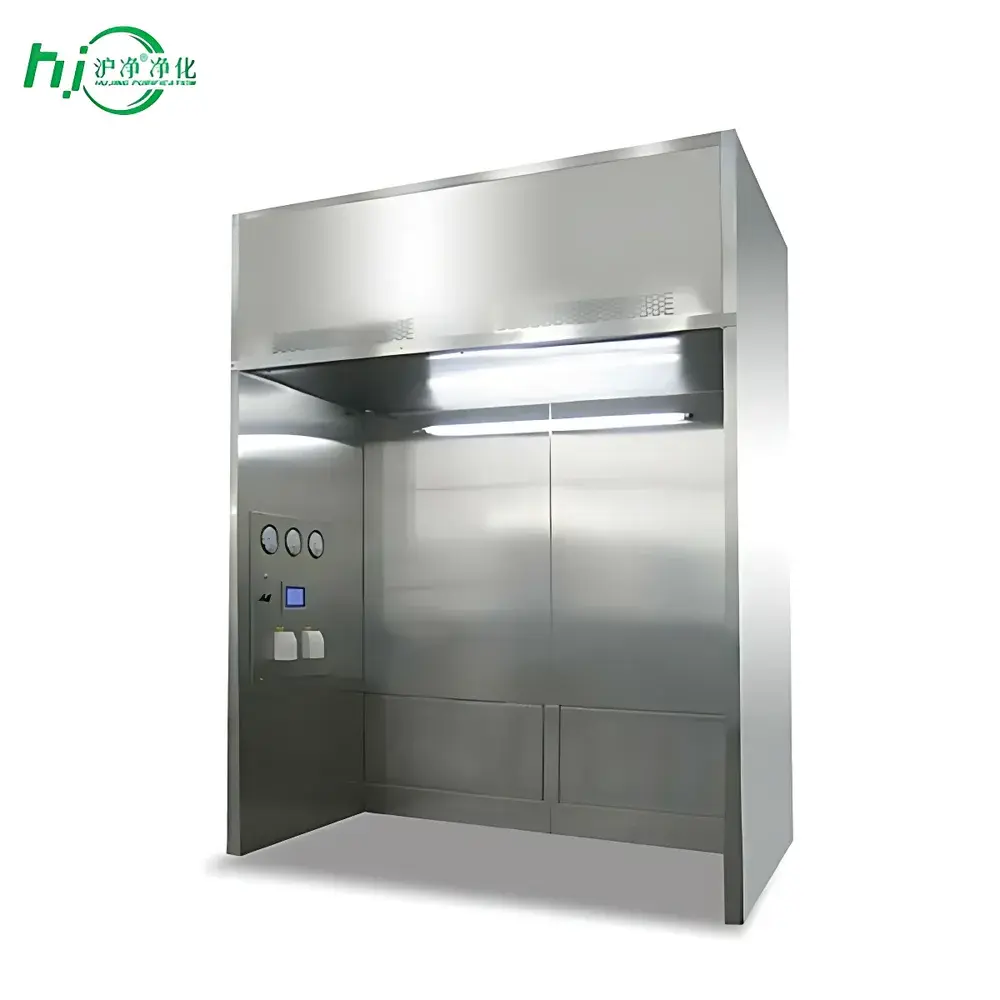
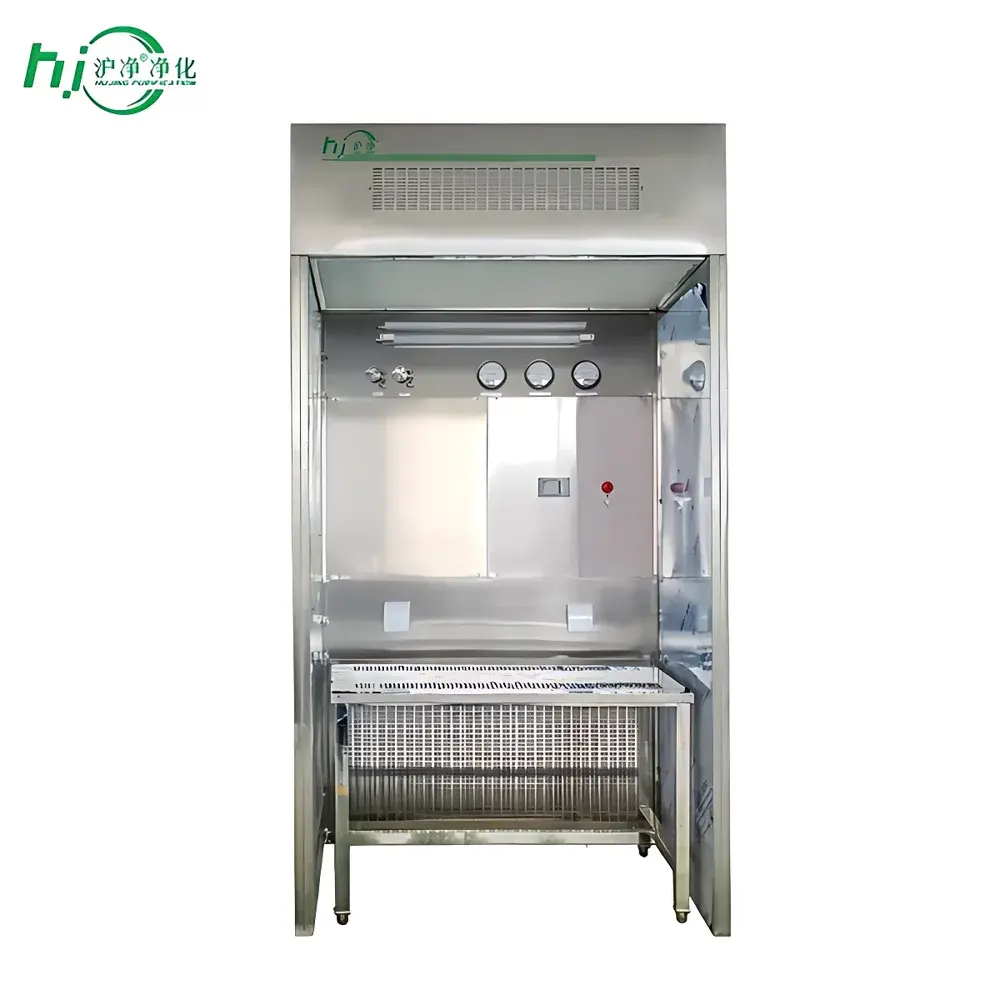
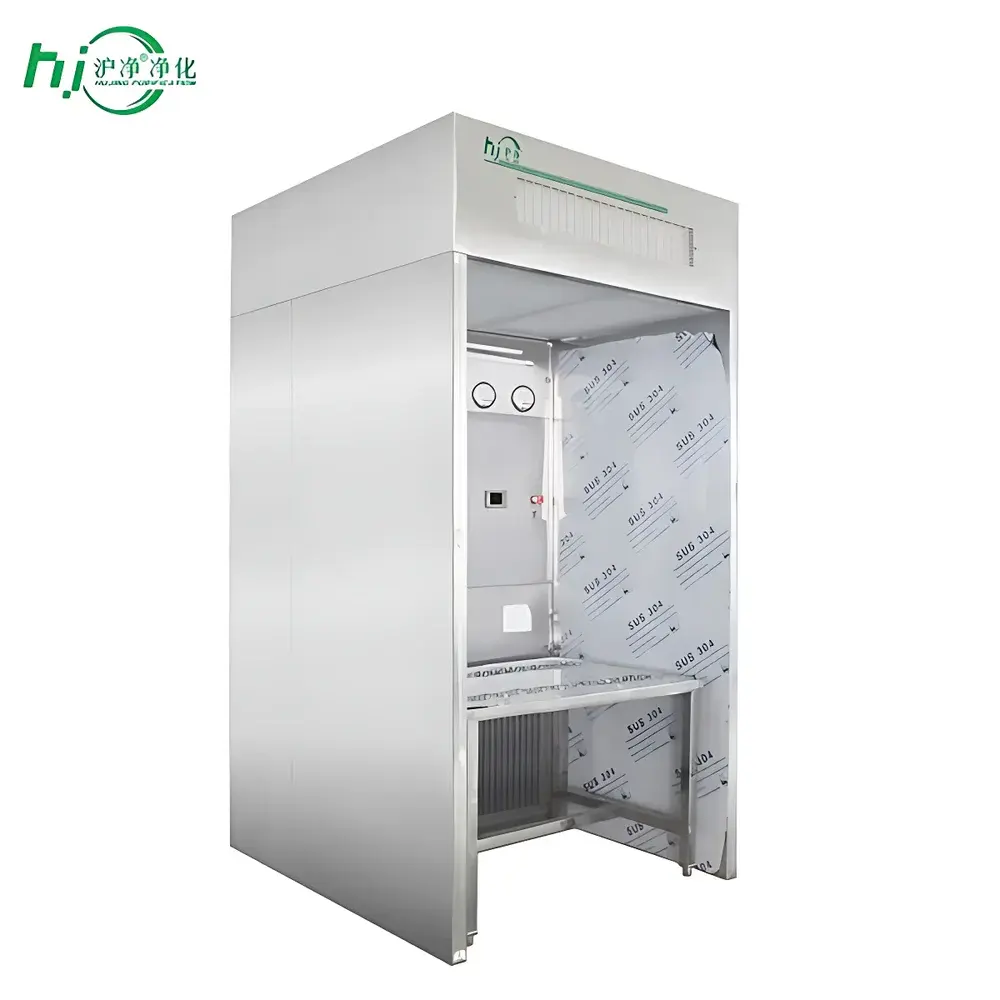
Hujing Purification ZJSJ Series PLC-Controlled Variable-Frequency Negative-Pressure Weighing Booth
| Brand | Hujing Purification (HJ) |
|---|---|
| Origin | Shanghai, China |
| Manufacturer Type | Direct Manufacturer |
| Country of Origin | China |
| Model | ZJSJ-1200 / ZJSJ-1600 / ZJSJ-1800 |
| Cleanliness Class | ISO 5 (Class 100) / ISO 6 (Class 1,000) |
| Downflow Air Velocity | 0.45 ± 20% m/s |
| Illuminance | ≥300 lx |
| Noise Level | ≤65 dB(A) |
| Power Supply | AC 380 V, 3-phase, 50 Hz |
| Construction Material | 304 Stainless Steel (1.0 mm thick) |
| Filtration | Pre-filter + Medium-efficiency filter + Liquid-seal HEPA filter (DOP/PAO test compliant) |
| Control System | PLC with VFD-driven fan control |
| Exhaust Ratio | 10% |
| Working Area Dimensions (W×D×H, mm) | 1100×900×2000 (ZJSJ-1200) |
| Unit Weight | 450–600 kg |
| Total Power Consumption | 1.1 kW (ZJSJ-1200) |
| Lighting | Two 15 W fluorescent lamps |
Overview
The Hujing Purification ZJSJ Series PLC-Controlled Variable-Frequency Negative-Pressure Weighing Booth is an engineered containment solution designed for GMP-compliant pharmaceutical manufacturing, analytical laboratories, and sterile R&D environments. It operates on the principle of controlled unidirectional downflow air—generated by a VFD-regulated centrifugal blower—to establish a stable negative-pressure gradient between the working area and surrounding space. This configuration ensures that airborne particulates generated during powder weighing, formulation, or API handling are confined within the booth and directed through a multi-stage filtration system before partial recirculation and controlled exhaust. The unit meets ISO 14644-1 Class 5 (equivalent to US FED-STD-209E Class 100) cleanroom performance standards in the work zone, with airflow uniformity enhanced by high-molecular-weight diffuser membranes. Its structural integrity, corrosion-resistant 304 stainless steel construction, and sealed liquid-slot HEPA filter housing support long-term compliance with EU Annex 1, PIC/S TR 79, and WHO Technical Report Series No. 961 requirements for aseptic processing and hazardous material handling.
Key Features
- PLC-integrated control architecture with variable-frequency drive (VFD) enables precise, stepless regulation of fan speed—optimizing airflow stability, energy efficiency, and noise reduction across varying filter loading conditions.
- Negative-pressure containment design maintains a minimum differential pressure of –20 to –30 Pa relative to adjacent laboratory zones, verified via built-in differential pressure sensors and real-time digital display.
- Three-stage filtration system: synthetic pre-filter (G4), medium-efficiency panel filter (F7/F8), and liquid-seal HEPA filter (H14, EN 1822-compliant), qualified for DOP or PAO aerosol challenge testing per ISO 14644-3.
- High-uniformity airflow distribution achieved via polymer-based laminar flow diffuser membrane, reducing turbulence and velocity deviation to <±15% across the full working plane.
- Full 304 stainless steel enclosure (1.0 mm gauge), fully welded seams, rounded internal corners (R ≥15 mm), and non-porous epoxy-coated base pan ensure cleanability, chemical resistance, and compatibility with routine disinfection protocols (e.g., sporicidal agents).
- Integrated safety interlocks include door position monitoring, filter clogging alarm, airflow failure alert, and emergency stop circuit—fully documented in the FAT/SAT protocol package.
Sample Compatibility & Compliance
The ZJSJ series accommodates solid dosage forms, lyophilized powders, cytotoxic APIs, and potent compounds requiring OEB 3–4 containment. Its negative-pressure operation prevents cross-contamination between sequential weighing batches and safeguards operators from inhalation exposure during manual dispensing. Units are validated per ISO 14644-1, ISO 14644-3, and ISO 14644-7 for cleanroom performance; airflow visualization (smoke studies) and particle counting (ISO 21501-4) are performed during commissioning. Documentation supports regulatory submissions under FDA 21 CFR Part 211, EU GMP Annex 1, and ICH Q5A/Q5B. Optional upgrades include integrated glove ports, static-dissipative work surfaces, and audit-trail-enabled PLC firmware compliant with 21 CFR Part 11 requirements.
Software & Data Management
The embedded PLC controller records operational parameters—including airflow velocity, differential pressure, runtime hours, filter delta-P, and alarm events—in non-volatile memory with timestamping. Data export is supported via RS485 Modbus RTU or optional Ethernet/IP interface for integration into LIMS or MES platforms. All critical alarms trigger visual and audible alerts, logged with operator acknowledgment requirement. Firmware supports configurable user access levels (operator, technician, administrator) and password-protected parameter modification. Electronic records comply with ALCOA+ principles (Attributable, Legible, Contemporaneous, Original, Accurate, Complete, Consistent, Enduring, Available) for GLP/GMP audits.
Applications
- GMP-grade active pharmaceutical ingredient (API) weighing and dispensing prior to tablet compression or capsule filling.
- Controlled handling of highly potent compounds (HPAPIs) in early-phase development labs.
- Microbial culture media preparation and antibiotic sensitivity testing requiring particulate-free environments.
- QC laboratory balance calibration and reference standard handling under ISO/IEC 17025 traceable conditions.
- Non-sterile compounding in hospital pharmacies adhering to USP and environmental controls.
FAQ
What cleanroom classification does the ZJSJ series achieve in the working area?
It delivers ISO 5 (Class 100) cleanliness at the working plane under dynamic operating conditions, verified per ISO 14644-1 with 0.5 µm particle counters.
Is the HEPA filter certified for leak testing using DOP or PAO methods?
Yes—the liquid-seal H14 HEPA filters are supplied with full EN 1822-3 test reports and are pre-qualified for in-situ DOP/PAO scanning per ISO 14644-3 Annex B.
Can the unit be integrated into a building management system (BMS)?
Standard RS485 Modbus RTU communication is provided; optional BACnet MS/TP or Ethernet/IP modules are available for BMS interoperability.
What validation documentation is included with delivery?
Factory Acceptance Test (FAT) report, Installation Qualification (IQ) checklist, Operational Qualification (OQ) protocol with executed data, and filter certification dossiers are delivered electronically and in hard copy.
Does the system support remote monitoring and alarm notification?
Remote monitoring is enabled via optional IoT gateway module with email/SMS alert configuration for critical alarms (e.g., airflow loss, door open, filter saturation).



