
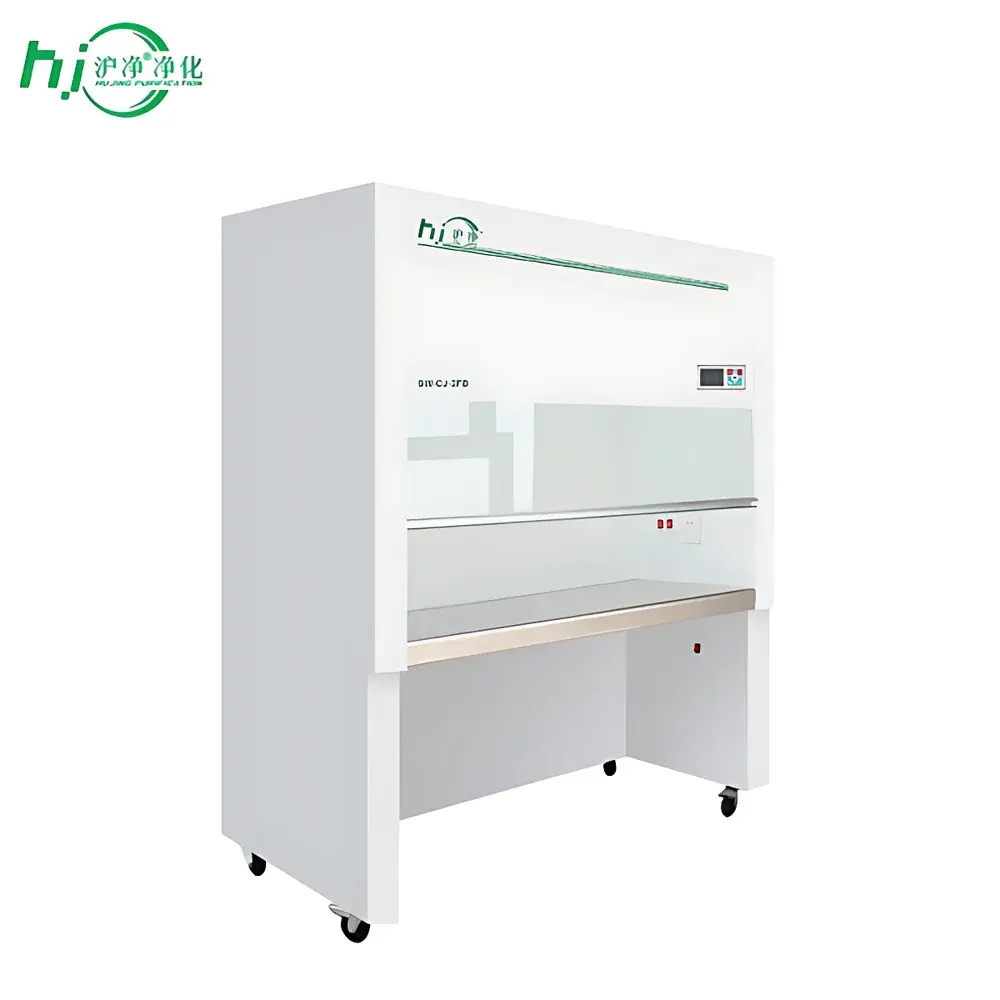
Hujing Purification SW-CJ-2FB Dual-Person Horizontal/Vertical Laminar Flow Clean Bench
| Brand | Hujing Purification (HJ) |
|---|---|
| Origin | Shanghai, China |
| Manufacturer Type | OEM Producer |
| Country of Origin | China |
| Model | SW-CJ-2FB |
| Price | USD 1,750 (approx.) |
| Cleanliness Class | ISO Class 5 (equivalent to Federal Standard 209E Class 100 @ ≥0.5 µm) |
| Noise Level | ≤62 dB(A) |
| User Capacity | Dual-person, single-face configuration |
| Average Air Velocity | 0.25–0.45 m/s (3-speed adjustable) |
| Vibration | ≤5 µm half-amplitude (X/Y/Z axes) |
| Illumination | ≥300 lux |
| Power Supply | AC 220 V / 50 Hz |
| Max. Power Consumption | 600 W |
| Net Weight | 140 kg |
| Work Area Dimensions | 1325 × 520 × 620 mm (W×D×H) |
| External Dimensions | 1485 × 740 × 1800 mm (W×D×H) |
| HEPA Filter Specifications | 1310 × 450 × 50 mm (1 unit) + 1275 × 565 × 50 mm (1 unit) |
| Pre-filter | Integrated coarse particulate filter |
| UV Lamp | 20 W × 1 |
| Fluorescent Lamp | 20 W × 1 |
| Microbial Recovery | ≤0.5 CFU/plate·hour (90 mm Petri dish) |
Overview
The Hujing Purification SW-CJ-2FB Dual-Person Horizontal/Vertical Laminar Flow Clean Bench is an ISO Class 5-certified (Federal Standard 209E Class 100) unidirectional airflow workstation engineered for routine aseptic operations in pharmaceutical QC labs, microbiology research facilities, and cell culture preparation areas. Unlike conventional clean benches that operate exclusively in horizontal or vertical flow mode, the SW-CJ-2FB features a dual-mode air distribution architecture—enabling seamless switching between horizontal laminar flow (for operator-facing protection) and vertical downflow (for product-oriented containment)—without mechanical reconfiguration. Air enters through a pre-filter to capture coarse particulates (>5 µm), then passes through two independently mounted HEPA filters (H14 grade, ≥99.995% efficiency at 0.3 µm), ensuring consistent particle removal across the full work surface. The laminar velocity is precisely regulated via a three-speed electronic controller (0.25–0.45 m/s), maintaining uniform airflow profile per ISO 14644-3 validation protocols.
Key Features
- Balanced counterweight sash system enabling stepless, friction-free positioning of the tempered glass front window—critical for ergonomic access during prolonged manipulations.
- Monocoque enclosure fabricated from pre-painted steel panels with seamless welded corners, minimizing dust-trapping crevices and enhancing structural rigidity.
- SUS304 brushed stainless-steel work surface—electropolished for low bioburden retention, corrosion resistance, and compatibility with common disinfectants (e.g., 70% ethanol, sodium hypochlorite).
- Interlocked lighting and UV sterilization circuits: UV lamp automatically deactivates when sash is raised above 100 mm; fluorescent illumination remains active only during operational use.
- Dual-lamp configuration: 20 W germicidal UV-C (253.7 nm) for surface decontamination and 20 W daylight-balanced fluorescent lamp for visual clarity—both with independent toggle switches and status indicators.
- Digital LCD control panel with real-time display of fan speed setting, UV exposure timer (0–60 min), and fault diagnostics (e.g., filter saturation alert, motor overheat).
Sample Compatibility & Compliance
The SW-CJ-2FB accommodates standard laboratory equipment including pipette racks, Petri dish stacks (up to 100 mm diameter), centrifuge tubes, and small-scale bioreactors within its 1325 mm wide work area. Its dual-flow design supports both open-vessel handling (horizontal mode) and sensitive reagent dispensing (vertical mode), making it suitable for applications requiring variable directional airflow per procedural step. The unit complies with GB/T 16292–2010 (Chinese national standard for clean bench performance testing), EN 12469:2000 (European biosafety standard for microbiological safety cabinets), and aligns with ISO 14644-1:2015 airborne particulate cleanliness classification requirements. While not a biological safety cabinet (BSC), it meets Class I BSC airflow velocity thresholds per NSF/ANSI 49 where applicable to non-hazardous aerosol-generating procedures.
Software & Data Management
This clean bench operates as a standalone hardware platform without embedded network connectivity or cloud-based software. All operational parameters—including fan speed selection, UV cycle duration, and runtime logging—are managed locally via the integrated LCD interface. The control system maintains non-volatile memory for last-used settings and records cumulative UV exposure time (in hours) for maintenance scheduling. For GLP/GMP environments, users may integrate external environmental monitoring systems (e.g., temperature/humidity/data loggers) via RS-485 or analog 4–20 mA outputs (optional add-on). Audit trail functionality is not natively supported; however, the unit’s mechanical simplicity and lack of firmware dependencies facilitate FDA 21 CFR Part 11 compliance when paired with validated third-party documentation workflows.
Applications
- Aseptic transfer of microbial cultures and fungal spores in academic and industrial mycology labs.
- Preparation of media plates and antibiotic susceptibility test discs under controlled particle-free conditions.
- Handling of primary cells and stem cell lines prior to incubation—particularly where chemical cross-contamination must be avoided.
- Assembly and calibration of microfluidic devices and MEMS sensors requiring sub-micron particulate exclusion.
- Quality control sampling of sterile pharmaceutical intermediates (e.g., lyophilized powders, ophthalmic solutions) in ISO 7 or ISO 8 classified rooms.
FAQ
Can the SW-CJ-2FB be used for handling pathogenic agents?
No. This unit provides personnel and product protection only against environmental particulates—not bioaerosols. It does not meet NSF/ANSI 49 Class II or III BSC requirements for containment of Risk Group 2+ organisms.
What is the recommended HEPA filter replacement interval?
Under continuous 8-hour/day operation in typical lab environments, replace HEPA filters every 18–24 months—or sooner if static pressure drop exceeds 250 Pa (verified via built-in manometer port). Pre-filters should be cleaned weekly and replaced quarterly.
Is vertical and horizontal airflow selection manual or automatic?
Airflow direction is selected manually by repositioning internal duct baffles and adjusting the rear exhaust damper—requiring a single 5-minute procedure using provided hex tools. No motorized actuators are involved.
Does the unit support external exhaust ducting?
Yes. A dedicated 150 mm diameter exhaust collar is located at the rear top panel, compatible with rigid PVC or flexible aluminum ducting for recirculation or hard-ducted exhaust configurations.
What certifications accompany shipment?
Each unit ships with a Factory Acceptance Test (FAT) report verifying airflow uniformity, noise level, illumination intensity, and UV irradiance (measured per ISO 15714), plus CE-marked electrical safety certification (EN 61000-6-3/6-4).



