
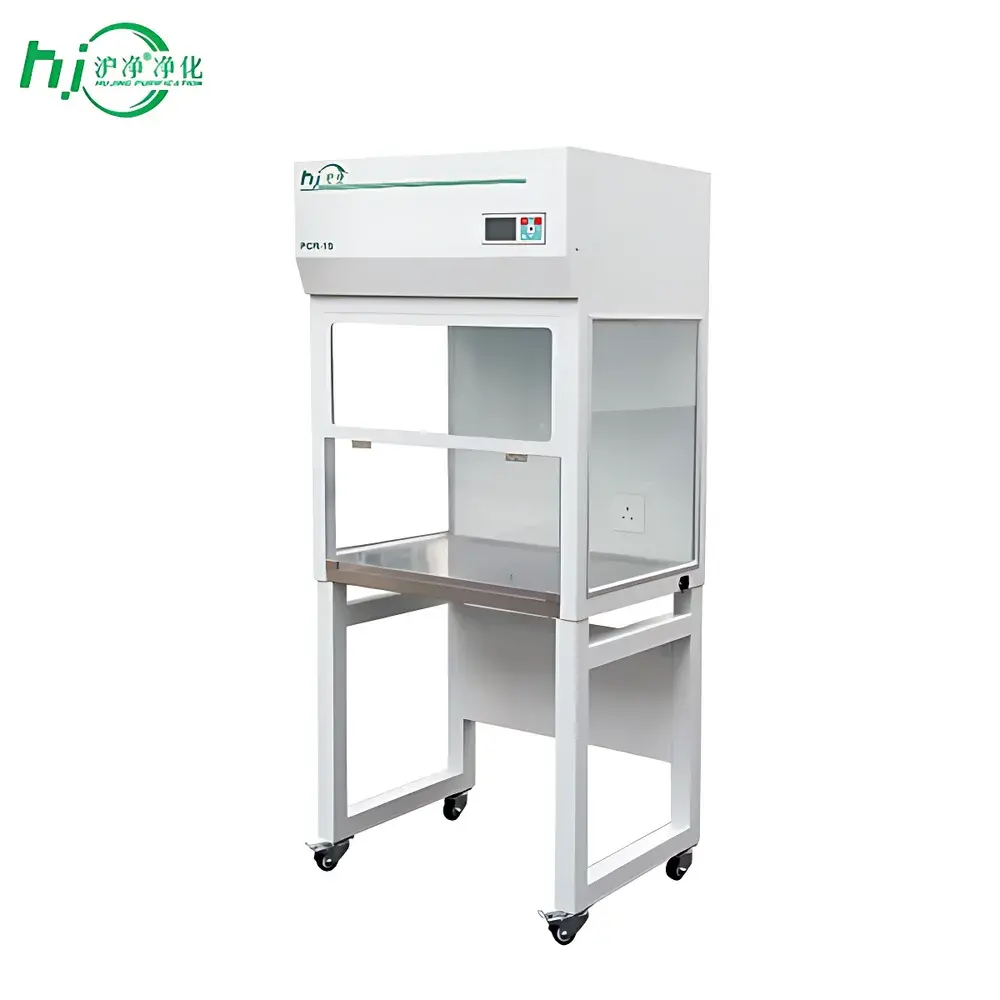
Hujing PCR-1S Vertical Laminar Flow Clean Bench
| Brand | Hujing Purification (HJ) |
|---|---|
| Origin | Shanghai, China |
| Manufacturer Type | Direct Manufacturer |
| Product Category | Domestic |
| Model | PCR-1S |
| Instrument Type | Vertical Laminar Flow Clean Bench |
| Cleanliness Class | ISO Class 5 (equivalent to Federal Standard 209E Class 100 @ ≥0.5 µm) |
| Noise Level | ≤62 dB(A) |
| User Capacity | 1 operator |
| Airflow Pattern | Vertical Downflow |
| Average Air Velocity | 0.25–0.45 m/s |
| Microbial Count | ≤0.5 CFU/plate·hour (Φ90 mm Petri dish) |
| Vibration | ≤5 µm (peak-to-peak, XYZ axes) |
| Illumination | ≥300 lux |
| Power Supply | AC 220 V, 50 Hz |
| Max. Power Consumption | 100 W |
| Net Weight | 80 kg |
| Work Area Dimensions (W×D×H) | 700 × 510 × 580 mm |
| Overall Dimensions (W×D×H) | 860 × 590 × 1620 mm |
| HEPA Filter Spec | 685 × 455 × 50 mm × 1 unit |
| Fluorescent Lamp | 12 W × 1 |
| UV Lamp | 20 W × 1 |
Overview
The Hujing PCR-1S Vertical Laminar Flow Clean Bench is an ISO Class 5-certified laminar flow workstation engineered specifically for polymerase chain reaction (PCR) sample preparation and other molecular biology applications requiring stringent particulate and microbial control. It operates on the principle of vertical unidirectional airflow: ambient laboratory air is drawn through a prefilter and then passed through a single-stage high-efficiency particulate air (HEPA) filter (rated at ≥99.99% efficiency for particles ≥0.3 µm), generating a continuous, uniform downflow of sterile air across the entire work surface. This airflow pattern minimizes turbulence and prevents cross-contamination between samples and reagents—critical for avoiding false positives in nucleic acid amplification workflows. The bench maintains a positive-pressure environment within the work chamber relative to the surrounding lab space, ensuring that filtered air consistently overflows outward at the front sash opening, thereby shielding the operator and the workspace from external airborne contaminants.
Key Features
- Optimized vertical laminar airflow design with precisely calibrated velocity range (0.25–0.45 m/s) to meet ISO 14644-1 Class 5 performance requirements under dynamic operating conditions.
- Ergonomic 10° forward-tilted work surface and stepped front edge configuration enhance operator comfort while improving containment integrity during full-sash closure.
- Integrated HEPA filtration system with factory-installed, certified 685 × 455 × 50 mm filter; filter life monitoring supported via pressure differential sensing (optional upgrade).
- Microprocessor-based digital controller with blue-backlit LCD display showing real-time airflow status, UV lamp operation time, and system fault indicators.
- Stainless steel monolithic work surface resistant to corrosion, thermal shock, and common decontamination agents (e.g., 70% ethanol, diluted sodium hypochlorite).
- Counterbalanced vertical sliding sash with dual side-view windows, enabling unrestricted lateral visibility and smooth, position-hold operation without mechanical assistance.
- Interlocked lighting and UV sterilization circuits: UV lamps deactivate automatically when the sash is raised above safe threshold; fluorescent illumination remains active during operation.
- Cold-rolled steel enclosure with electrostatic powder coating ensures structural rigidity, chemical resistance, and long-term dimensional stability in regulated laboratory environments.
Sample Compatibility & Compliance
The PCR-1S accommodates standard PCR consumables—including 0.2 mL tube racks, 96-well plates, pipette stands, mini-centrifuges, and thermal cyclers—within its 700 × 510 × 580 mm work area. Its ISO Class 5 performance is validated per ISO 14644-1:2015 and aligns with U.S. Federal Standard 209E Class 100 (≥0.5 µm). Microbial performance is verified using settle plate methodology (ISO 14698-1), achieving ≤0.5 CFU/plate·hour (Φ90 mm). While not classified as a biological safety cabinet (BSC), the PCR-1S complies with relevant electrical safety standards (IEC 61010-1) and electromagnetic compatibility (EMC) directives (IEC 61326-1). It supports GLP-compliant documentation practices through optional audit-trail-enabled firmware (requires Hujing DataLink Module).
Software & Data Management
The built-in microcontroller provides local parameter monitoring but does not include network connectivity or cloud-based data export by default. Optional firmware upgrades support RS-232 serial output for integration into centralized lab equipment monitoring systems. All operational logs—including UV exposure duration, filter runtime estimates, and error codes—are timestamped and stored locally for up to 30 days. For laboratories operating under FDA 21 CFR Part 11 or EU Annex 11 requirements, Hujing offers a validated software package (Hujing LabTrack v3.1) with electronic signatures, role-based access control, and immutable audit trails—available upon request and subject to site-specific validation protocols.
Applications
This clean bench is deployed primarily in molecular diagnostics, clinical research, and academic genomics labs where low-bioburden environments are essential for sensitive nucleic acid handling. Typical use cases include: pre-PCR template preparation and master mix assembly; plasmid cloning workflows; RNA extraction and cDNA synthesis; CRISPR guide RNA complex assembly; and quality control testing of oligonucleotide reagents. It is not intended for handling viable pathogens, human bloodborne agents, or volatile chemicals—applications requiring biosafety level 2 containment must utilize certified Class II BSCs instead.
FAQ
Is the PCR-1S certified to ISO Class 5 or Federal Standard 209E Class 100?
Yes—the unit is factory-tested and certified to ISO 14644-1 Class 5 (equivalent to FS209E Class 100 for particles ≥0.5 µm) under standard operating conditions.
Can this unit be used for cell culture work?
No. The PCR-1S provides particle-free air but offers no protection against aerosolized biological hazards or operator exposure. Cell culture requires a Class II biological safety cabinet.
What maintenance is required for the HEPA filter?
HEPA filter replacement is recommended every 12–18 months depending on usage frequency and ambient air quality; prefilter cleaning every 2 weeks extends filter service life.
Does the unit comply with FDA 21 CFR Part 11 for electronic records?
Out-of-the-box compliance is not included; however, the optional Hujing LabTrack software package supports Part 11 requirements when installed and validated per site-specific SOPs.
Is UV irradiation dose validated for DNA decontamination?
UV output (254 nm, 20 W) delivers ≥100 µW/cm² at the work surface when measured per IEC 62471, sufficient for routine surface decontamination of PCR carryover; full-cycle validation per ISO 15190 is recommended for diagnostic labs.



