
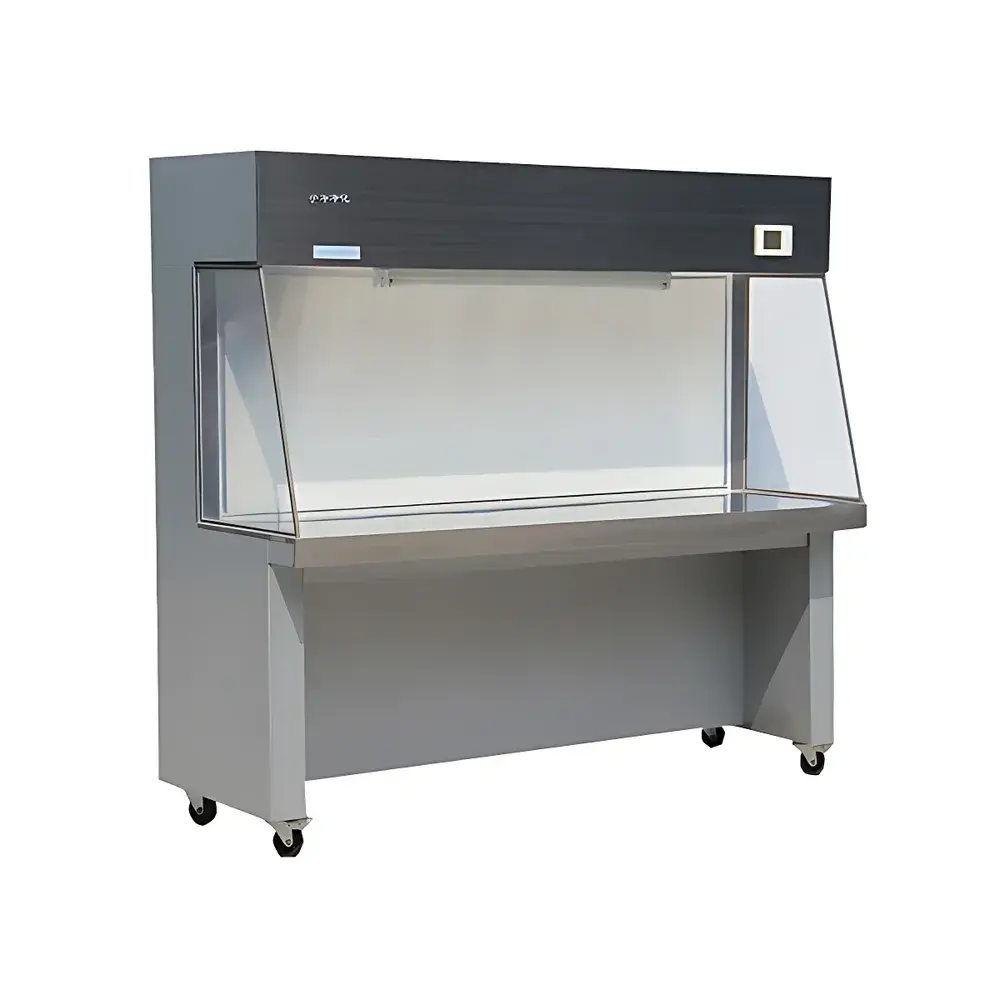
HJ SW-CJ-1CU Dual-Operator Vertical Laminar Flow Clean Bench
| Brand | HJ Purification |
|---|---|
| Origin | Shanghai, China |
| Manufacturer Type | Direct Manufacturer |
| Product Category | Domestic |
| Model | SW-CJ-1CU |
| Instrument Type | Vertical Laminar Flow Clean Bench |
| Cleanliness Class | ISO Class 5 (100 @ ≥0.5 µm, Fed. Std. 209E) |
| Noise Level | ≤62 dB(A) |
| Operator Capacity | Dual-Operator, Single-Face |
| Airflow Pattern | Vertical Downflow |
| Average Air Velocity | 0.25–0.45 m/s (dual-speed control) |
| Microbial Count | ≤0.5 CFU/plate·hour (Φ90 mm settle plate) |
| Vibration Peak-to-Peak | ≤10 µm (X/Y/Z axes) |
| Illuminance | ≥300 lx |
| Power Supply | AC 220 V / 50 Hz |
| Rated Power | 800 W |
| Net Weight | 150 kg |
| Work Area Dimensions (W×D×H) | 1785 × 510 × 600 mm |
| Overall Dimensions (W×D×H) | 1815 × 740 × 1465 mm |
| HEPA Filter Spec | 1675 × 600 × 38 mm (1 unit) |
| Lighting | 30 W fluorescent lamp (1 unit) |
| UV Lamp | 30 W germicidal lamp (1 unit) |
Overview
The HJ SW-CJ-1CU is a vertically oriented laminar flow clean bench engineered for routine aseptic operations in microbiology laboratories, pharmaceutical QC environments, and academic research settings where personnel protection is not required but product sterility must be rigorously maintained. Unlike biosafety cabinets, this clean bench provides unidirectional downward airflow—generated by a low-turbulence centrifugal blower—passing through a certified HEPA filter (≥99.99% efficiency at 0.3 µm) to deliver ISO Class 5 (Federal Standard 209E Class 100) air quality within the work area. The vertical downflow design minimizes turbulence-induced particle resuspension and ensures consistent velocity distribution across the full work surface (0.25–0.45 m/s, adjustable via dual-speed electronic control), supporting reliable handling of cell cultures, media preparation, sterile packaging, and sensitive instrumentation calibration.
Key Features
- Structural integrity: One-piece pre-painted steel enclosure with seamless joints; work surface fabricated from brushed 304 stainless steel for corrosion resistance, non-porosity, and compliance with cleaning validation protocols.
- Safety interlock system: UV germicidal lamp (30 W, 254 nm) automatically deactivates when the front sash is opened or the lighting circuit is energized—preventing accidental UV exposure during operation.
- Intuitive digital interface: Backlit LCD controller enables real-time monitoring and selection of fan speed (low/medium/high), UV timing (0–60 min preset), and illumination status—designed for glove-compatible interaction and GLP-compliant operational logging.
- Dual-stage filtration architecture: A washable aluminum pre-filter captures coarse particulates (>5 µm), significantly extending HEPA service life and reducing long-term maintenance frequency per ISO 14644-3 guidance.
- Acoustically optimized blower assembly: Integrated vibration-damping mounts and aerodynamically tuned ductwork ensure noise emission remains ≤62 dB(A) at 1 m distance—meeting ISO 7779 and ANSI S12.55 requirements for laboratory ambient noise control.
Sample Compatibility & Compliance
The SW-CJ-1CU accommodates standard Petri dishes, tissue culture flasks (T25–T225), pipette racks, weighing boats, and small-scale bioreactors up to 300 mm in height. Its 1785 mm wide work zone supports side-by-side dual-operator workflows without cross-contamination risk, provided procedural discipline (e.g., staggered arm movement, unidirectional material transfer) is observed. The unit complies with GB/T 16292–2010 (Chinese standard for cleanroom airborne particle counts), aligns with ISO 14644-1:2015 Class 5 performance thresholds, and satisfies electrical safety requirements per IEC 61010-1:2010 for laboratory equipment. While not rated for biohazardous agents, it meets prerequisite conditions for USP environmental controls in non-hazardous sterile compounding areas when operated in ISO Class 7–8 background environments.
Software & Data Management
This clean bench operates as a standalone hardware platform with no embedded firmware-based data logging or network connectivity. All operational parameters—including fan speed selection, UV exposure duration, and illumination state—are manually set and retained only during active power cycles. For regulated environments requiring audit trails (e.g., FDA 21 CFR Part 11, EU Annex 11), users must implement external documentation practices: manual entry into bound logbooks, timestamped photographic records of pre-use UV sterilization cycles, and periodic third-party HEPA filter integrity testing reports (e.g., DOP/PAO scanning per ISO 14644-3). Optional integration with building management systems (BMS) is feasible via dry-contact relay outputs for status signaling (fan on/off, UV active).
Applications
- Microbiological assays: Aseptic inoculation of agar plates, serial dilution preparation, and colony isolation under controlled particle-free conditions.
- Pharmaceutical QC: Sterile sampling of bulk drug substances, visual inspection of parenteral vials, and preparation of reference standards per USP general chapters , .
- Cell culture support: Handling of primary cells and established lines during passaging, transfection reagent addition, and cryovial recovery—provided compatible with laminar flow best practices.
- Electronics and optics: Assembly and inspection of precision components sensitive to sub-micron particulate deposition, including photomasks and laser optics.
- Educational labs: Demonstrating fundamental principles of air filtration, fluid dynamics in laminar flow fields, and contamination control methodology.
FAQ
Is the SW-CJ-1CU suitable for working with pathogenic microorganisms?
No. This is a clean bench—not a biological safety cabinet—and provides no personnel or environmental protection against aerosolized biohazards.
What HEPA filter replacement interval is recommended?
Under typical usage (6–8 hrs/day, ISO Class 8 ambient), replace every 18–24 months; extendable to 36 months with rigorous pre-filter maintenance and annual integrity testing.
Can the unit be installed in a non-temperature-controlled room?
Yes, but ambient temperature must remain between 15–30°C and relative humidity below 70% to prevent condensation on internal surfaces and maintain filter efficiency.
Does the UV lamp meet NSF/ANSI 50 standards for germicidal efficacy?
The 30 W low-pressure mercury lamp emits >90% of output at 254 nm and achieves ≥30 mJ/cm² fluence at 15 cm distance in 30 minutes—sufficient for surface decontamination per ISO 15714, though not NSF-certified as a standalone device.
Is electrical grounding mandatory for safe operation?
Yes. The unit requires a dedicated grounded AC 220 V / 50 Hz circuit with earth leakage protection (RCD/GFCI) per IEC 60364-7-710 to prevent shock hazard during wet-cleaning procedures.



