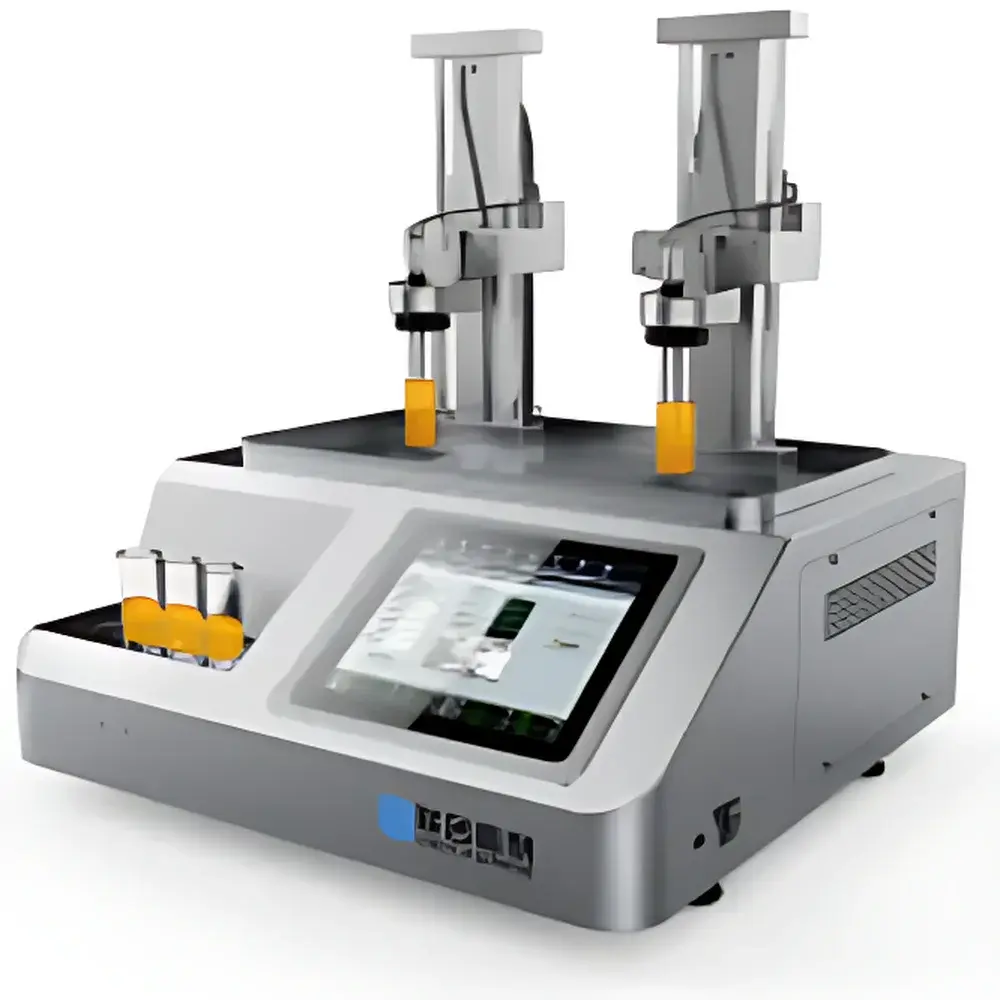
KARRIE EPP110M Fully Automated Pour Point, Cloud Point and Cold Filter Plugging Point (CFPP) Analyzer
| Brand | KARRIE |
|---|---|
| Model | EPP110M |
| Standards Compliance | GB/T 3535, GB/T 6986, GB/T 510, ISO 3015, ISO 3016, ASTM D97, ASTM D5950, SH/T 0248 |
| Cooling Method | Semiconductor-based Refrigeration |
| Temperature Range | –51 °C to +45 °C |
| Cold Bath Control Range | –68 °C to +45 °C |
| Temperature Stability | ±0.1 °C |
| Repeatability | ≤3 °C |
| Reproducibility | ≤6 °C |
| Display | 10.4″ Color LCD (800×600) |
| Power Supply | AC 220 V, 50 Hz |
| Rated Power | 1500 W |
| Dimensions (L×W×H) | 645 × 660 × 800 mm |
| Weight | 45 kg |
| Interface Options | USB, RS232, RJ45, Wi-Fi |
| Data Storage Capacity | >10,000 test records with time/sample/operator-based query |
Overview
The KARRIE EPP110M Fully Automated Pour Point, Cloud Point and Cold Filter Plugging Point (CFPP) Analyzer is engineered for precise, standardized low-temperature performance evaluation of petroleum products—including diesel fuels, lubricating oils, jet fuels, and crude fractions—under controlled thermal conditions. It operates on the principle of sequential cooling and visual or optical detection of flow cessation (pour point), phase separation onset (cloud point), and filter blockage under vacuum (CFPP), in strict accordance with internationally harmonized test protocols. The instrument integrates two thermally isolated cooling baths, each independently programmable and capable of concurrent execution of different test methods on separate samples. This dual-bath architecture eliminates cross-test interference and supports method-comparative analysis within a single run cycle—critical for quality control laboratories requiring high throughput without compromising metrological integrity.
Key Features
- Dual independent semiconductor-cooled baths enable simultaneous determination of pour point, cloud point, and CFPP on two distinct samples—without thermal crosstalk or operational delay.
- Patented liquid surface solidification detection system (Patent No. ZL202021211364.1) provides objective, operator-independent endpoint identification by monitoring meniscus immobilization via high-resolution optical sensing—eliminating subjective visual interpretation errors.
- User-configurable test parameters include initial detection temperature, cooling interval (1–3 °C), tilt frequency, pre-heating activation (with adjustable duration and setpoint), and alarm thresholds—supporting method adaptation per sample matrix or regulatory requirement.
- Integrated automatic functions: staged cooling ramping, timed sample tilting, real-time bath temperature stabilization, and endpoint confirmation logic—all executed without manual intervention.
- High-stability temperature control (±0.1 °C) across the full operating range (–68 °C to +45 °C) ensures compliance with stringent repeatability (≤3 °C) and reproducibility (≤6 °C) requirements defined in ASTM, ISO, and GB standards.
- Robust hardware design incorporates imported critical components—including precision thermistors, corrosion-resistant bath vessels, and sealed semiconductor modules—ensuring long-term reliability in continuous laboratory operation.
Sample Compatibility & Compliance
The EPP110M accommodates standard ASTM/ISO-compliant sample containers: pour point test cups (EPP110), cloud point test tubes (EPP110D), and CFPP-specific suction pipettes and filtration assemblies (EPP110F). It is validated for use with distillate fuels (EN 590, ASTM D975), marine fuels (ISO 8217), aviation turbine fuels (ASTM D1655), and base oils (ASTM D2500). All test procedures align with mandatory regulatory frameworks—including EPA fuel certification, EU EN 14214 biodiesel specifications, and China’s GB 17930 gasoline and GB 252 diesel standards. Instrument calibration traceability follows ISO/IEC 17025 requirements, and built-in bath temperature verification supports routine GLP audit readiness.
Software & Data Management
The embedded Linux-based control interface features a 10.4″ capacitive touchscreen with intuitive icon-driven navigation—compatible with keyboard, mouse, or stylus input. Test data—including raw temperature/time logs, endpoint timestamps, user annotations, and system diagnostic flags—are stored locally in encrypted binary format with timestamped metadata. Over 10,000 test records can be archived and retrieved via flexible search filters (date range, sample ID, operator name, test type). Export options include CSV and PDF reports compliant with FDA 21 CFR Part 11 requirements when integrated with validated LIMS environments (e.g., Thermo Fisher SampleManager, LabVantage). Network connectivity via RJ45 Ethernet, Wi-Fi, or RS232 enables remote monitoring, firmware updates, and centralized data aggregation in multi-instrument labs.
Applications
This analyzer serves core analytical workflows in refinery QC/QA labs, third-party testing facilities, and R&D centers focused on fuel formulation, cold-flow improver evaluation, and winter-grade specification validation. Typical use cases include: verification of diesel fuel compliance with EN 590 Class F (–20 °C CFPP); assessment of biofuel blend stability at sub-zero temperatures; monitoring wax crystallization kinetics in heavy crudes; and supporting ASTM D6377 vapor pressure correlation studies where cloud point defines upper operational limits. Its dual-bath capability also facilitates comparative method validation—e.g., cross-checking ASTM D5950 (CFPP) against ISO 3016 (pour point) on identical batches—reducing inter-laboratory variability.
FAQ
Does the EPP110M support fully unattended overnight testing?
Yes—once parameters are configured and samples loaded, the instrument executes complete cooling, detection, and reporting cycles autonomously, including automatic shutdown after final result confirmation.
Can test methods be customized beyond standard ASTM/ISO protocols?
Yes—users may define non-standard cooling rates, hold times, and tilt sequences via the advanced programming mode, provided such modifications are documented for internal method validation.
Is external calibration required for temperature sensors?
The system includes built-in NIST-traceable reference junctions and supports two-point bath calibration using certified PT100 probes—no external recalibration service is needed under normal operation.
How is data integrity maintained during power interruption?
Non-volatile memory preserves all active test states and partial results; upon power restoration, the instrument resumes from the last stable checkpoint without data loss.
What maintenance intervals are recommended for semiconductor cooling modules?
Under typical usage (≤8 hrs/day), no scheduled maintenance is required; periodic inspection of condensate drainage and ambient air filter cleaning every 6 months ensures optimal thermal efficiency.