Karrie EPP110F Fully Automatic Cold Filter Plugging Point (CFPP) Analyzer
| Brand | Karrie |
|---|---|
| Model | EPP110F |
| Application | Petroleum Low-Temperature Property Testing |
| Standard Compliance | SH/T 0248 |
| Temperature Range | −68 °C to +45 °C |
| Temperature Control Accuracy | ±0.1 °C |
| Repeatability | ≤2 °C |
| Reproducibility | ≤4 °C |
| Display | 10.4″ Color LCD (800×600) |
| Power Supply | AC 220 V, 50 Hz |
| Rated Power | 1500 W |
| Dimensions (L×W×H) | 645×660×800 mm |
| Weight | 45 kg |
| Cooling Method | External Recirculating Chiller |
| Interface Options | USB, RS-232, RJ45, Wi-Fi |
| Data Storage Capacity | >10,000 test records |
Overview
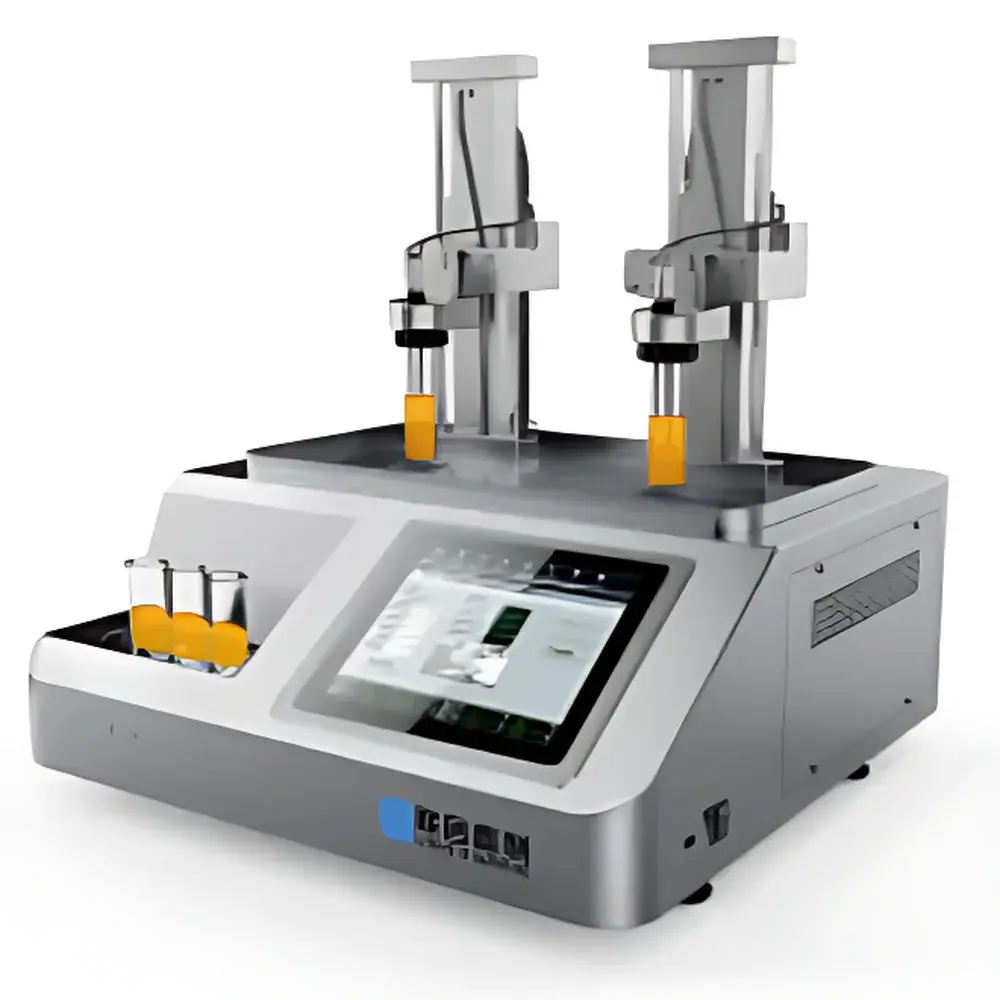
The Karrie EPP110F Fully Automatic Cold Filter Plugging Point (CFPP) Analyzer is an engineered solution for precise, standardized determination of the cold filter plugging point of diesel fuels, middle distillates, and related petroleum products in accordance with SH/T 0248 — the Chinese national standard equivalent to ASTM D6371 and ISO 3016. CFPP is a critical low-temperature performance parameter that indicates the lowest temperature at which a given fuel can pass through a standardized wire mesh filter under specified vacuum and flow conditions. Unlike cloud point or pour point measurements, CFPP directly reflects real-world operability in fuel filtration systems during cold ambient conditions. The EPP110F employs a dual-bath architecture with independent thermal control, enabling concurrent analysis of two samples without cross-interference — a configuration essential for laboratory throughput, method validation, and comparative batch testing. Its core measurement principle relies on automated sequential cooling, timed suction cycles, and real-time visual monitoring of filtrate flow through a 45-µm stainless-steel mesh, all governed by programmable logic that strictly enforces the stepwise temperature decrement protocol defined in SH/T 0248.
Key Features
- Dual independent test baths — each bath operates under separate PID-controlled thermal regulation, allowing simultaneous CFPP determinations on two distinct samples while maintaining full compliance with SH/T 0248 timing and temperature ramp requirements.
- Integrated external recirculating chiller interface — supports connection to industrial-grade low-temperature chillers capable of achieving and stabilizing bath temperatures from −68 °C to +45 °C with ±0.1 °C precision.
- Real-time optical observation window — enables direct visual confirmation of filtrate flow cessation, supporting operator verification and troubleshooting without interrupting automated sequences.
- Intelligent sample detection — capacitive sensing system automatically confirms presence and correct positioning of the test cup prior to test initiation, preventing erroneous runs due to missing or misaligned samples.
- Configurable thermal pre-conditioning — users may define optional pre-heating steps (including target temperature and duration) to ensure consistent thermal history across samples, reducing inter-test variability.
- Full parametric programmability — operators set initial test temperature, temperature decrement interval (1–3 °C), suction duration, vacuum level, and alarm thresholds via intuitive touchscreen or external input devices.
- Robust hardware construction — critical components including temperature sensors, solenoid valves, vacuum regulators, and filtration assemblies are sourced from internationally certified suppliers to ensure long-term stability and measurement reproducibility.
Sample Compatibility & Compliance
The EPP110F is validated for use with a broad range of petroleum-based liquid fuels, including but not limited to ultra-low-sulfur diesel (ULSD), biodiesel blends (B5–B20), heating oils, kerosene, and light lubricating oil fractions. It accommodates standard SH/T 0248 test vessels (45-mL sample cups), 20-mL graduated suction pipettes, and 45-µm stainless-steel filter assemblies. All operational logic, timing sequences, and acceptance criteria adhere strictly to SH/T 0248, ensuring data traceability and regulatory acceptability in domestic quality control laboratories. While not certified to ISO/IEC 17025 as a standalone system, the instrument’s design supports GLP-compliant workflows when deployed within auditable laboratory environments — including mandatory audit trails for method changes, user logins, and result modifications when integrated with LIMS via its native Ethernet (RJ45), USB, or Wi-Fi interfaces.
Software & Data Management
The embedded firmware provides a full-featured, menu-driven interface displayed on a high-resolution 10.4″ color LCD (800×600). All test parameters, calibration logs, and raw acquisition timestamps are stored locally in non-volatile memory. The system maintains over 10,000 complete test records, indexed by date/time stamp, operator ID, sample ID, and test method version. Search functionality allows Boolean-combined queries — e.g., “all CFPP results for Sample Batch #X between Jan–Mar 2024, performed by Operator Y.” Export options include CSV via USB mass storage or direct network transfer to LIMS platforms using TCP/IP protocols. Optional firmware upgrades support FDA 21 CFR Part 11-compliant electronic signatures and audit trail generation when paired with validated third-party laboratory information management software.
Applications
- Quality assurance in refinery final product release testing for diesel and jet fuel specifications.
- Formulation development of cold-flow improver (CFI) additives and evaluation of their efficacy across multiple base stocks.
- Batch-to-batch consistency monitoring in fuel blending operations and terminal storage facilities.
- Contract laboratory service delivery for third-party certification and regulatory submission packages.
- Educational use in petroleum engineering curricula for hands-on instruction in low-temperature fuel behavior and standardized test methodology.
FAQ
What standards does the EPP110F comply with?
The instrument fully implements SH/T 0248 and is functionally compatible with ASTM D6371 and ISO 3016 methodologies.
Can the EPP110F operate without an external chiller?
No — it requires connection to a certified external recirculating chiller capable of reaching −68 °C; no internal compressor is included.
Is remote monitoring or control supported?
Yes — via built-in Wi-Fi, Ethernet (RJ45), or RS-232, enabling integration with central lab monitoring systems and LIMS.
How is calibration verified?
The system supports manual bath temperature offset correction using NIST-traceable reference thermometers; calibration logs are stored with user attribution and timestamp.
What maintenance intervals are recommended?
Filter assemblies and suction pipettes should be cleaned after every 5–10 tests; annual verification of temperature sensor linearity and vacuum regulator response is advised per internal SOPs.