
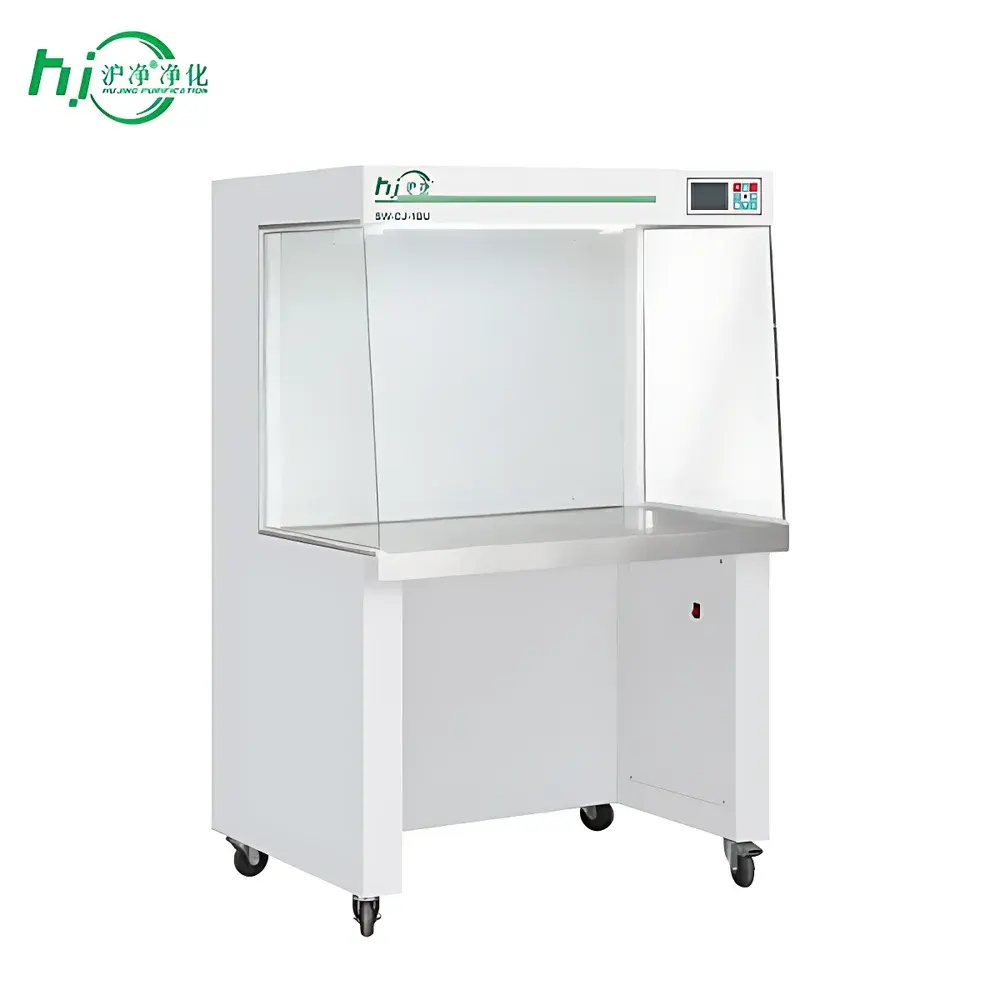
Hujing SWCJ-1BU Stainless Steel Horizontal Laminar Flow Clean Bench
| Brand | Hujing Purification (HJ) |
|---|---|
| Origin | Shanghai, China |
| Manufacturer Type | Direct Manufacturer |
| Product Category | Domestic |
| Model | SWCJ-1BU |
| Instrument Type | Horizontal Laminar Flow Clean Bench |
| Cleanliness Class | ISO Class 5 (equivalent to Fed. Std. 209E Class 100 @ ≥0.5 µm) |
| Noise Level | ≤62 dB(A) |
| User Capacity | Single-user, single-front configuration |
| Airflow Pattern | Horizontal laminar flow |
| Work Surface Material | SUS304 brushed stainless steel |
| Cabinet Material | Cold-rolled steel with electrostatic powder coating |
| Filtration System | Pre-filter + HEPA filter (H14, ≥99.995% @ 0.3 µm) |
| Average Air Velocity | 0.25–0.45 m/s |
| Illumination | ≥300 lx (fluorescent lamp, 12 W) |
| UV Lamp | 12 W, timer-equipped (safety interlocked with lighting) |
| Power Supply | AC 220 V / 50 Hz |
| Max. Power Consumption | 490 W |
| Net Weight | 90 kg |
| Work Area Dimensions (W×D×H) | 900 × 510 × 600 mm |
| External Dimensions (W×D×H) | 930 × 740 × 1440 mm |
| Vibration | ≤5 µm (peak-to-peak, X/Y/Z axes) |
| Microbial Recovery | ≤0.5 CFU/plate·hour (Φ90 mm settle plate) |
Overview
The Hujing SWCJ-1BU Stainless Steel Horizontal Laminar Flow Clean Bench is an ISO Class 5-certified containment system engineered for non-hazardous applications requiring particulate-free environments. It operates on the principle of horizontal unidirectional airflow: air is drawn through a pre-filter to remove coarse particulates, then passed through an H14-grade HEPA filter (≥99.995% efficiency at 0.3 µm), and delivered across the work surface at a uniform velocity of 0.25–0.45 m/s. This laminar stream creates a sterile barrier that sweeps contaminants away from the operator and out of the working zone—ideal for aseptic handling of cell cultures, microbiological media preparation, pharmaceutical compounding, and precision electronics assembly. Unlike vertical flow cabinets, the SWCJ-1BU directs filtered air horizontally toward the user, eliminating turbulence at the rear wall and minimizing cross-contamination risk in open-bench workflows.
Key Features
- Robust all-steel construction: Cold-rolled steel cabinet with electrostatic powder coating ensures structural integrity, corrosion resistance, and long-term dimensional stability under laboratory conditions.
- SUS304 brushed stainless steel work surface: Non-porous, non-shedding, and compatible with common disinfectants (e.g., 70% ethanol, sodium hypochlorite); facilitates rapid decontamination and meets GLP-compliant surface hygiene requirements.
- Interlocked UV and lighting system: UV lamp (12 W) activates only when the sash is fully closed and lighting is off—preventing accidental exposure and ensuring operator safety per IEC 62471 photobiological safety guidelines.
- Digital LCD control panel: Enables real-time monitoring of operational status, UV timer setting (0–60 min), and fan speed adjustment—supporting reproducible setup across shifts and users.
- Adjustable sash mechanism: Precision-engineered counterbalanced vertical sash allows smooth, tool-free positioning at any height—optimizing ergonomics while maintaining laminar integrity across variable workflow heights.
- Integrated pre-filter + HEPA filtration: Dual-stage design extends HEPA service life and reduces maintenance frequency; filter replacement indicators are accessible via front panel access without disassembly.
Sample Compatibility & Compliance
The SWCJ-1BU accommodates standard Petri dishes, tissue culture flasks (T25–T175), glassware up to 300 mm tall, and small-scale instrumentation (e.g., pipette controllers, microcentrifuges). Its open-front architecture supports glove-free manipulation where operator dexterity is critical. The unit complies with ISO 14644-1:2015 (cleanroom classification), ISO 14644-3:2019 (test methods), and adheres to key elements of USP environmental controls for non-sterile compounding. While not certified for biosafety level (BSL) containment, it satisfies ISO Class 5 performance criteria verified via particle counters (e.g., Met One GT-321) and microbial settle plate assays (ASTM D6841-03) conducted annually or after filter replacement.
Software & Data Management
This clean bench operates as a standalone mechanical system with no embedded firmware or network interface. All operational parameters—including UV exposure duration, fan runtime, and maintenance logs—are recorded manually per facility SOPs. The digital interface retains last-set values after power cycling, supporting continuity in regulated environments. For GMP/GLP traceability, users are advised to integrate the unit into broader facility logbooks or CMMS platforms using standardized entries (e.g., “SWCJ-1BU-01: HEPA replaced 2024-05-12; post-replacement particle test passed per ISO 14644-3 Annex B”). No data export or electronic audit trail is provided natively, consistent with Class I medical device-equivalent equipment per FDA 21 CFR Part 820.
Applications
- Aseptic transfer of mammalian and insect cell lines in academic and contract research laboratories.
- Preparation of agar plates, broth media, and antibiotic stock solutions under controlled low-bioburden conditions.
- Assembly and inspection of optical components, semiconductor wafers, and MEMS devices sensitive to sub-micron particulates.
- Non-hazardous formulation activities in pharmaceutical R&D, including excipient blending and capsule filling pre-validation studies.
- Quality control sampling in food and beverage testing labs where ambient airborne flora must be excluded during plating procedures.
FAQ
What ISO cleanliness class does the SWCJ-1BU achieve, and how is it verified?
It meets ISO Class 5 (equivalent to Fed. Std. 209E Class 100) for particles ≥0.5 µm, validated using calibrated light-scattering particle counters per ISO 14644-3:2019 Annex B.
Can this unit be used for handling hazardous biological agents?
No—it provides personnel and product protection only; it is not a biosafety cabinet and offers no protection against aerosolized pathogens or toxic chemicals.
Is the HEPA filter certified to EN 1822 or IEST-RP-CC001 standards?
Yes—the installed H14 filter carries independent third-party certification confirming ≥99.995% retention at MPPS (most penetrating particle size) of 0.3 µm.
What maintenance intervals are recommended for optimal performance?
Pre-filter cleaning every 2 weeks; HEPA integrity testing semiannually; full filter replacement every 18–24 months depending on ambient air quality and usage frequency.
Does the unit include documentation compliant with EU Declaration of Conformity?
Yes—CE-marked units ship with technical files, EC Declaration of Conformity (2014/30/EU EMC Directive and 2014/35/EU LVD Directive), and ISO 9001:2015 manufacturing certification.



