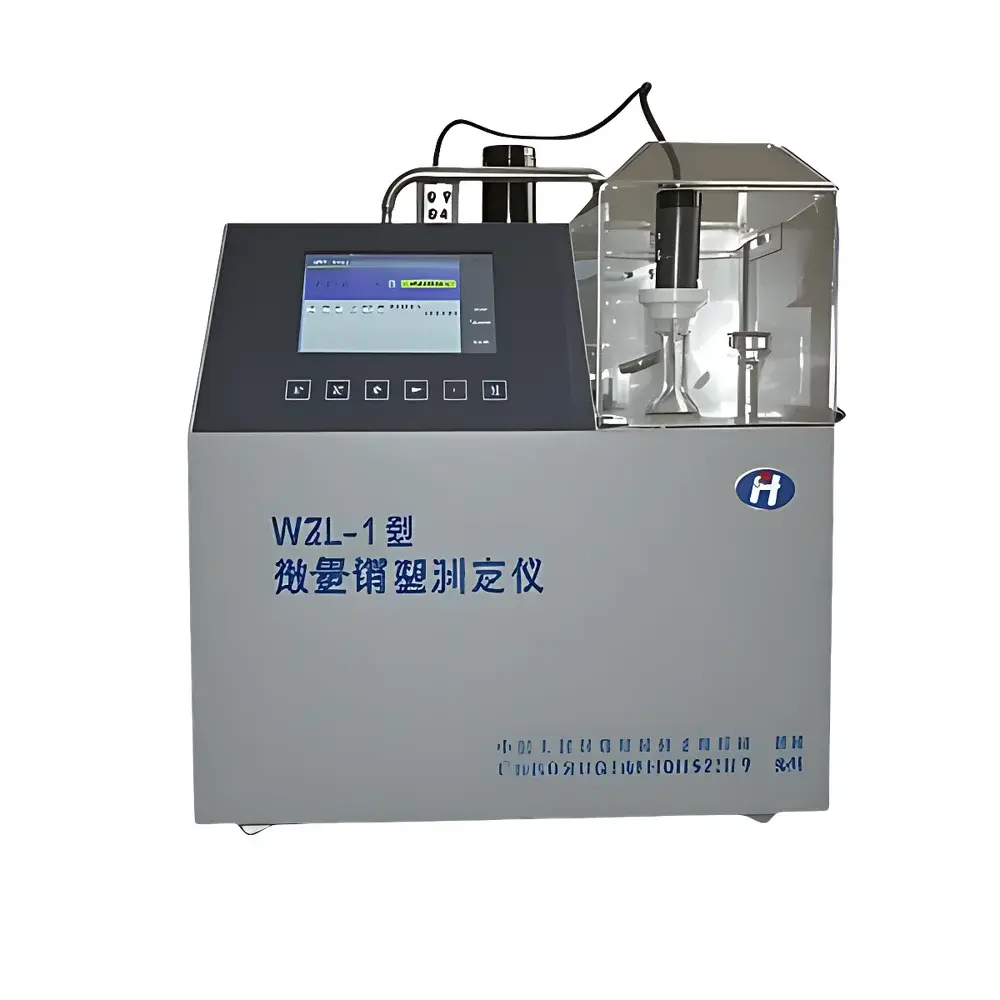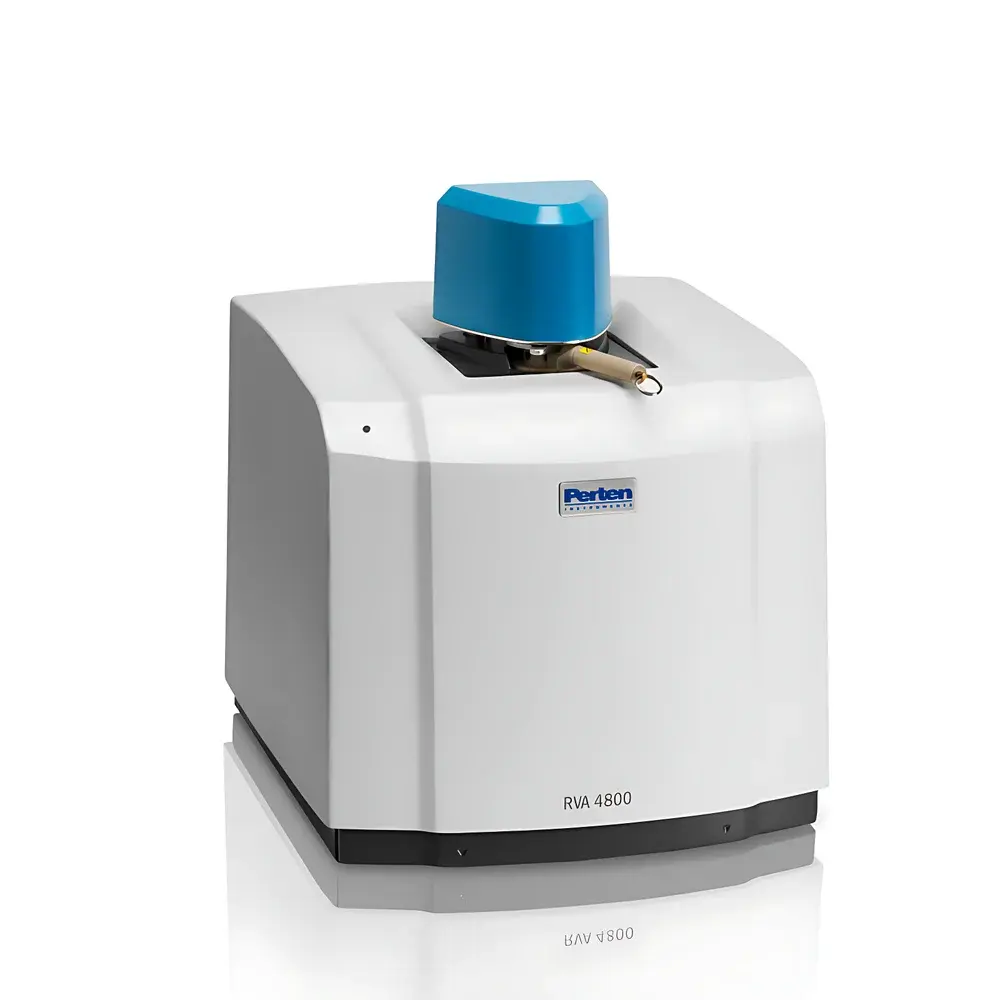
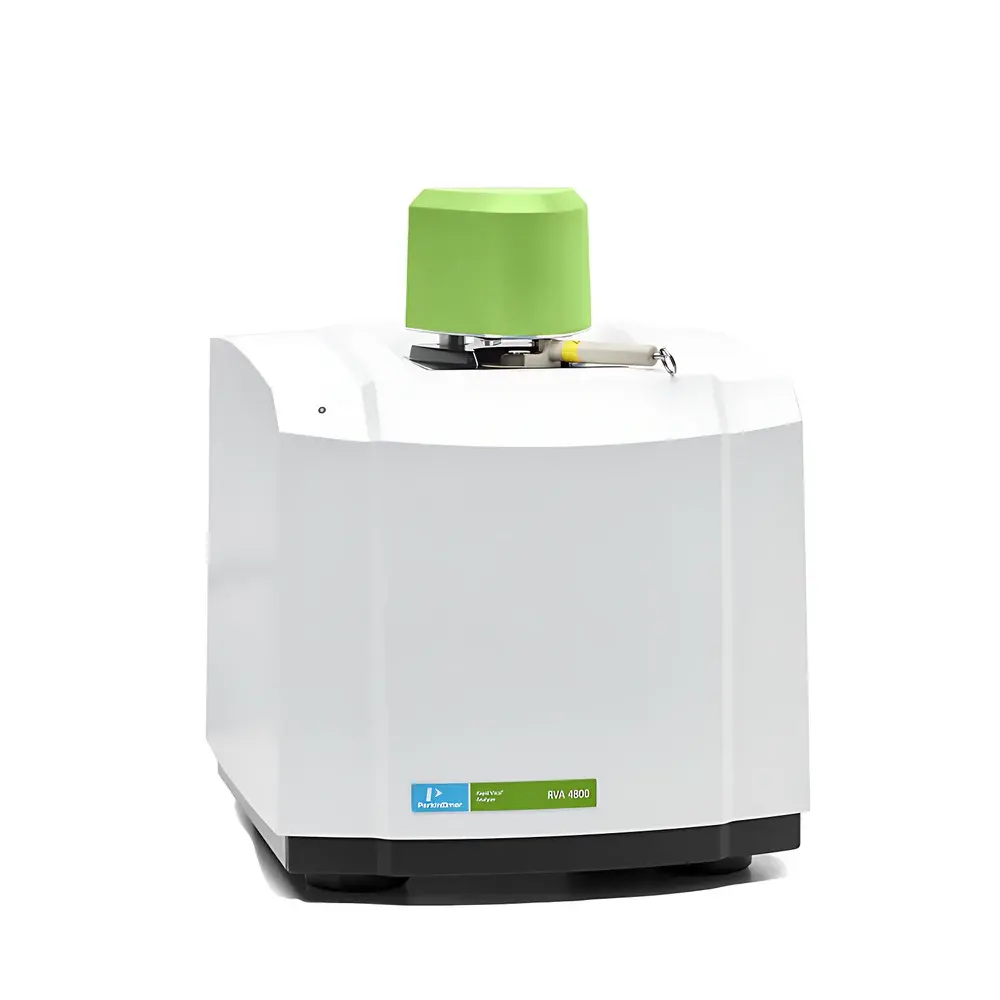
Perten RVA 4800 Rapid Visco Analyzer
| Brand | Perten |
|---|---|
| Origin | Imported |
| Model | RVA 4800 |
| Temperature Range | Up to 140 °C |
| Viscosity Range | 20–50,000 cP (at 80 rpm) |
| Sample Mass | 2–3 g |
| Test Duration | 3 min (stirring value), 13 min (standard starch gelatinization) |
| Compliance | GB/T 22427.7–2023, GB/T 24852–2010, GB/T 24853–2010, AACC 61-02, AACC 22-08, AACC 76-21 |
| Software | TCW3 with 67 pre-validated methods |
| Interface | PC-connected via USB/RS-232 |
Overview
The Perten RVA 4800 Rapid Visco Analyzer is a precision-controlled rotational viscometer engineered for the dynamic characterization of starch gelatinization, thermal stability, and shear-dependent rheological behavior under programmable temperature and shear profiles. Operating on the principle of controlled-shear viscometry—where torque response to defined angular velocity is measured in real time—the instrument applies precise thermal ramps (up to 140 °C) and variable rotational speeds (e.g., 80 or 160 rpm) to simulate industrial processing conditions including UHT sterilization, extrusion, retorting, and steam cooking. Unlike static viscosity measurements, the RVA 4800 captures time-resolved viscosity curves (viscograms), enabling quantitative derivation of critical functional parameters: onset temperature, peak viscosity, holding viscosity, breakdown, setback, and final viscosity. Its design adheres to the fundamental requirements of standardized starch and cereal-based food testing, serving as a validated surrogate for full-scale process trials during formulation development and quality assurance.
Key Features
- Thermal capability up to 140 °C—enabling simulation of ultra-high-temperature processing such as UHT dairy treatment and aseptic canning.
- High-speed analysis: stirring value determination in ≤3 minutes; full starch gelatinization profile in ≤13 minutes.
- Low sample consumption (2–3 g), minimizing raw material waste and supporting high-throughput screening.
- Dual-speed operation (80 rpm and 160 rpm) with calibrated torque sensing across broad viscosity ranges (10–50,000 cP).
- Robust stainless-steel sample canister and thermally insulated heating block ensuring reproducible heat transfer and minimal thermal lag.
- Modular firmware architecture compatible with method-driven workflows and audit-ready data capture.
Sample Compatibility & Compliance
The RVA 4800 is validated for use with native and modified starches, flours, hydrocolloids (e.g., guar gum, xanthan, carrageenan), dairy blends, cereal-based slurries, and formulated food intermediates. It supports compliance with internationally recognized standard methods including ASTM-aligned AACC protocols (AACC 61-02 for rice gelatinization, AACC 22-08 for stir number, AACC 76-21 for flour paste viscosity), as well as Chinese national standards GB/T 22427.7–2023 (starch viscosity), GB/T 24852–2010 (rice and rice flour), and GB/T 24853–2010 (wheat and rye). All test methods are implemented with traceable calibration routines and documented thermal ramp fidelity, facilitating GLP-compliant laboratory operations and regulatory submissions where required.
Software & Data Management
Controlled exclusively via Perten’s TCW3 software, the RVA 4800 integrates method library management, real-time curve visualization, automated parameter extraction, and export-ready reporting. The TCW3 platform hosts 67 pre-validated methods—including those aligned with AACC, ISO, and GB standards—and allows users to define custom thermal profiles (heating/cooling rates, hold durations, shear transitions) with sub-degree temperature resolution and ±0.5 °C accuracy. Raw viscosity-time-temperature datasets are stored with embedded metadata (operator ID, timestamp, method version, instrument serial number), supporting 21 CFR Part 11–compliant electronic records when deployed with appropriate system validation and user access controls. Export formats include CSV, PDF, and XML for integration into LIMS or statistical process control platforms.
Applications
- Starch & Ingredient Development: Quantifying gelatinization kinetics, retrogradation tendency, and shear-thinning behavior of native, pregelatinized, or cross-linked starches.
- Dairy Processing: Evaluating thickener performance under UHT conditions; predicting cheese melt behavior, yogurt syneresis, and ice cream mix stability.
- Bakery & Noodle Production: Assessing flour enzyme activity (α-amylase), damaged starch content, and climate-induced quality variation affecting dough handling and final texture.
- Hydrocolloid Optimization: Characterizing synergistic interactions between starches and gums (e.g., amylose–xanthan complexes) under thermal stress.
- Process Scale-Up Support: Serving as a miniature process simulator—validating new formulations or thermal treatments prior to pilot or commercial production runs.
- QC/QA Laboratories: Routine monitoring of incoming raw materials (e.g., corn starch, tapioca, wheat flour) against specification limits using statistically robust control charts.
FAQ
What temperature accuracy does the RVA 4800 maintain across its operating range?
The instrument achieves ±0.5 °C accuracy from ambient to 140 °C, verified per internal calibration routine traceable to NIST-certified references.
Can the RVA 4800 comply with FDA 21 CFR Part 11 requirements?
Yes—when configured with TCW3 v4.2+ and deployed within a validated environment (including role-based access, electronic signatures, and audit trail activation), it supports Part 11 compliance for regulated food and pharmaceutical applications.
Is method transfer possible between different RVA generations?
TCW3 maintains backward compatibility with method files from earlier Perten RVA models (e.g., RVA 3D, RVA 4), provided thermal and shear profiles fall within the 4800’s mechanical and thermal specifications.
How is viscosity calibration performed?
Calibration uses certified Newtonian reference oils (e.g., Cannon-Manning series) at multiple temperatures and rotational speeds, with torque sensor verification conducted annually or after major maintenance.
Does the system support GMP/GLP documentation workflows?
Yes—TCW3 generates instrument qualification reports (IQ/OQ), method validation templates, and raw data archives with immutable timestamps and operator attribution, aligning with ICH and AOAC guidelines for food testing laboratories.
Related Products