
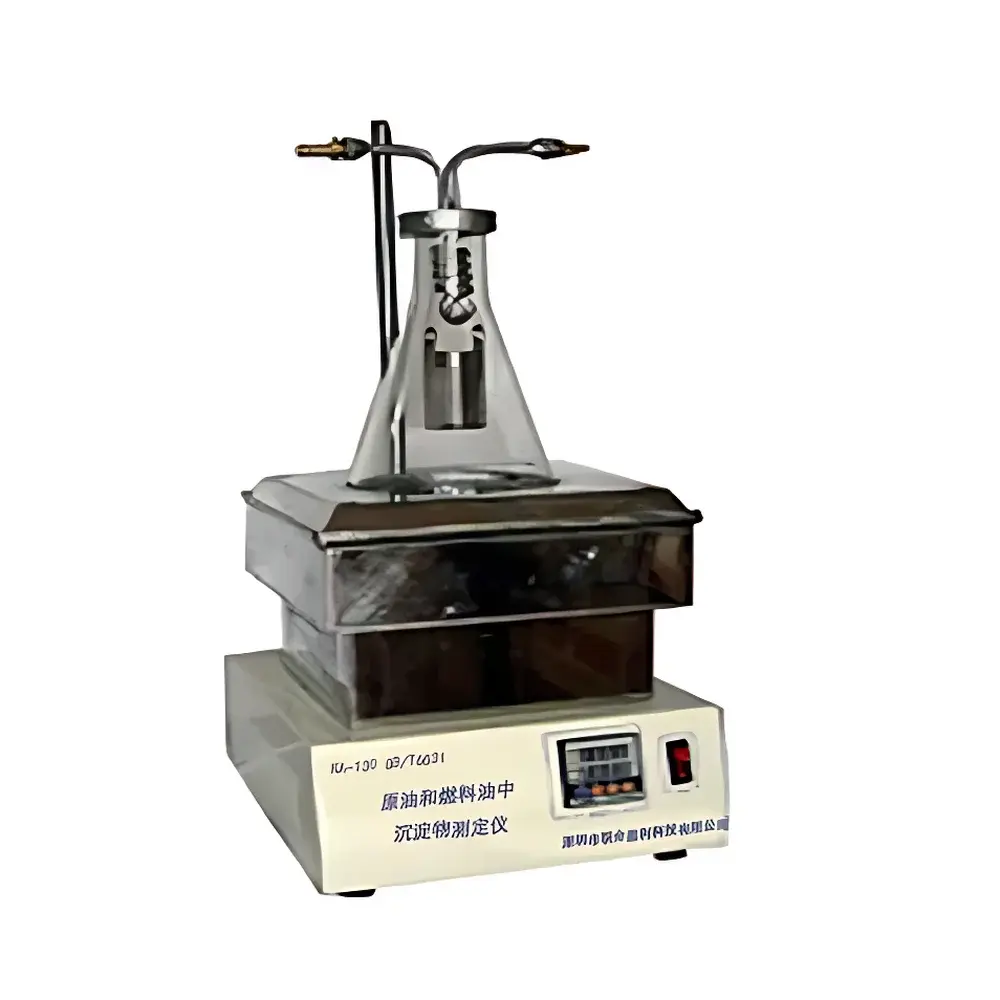
KA-130 Karrie Petroleum Sediment Analyzer for Crude Oil and Fuel Oils
| Brand | Karrie (KARRIE) |
|---|---|
| Origin | Shenzhen, China |
| Model | KA-130 |
| Applicable Standards | GB/T 6531, ISO 3735, ASTM D473 |
| Heating Method | Infrared Heating |
| Temperature Range | Ambient to 120 °C ±0.5 °C |
| Temperature Control Accuracy | ±0.5 °C |
| Power Supply | AC 220 V ±10%, 50 Hz |
| Sample Extraction Medium | Hot Toluene |
| Measurement Principle | Gravimetric Determination of Insoluble Sediment |
Overview
The KA-130 Karrie Petroleum Sediment Analyzer is a precision-engineered instrument designed for the quantitative determination of insoluble sediment in crude oil and fuel oils via hot toluene extraction—fully compliant with internationally recognized test methods including GB/T 6531, ISO 3735, and ASTM D473. The analyzer operates on a gravimetric principle: a representative sample is placed into a sintered glass or ceramic crucible (fire-resistant porous medium), subjected to continuous reflux extraction with preheated toluene under controlled thermal conditions, and subsequently dried and weighed to determine residual sediment mass as a weight percentage. This method isolates mechanically entrained particulates, asphaltene aggregates, and oxidative degradation products that compromise pipeline integrity, combustion efficiency, and storage stability. Unlike conventional open-flame or resistive heating systems, the KA-130 employs infrared radiant heating elements, ensuring uniform thermal distribution across the extraction chamber without localized overheating or ignition risk—critical for handling volatile hydrocarbon solvents.
Key Features
- Infrared heating system delivering stable, flameless thermal energy with rapid response and minimal thermal inertia
- Digital PID temperature controller maintaining setpoint accuracy within ±0.5 °C over the full operating range (ambient to 120 °C)
- Integrated extraction assembly with standardized sintered crucible support and condenser reflux configuration per ASTM D473 requirements
- Robust stainless-steel chassis with heat-resistant insulation and ventilated enclosure for safe solvent vapor management
- Compliance-ready design supporting GLP documentation workflows, including time-stamped temperature logs and operator ID fields in optional data export modes
- Modular construction enabling field calibration verification and maintenance access without disassembly of core thermal pathways
Sample Compatibility & Compliance
The KA-130 accommodates standard 50–100 g crude oil or distillate fuel samples in accordance with GB/T 6531’s prescribed sample mass tolerances. It supports both light and heavy fractions—including marine bunker fuels (RMG/RME), vacuum gas oils, and blended crudes—with consistent recovery of sediment down to 0.01 wt%. All wetted components are chemically resistant to toluene, xylene, and other aromatic extraction solvents. The instrument meets mechanical and electrical safety requirements outlined in IEC 61010-1 for laboratory equipment and is constructed to facilitate audit readiness under ISO/IEC 17025-accredited testing laboratories. While not certified to UL or CE by default, its architecture permits third-party conformity assessment for regional market deployment.
Software & Data Management
The KA-130 operates as a standalone benchtop unit with embedded microcontroller-based control logic; no PC interface is required for routine operation. However, an optional RS-232 or USB-to-serial adapter enables connection to LIMS or ELN platforms for automated capture of run parameters—including start/stop timestamps, target temperature, actual chamber temperature profile, and operator identifier. Data output conforms to ASTM E1382-compliant ASCII format, supporting traceability in FDA 21 CFR Part 11 environments when paired with validated electronic signature modules. Audit trails retain all parameter modifications and calibration events for minimum 12 months, aligning with GLP record retention mandates.
Applications
- Quality assurance of incoming crude feedstocks at refineries to prevent fouling in desalters and heat exchangers
- Monitoring sediment accumulation during long-term fuel storage per API RP 2510 guidelines
- Supporting ASTM D975 and EN 590 compliance verification for diesel fuel cleanliness specifications
- Research into asphaltene precipitation thresholds under varying temperature and solvent ratios
- Contract testing laboratories performing third-party certification per ISO 8217 for marine fuels
- Development of stabilizer additives where sediment suppression is a primary performance metric
FAQ
What standards does the KA-130 explicitly support?
It is configured and validated for GB/T 6531, ISO 3735, and ASTM D473—covering sediment determination in crude oils, residual fuels, and distillates.
Is toluene the only permissible extraction solvent?
Toluene is specified in all three referenced standards; alternative solvents require method validation and are not supported out-of-the-box.
Can the instrument be used for water-sediment separation analysis?
No—the KA-130 is designed exclusively for organic-solvent-based insoluble residue quantification, not aqueous phase separation or water content measurement.
What maintenance intervals are recommended for sustained accuracy?
Annual verification of temperature sensor calibration and infrared emitter output uniformity is advised; crucible integrity should be inspected before each use per ASTM D473 Section 7.3.
Does the system include provisions for method deviation logging?
Yes—operator-initiated deviations (e.g., extended extraction time, manual temperature override) are timestamped and stored in non-volatile memory for regulatory review.
Related Products






