
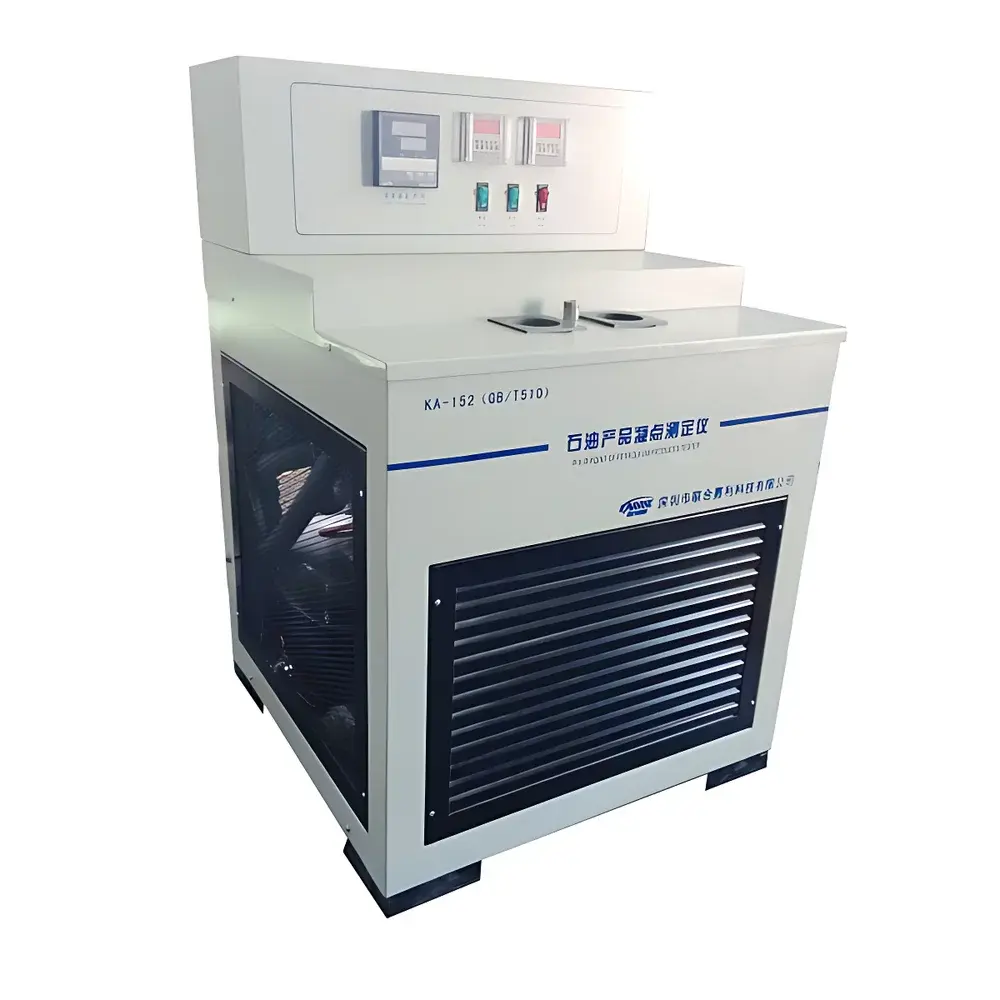
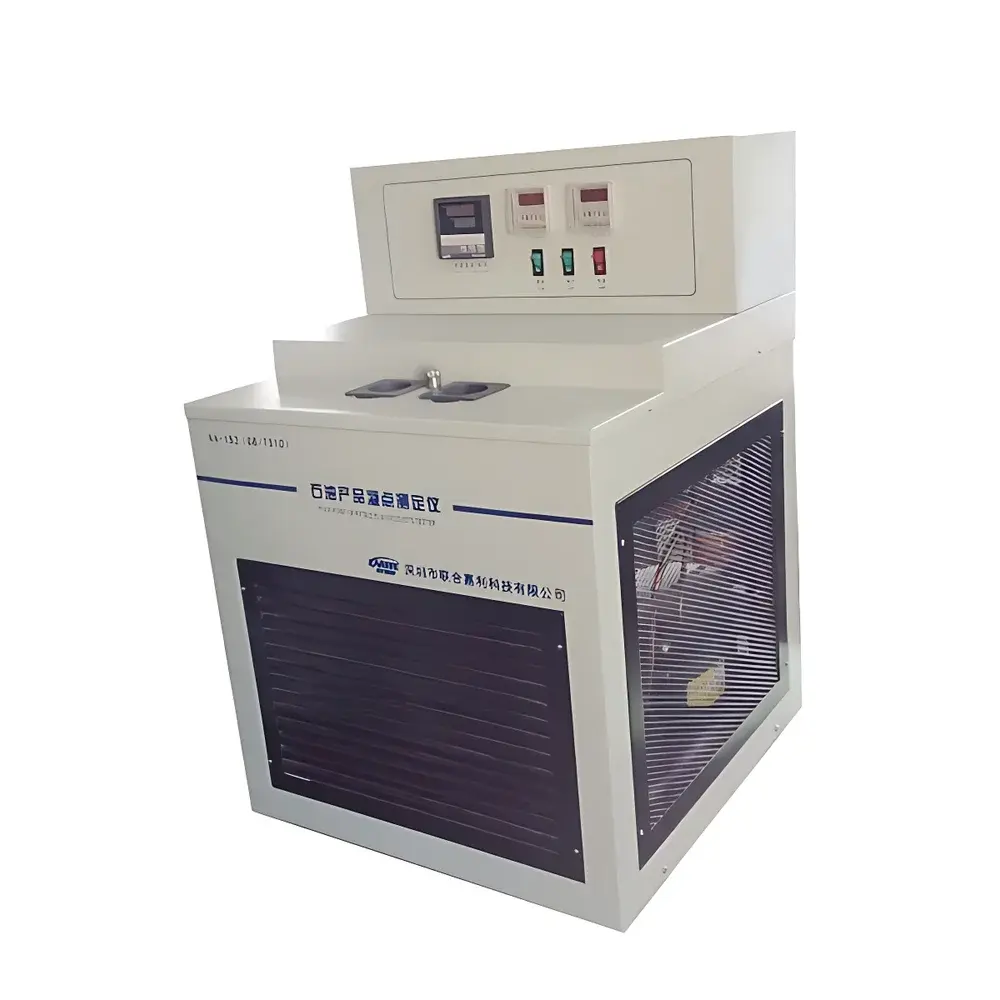
Karrie KA-150 Petroleum Pour Point Tester (–40 °C)
| Brand | Karrie |
|---|---|
| Model | KA-150 |
| Cooling Range | –40 °C |
| Temperature Control Accuracy | ±1 °C |
| Bath Capacity | Dual-Sample (2 positions) |
| Refrigeration System | Hermetic Compressor (3/8 HP) |
| Temperature Sensor | Pt100 Platinum Resistance Thermometer |
| Timing Alarm | 60-second Delayed Audible Alert (Digital Display) |
| Power Supply | AC 220 V, 50 Hz |
| Typical Cooling Time | <100 min (from 25 °C to –40 °C) |
| Compliance | Designed per GB/T 510–1983 |
Overview
The Karrie KA-150 Petroleum Pour Point Tester is an engineered benchtop instrument designed for the precise and repeatable determination of pour point in petroleum products—including lubricating oils, fuel oils, diesel, and residual fuels—according to the national standard GB/T 510–1983. The pour point is defined as the lowest temperature at which a petroleum sample remains fluid under standardized cooling and tilt conditions; specifically, it is the highest temperature at which the sample ceases to flow when the test jar is held at a 45° inclination for 60 seconds. Unlike cryogenic methods relying on dry ice or thermoelectric (Peltier) modules—both prone to thermal drift, limited low-temperature stability, and inconsistent bath uniformity—the KA-150 employs a sealed hermetic compressor refrigeration system. This architecture delivers stable, controllable cooling down to –40 °C with minimal thermal overshoot and high spatial homogeneity across the cold bath, ensuring compliance with the thermal ramping and dwell requirements specified in GB/T 510.
Key Features
- Dual-position cold bath design enables parallel testing of two samples, improving laboratory throughput without compromising thermal isolation between stations.
- Hermetic compressor-based refrigeration (3/8 HP) provides rapid, reliable cooling from ambient (25 °C) to –40 °C in under 100 minutes—significantly reducing assay cycle time compared to alternative low-temperature systems.
- Pt100 platinum resistance thermometer integrated into the bath ensures traceable, NIST-compatible temperature measurement with ±1 °C control accuracy across the full operating range.
- Automated 45° mechanical tilt mechanism coupled with a digitally timed 60-second audible alarm eliminates subjective timing errors and supports consistent observation protocol per GB/T 510.
- Robust thermal insulation and optimized evaporator geometry minimize ambient heat ingress and power consumption while maintaining bath temperature stability within ±0.8 °C over extended dwell periods.
- Front-panel digital display shows real-time bath temperature, countdown timer, and system status indicators—no external software or PC interface required for basic operation.
Sample Compatibility & Compliance
The KA-150 accommodates standard ASTM D97 / GB/T 510 sample jars (typically 50–60 mL capacity) and is validated for use with dark-colored petroleum products including heavy fuel oils, marine distillates, and base oils where visual flow cessation is challenging. While GB/T 510–1983 is the primary reference method, the instrument’s thermal performance profile aligns with the operational envelope of ISO 3016:2015 (Petroleum products — Determination of pour point) and ASTM D97–22 (Standard Test Method for Pour Point of Petroleum Products). Its mechanical tilt actuation, fixed 60-second observation interval, and calibrated cold bath meet the procedural rigidity required for QC labs operating under GLP or internal quality management systems. No modifications are needed to support routine audit readiness for regulatory review.
Software & Data Management
The KA-150 operates as a standalone hardware platform with embedded firmware—no host PC, proprietary drivers, or cloud connectivity are required. All temperature logging, alarm triggering, and tilt sequencing are managed by an industrial-grade microcontroller with non-volatile event memory. While raw data export is not supported via USB or Ethernet, users may manually record results (test ID, sample batch, observed pour point, ambient conditions) into LIMS or Excel using the digital display readout. For laboratories requiring electronic records compliant with FDA 21 CFR Part 11 or ISO/IEC 17025, the unit may be integrated into broader QA workflows via external digital loggers or camera-based documentation systems—though such configurations fall outside the device’s native scope.
Applications
- Quality assurance of finished lubricants and base stocks during refinery off-gas and blending operations.
- Batch release testing of marine fuels (e.g., IFO 380, MGO) to verify low-temperature operability in arctic or sub-zero maritime environments.
- Research and development of cold-flow improvers (CFIs), where comparative pour point depression across additive-treated formulations must be quantified reproducibly.
- Contract testing laboratories performing third-party certification against GB/T, ASTM, or ISO specifications for domestic and export markets.
- Educational use in petroleum engineering curricula to demonstrate phase transition behavior and wax crystallization kinetics in paraffinic hydrocarbons.
FAQ
What standards does the KA-150 comply with?
It is engineered to meet the procedural and thermal requirements of GB/T 510–1983 and functionally compatible with ISO 3016:2015 and ASTM D97–22.
Can the instrument cool below –40 °C?
No—the system is calibrated and validated for operation down to –40 °C only; extended cooling is neither specified nor recommended.
Is calibration traceable to national standards?
The Pt100 sensor is factory-calibrated; users may perform periodic verification using certified reference thermometers per ISO/IEC 17025 Clause 6.6.
Does the unit support automatic result printing or data export?
No—it features no built-in printer port, USB interface, or network connectivity; results must be recorded manually.
What maintenance is required for the compressor system?
Annual inspection of condenser coils and refrigerant integrity is advised; no user-serviceable refrigerant charging is supported—service must be performed by authorized technicians.






