
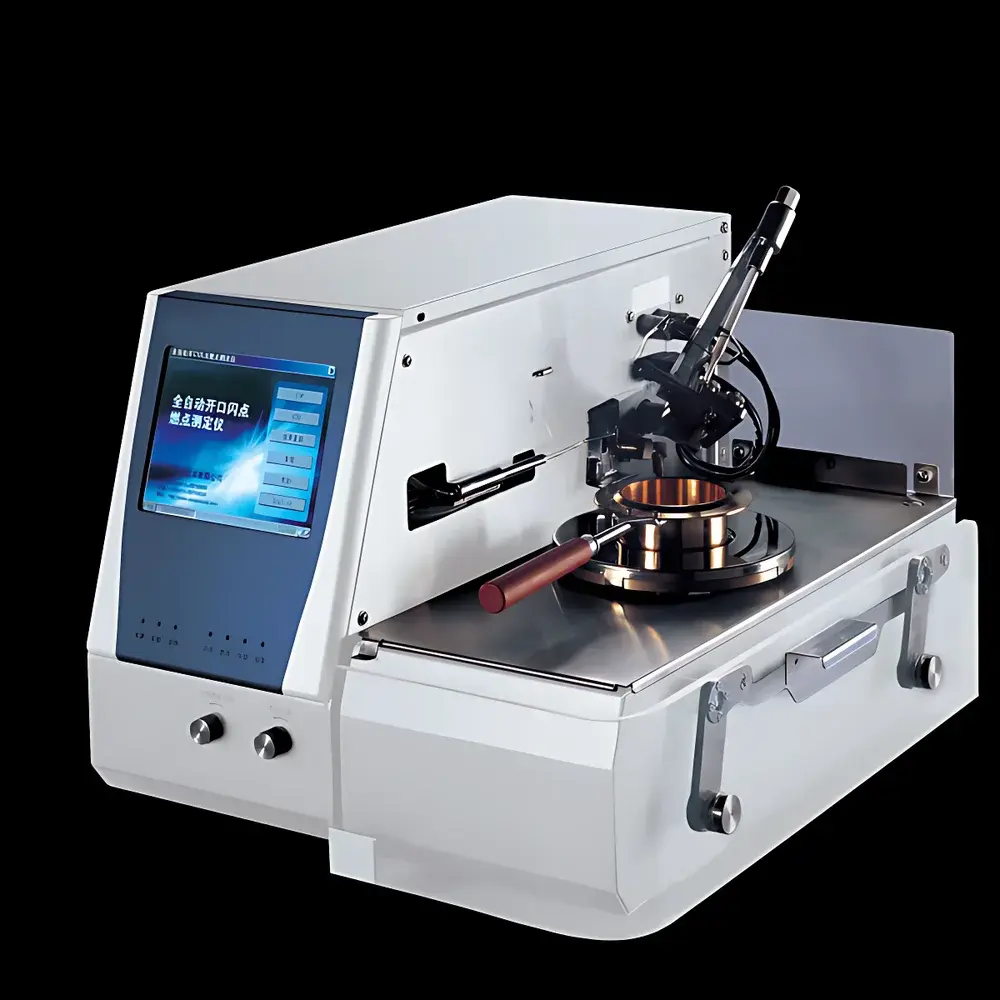
English Product Name
| Brand | KARRIE |
|---|---|
| Model | EFP610 |
| Origin | Guangdong, China |
| Compliance | GB/T 21622–2008, GB 5085.4–2007 |
| Atmospheric Pressure Range | 0–110 kPa (±0.25% F.S.) |
| Temperature Control Range | Ambient to 100 °C (±0.5 °C) |
| Standard Test Temperatures | 60.5 °C, 75 °C |
| Timing Range | 0–999 s (±0.01 s) |
| Ignition Methods | Electronic ignition or gas-assisted ignition with auto-rotating ignition source positioning |
| Display | 6.4″ color TFT LCD (640 × 480 pixels) |
| Power Supply | AC 220 V, 50 Hz |
| Heating Power | 300 W |
| Total Power Consumption | 500 W |
| Operating Temperature | –5 °C to 45 °C |
| Storage Temperature | –20 °C to 50 °C |
| Safety Cut-off Temperature | 100 °C |
| Absolute Thermal Limit | 120 °C |
| Flame Detection | Ionization ring sensor |
| Dimensions (L×W×H) | 480 × 376 × 305 mm |
| Weight | 32 kg |
Overview
The KARRIE EFP610 Sustained Combustibility Tester for Liquids is a precision-engineered instrument designed to evaluate the sustained burning behavior of liquid hazardous substances under controlled thermal and atmospheric conditions. It operates in strict accordance with Chinese national standards GB/T 21622–2008 (“Determination of Sustained Combustibility of Liquids”) and GB 5085.4–2007 (“Identification Standards for Hazardous Wastes — Identification of Ignitability”), providing objective, repeatable data essential for regulatory classification, safety data sheet (SDS) authoring, and waste characterization in chemical manufacturing, environmental testing laboratories, and waste treatment facilities. The instrument employs a dual-sensor thermal control architecture coupled with ionization-based flame detection to ensure unambiguous identification of sustained combustion—defined as continuous flame propagation for ≥5 seconds after ignition—without operator intervention. Its robust thermal chamber design, calibrated pressure sensing, and high-resolution timing subsystem collectively support metrological traceability aligned with ISO/IEC 17025 laboratory quality requirements.
Key Features
- Dual-control architecture: A real-time embedded microcontroller manages heater regulation and sensor acquisition (temperature, pressure, flame status), while an industrial-grade Windows 10 IoT PC handles system coordination, data logging, and UI rendering—ensuring deterministic response and long-term operational stability.
- Auto-rotating ignition source positioning: Motorized alignment ensures precise, repeatable placement of the ignition source relative to the test specimen surface, minimizing positional variance across replicate tests.
- Redundant ignition capability: Supports both electronic spark ignition and auxiliary gas-assisted ignition (e.g., propane or butane). Gas ignition is initiated and monitored automatically; if flame extinction is detected via ionization ring feedback, re-ignition occurs without user input.
- True-color touch interface: 6.4″ 24-bit TFT LCD (640 × 480 resolution) with integrated resistive touch panel, supplemented by optional keyboard/mouse support for lab environments requiring high-throughput data entry or audit-trail review.
- Multi-protocol connectivity: RS-232, USB 2.0, and RJ-45 Ethernet interfaces enable seamless integration with LIMS, enterprise networks, or remote diagnostic systems. USB port supports firmware updates and direct export of test reports in CSV or PDF format.
- Thermal safety interlocks: Dual-stage overtemperature protection—active cut-off at 100 °C and hardware-latched shutdown at 120 °C—meets IEC 61010-1 requirements for laboratory electrical equipment safety.
Sample Compatibility & Compliance
The EFP610 accommodates standard 5 mL glass sample cups (supplied with syringes) and is validated for use with flammable liquids, solvent blends, distillates, and aqueous organic mixtures exhibiting flash points above ambient temperature. It excludes aerosols, pressurized containers, or solids requiring prior dissolution. All test procedures comply with the procedural rigor defined in GB/T 21622–2008, including mandatory pre-conditioning at specified test temperatures (60.5 °C or 75 °C), atmospheric pressure compensation, and flame duration threshold validation. While not certified to ASTM D4206 or UN Manual of Tests and Criteria Part III, Section 32.3, its measurement principle and performance envelope are functionally equivalent for domestic regulatory reporting and internal safety screening.
Software & Data Management
The embedded Windows 10 IoT platform runs proprietary test management software featuring full audit trail capability—including user login timestamps, parameter change logs, and result finalization signatures—supporting GLP-compliant documentation workflows. Data files include raw sensor time-series (temperature, pressure, ion current), annotated event markers (ignition trigger, flame onset, extinction), and pass/fail determinations per GB criteria. Export formats include timestamped CSV for statistical analysis and printer-ready PDF reports with embedded instrument ID, calibration due date, and operator credentials. Optional 21 CFR Part 11 compliance packages (electronic signature, role-based access control, and immutable archive mode) are available upon configuration request.
Applications
- Hazardous waste classification per GB 5085.4–2007 for landfill disposal or incineration permitting
- Pre-manufacturing screening of solvent-based formulations in coatings, adhesives, and cleaning agents
- Quality control verification of batch-to-batch consistency in flammability-critical intermediates
- Supporting SDS Section 9 (Physical and Chemical Properties) and Section 2 (Hazard Identification) authoring
- Academic research on combustion kinetics of bio-derived liquid fuels under standardized thermal exposure
FAQ
What standards does the EFP610 formally comply with?
The instrument is engineered and verified for full conformance with GB/T 21622–2008 and GB 5085.4–2007. It is not CE-marked or UL-listed for EU or North American markets.
Is external gas supply required for operation?
Gas-assisted ignition requires a regulated propane or butane source (not included); however, electronic spark ignition functions independently and is sufficient for most routine testing.
Can test data be exported to LIMS without manual intervention?
Yes—via RS-232 or Ethernet, the instrument supports ASTM E1384-compliant HL7 or custom ASCII message protocols for automated result ingestion into validated LIMS environments.
What maintenance is required to maintain measurement validity?
Annual recalibration of the pressure transducer and PT100 temperature probe is recommended; ionization ring cleaning with isopropyl alcohol every 50 tests ensures consistent flame detection sensitivity.
Does the system support multi-user authentication and permission levels?
Base firmware includes operator/administrator roles; full 21 CFR Part 11-compliant user management (including biometric or smart-card integration) is available in the optional GxP Edition software package.



