
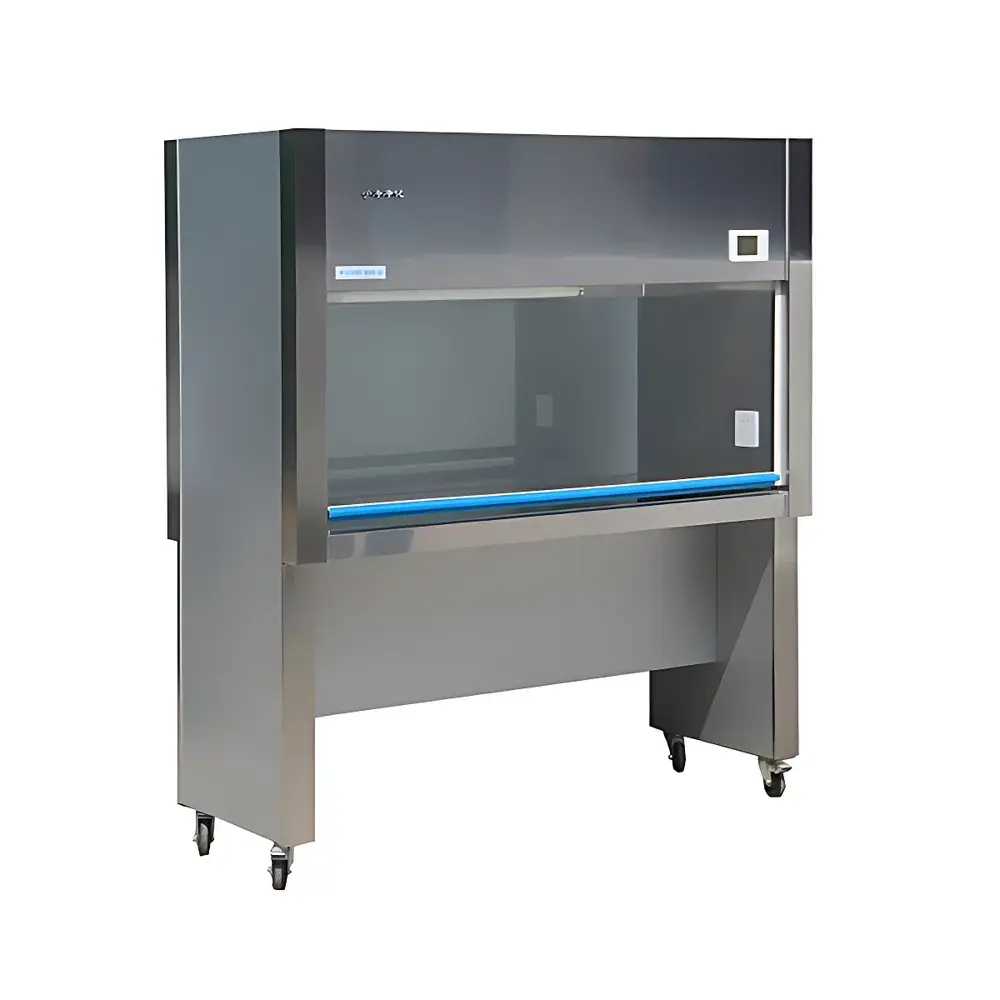
HJ SW-CJ-2F Dual-Operator Vertical Laminar Flow Clean Bench
| Brand | HJ Purification |
|---|---|
| Origin | Shanghai, China |
| Manufacturer Type | Direct Manufacturer |
| Instrument Category | Vertical Laminar Flow Clean Bench |
| Cleanliness Class | ISO Class 5 (100 @ ≥0.5 µm, Fed. Std. 209E) |
| Noise Level | ≤62 dB(A) |
| Operator Capacity | 2 |
| Airflow Pattern | Vertical Downflow |
| Average Air Velocity | 0.25–0.45 m/s (3-speed adjustable) |
| Microbial Contamination | ≤0.5 CFU/plate·hr (Φ90 mm settle plate) |
| Vibration | ≤5 µm peak-to-peak (X/Y/Z axes) |
| Illumination | ≥300 lux |
| Power Supply | AC 220 V / 50 Hz |
| Max. Power Consumption | 800 W |
| Net Weight | 160 kg |
| Work Area Dimensions (W×D×H) | 1360 × 580 × 515 mm |
| Overall Dimensions (W×D×H) | 1520 × 670 × 1625 mm |
| HEPA Filter Spec. | 1355 × 555 × 38 mm (1 unit) |
| Fluorescent Lamp | 30 W × 1 |
| UV Lamp | 30 W × 1 |
Overview
The HJ SW-CJ-2F Dual-Operator Vertical Laminar Flow Clean Bench is an ISO Class 5-certified laminar airflow workstation engineered for routine aseptic procedures in microbiology, cell culture, pharmaceutical quality control, and academic research laboratories. It operates on the principle of vertical unidirectional airflow: ambient air is drawn through a pre-filter, conditioned, and then forced downward through a certified HEPA filter (≥99.995% efficiency at 0.3 µm), generating a uniform, particle-free laminar curtain across the entire work surface. This vertical downflow design establishes a sterile barrier that isolates the operator from the process while preventing cross-contamination between samples. Unlike horizontal flow benches, the vertical configuration directs exhaust air away from the operator’s face—enhancing personnel safety during handling of non-hazardous biological agents or sterile materials. The bench complies with core performance benchmarks defined in Fed. Std. 209E (now superseded but still widely referenced), ISO 14644-1, and relevant sections of ISO 13485 for medical device manufacturing environments.
Key Features
- Vertically oriented laminar airflow system with three-speed adjustable fan control (0.25–0.45 m/s), enabling optimization for varying procedural sensitivity and material volatility.
- Full-height, counterbalanced sash window with arbitrary positioning capability—providing flexible access while maintaining consistent inflow velocity and containment integrity.
- Monocoque enclosure fabricated from pre-painted color-coated steel panels; work surface constructed from brushed 304 stainless steel for corrosion resistance, structural rigidity, and compliance with cleaning validation protocols (e.g., ATP swabbing, alcohol wipe tests).
- Dual interlocked lighting: 30 W fluorescent lamp (≥300 lux at work surface) and 30 W UV germicidal lamp (254 nm), with hardware-level safety circuitry preventing simultaneous activation to protect operator eyes and skin.
- Intuitive digital LCD controller with real-time display of fan speed setting, UV timer, and operational status—designed for use under standard lab gloves and compatible with GLP documentation workflows.
- Integrated pre-filter upstream of the HEPA module extends filter service life by capturing coarse particulates (e.g., lint, dust, skin flakes); HEPA filter conforms to EN 1822-1:2019 H14 classification.
Sample Compatibility & Compliance
The SW-CJ-2F supports open-vessel manipulations including petri dish plating, pipetting, media preparation, and sterile instrument staging. Its ISO Class 5 environment (≤3,520 particles/m³ ≥0.5 µm) meets the baseline requirement for USP compounding (non-hazardous preparations), ISO 13408-1 for aseptic processing validation, and ASTM E2500-13 for equipment qualification in regulated settings. While not rated for chemical fume containment or biohazardous agent work (i.e., no negative pressure or ducted exhaust), it satisfies CE marking requirements under the Machinery Directive 2006/42/EC and Low Voltage Directive 2014/35/EU. All electrical components are IP20-rated; UV lamp output is verified per IEC 62471 photobiological safety standards.
Software & Data Management
This clean bench operates as a standalone mechanical system with no embedded firmware or network connectivity. The LCD interface logs only runtime parameters (fan speed mode, UV exposure duration) without timestamped audit trails. For laboratories operating under FDA 21 CFR Part 11 or EU Annex 11, manual logbook entries—including daily airflow verification using calibrated anemometers, weekly UV intensity checks with a radiometer, and quarterly HEPA leak testing per ISO 14644-3—are required to maintain compliance. Optional calibration certificates for anemometers and UV meters can be sourced from accredited third-party metrology providers.
Applications
- Microbiological assay setup and colony isolation in clinical and environmental labs.
- Aseptic transfer of mammalian or insect cell lines in teaching and R&D facilities.
- Preparation of culture media, buffers, and reagents for downstream analytical instrumentation (e.g., HPLC, GC-MS).
- Assembly and inspection of sterile medical device components prior to packaging.
- Quality assurance testing of raw materials in food, cosmetic, and nutraceutical production environments.
FAQ
Is the SW-CJ-2F suitable for working with hazardous pathogens or volatile solvents?
No. It provides personnel protection only against particulate contamination—not aerosolized biohazards or vapors. Use a Class II biosafety cabinet for BSL-2 agents or a ducted fume hood for organic solvents.
What maintenance intervals are recommended for the HEPA filter?
HEPA filter replacement is typically required every 12–24 months depending on ambient air quality and usage frequency; pre-filter replacement is advised every 3–6 months. Always perform a qualitative smoke test after filter change.
Does the unit include validation documentation for GMP environments?
The base unit ships with a manufacturer’s conformity statement and filter certification. Full IQ/OQ/PQ documentation must be generated in-house or by a qualified third party per ISO/IEC 17025.
Can the UV lamp be used while the fan is running?
No. Hardware interlock prevents concurrent operation of UV and airflow systems to avoid ozone generation and ensure operator safety.
What is the maximum allowable ambient temperature and humidity for stable operation?
Rated for continuous operation at 15–30°C and ≤70% RH (non-condensing). Performance degrades above 32°C due to reduced HEPA efficiency and increased microbial growth risk.



