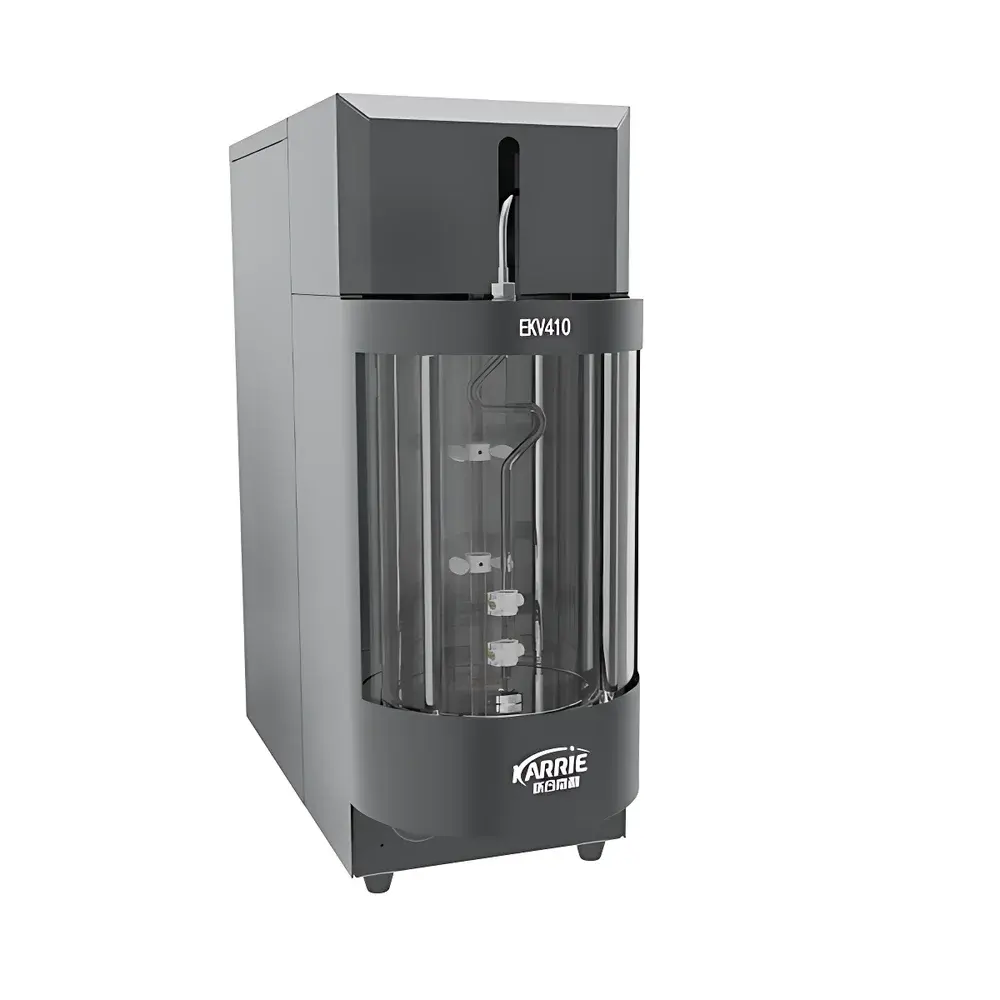
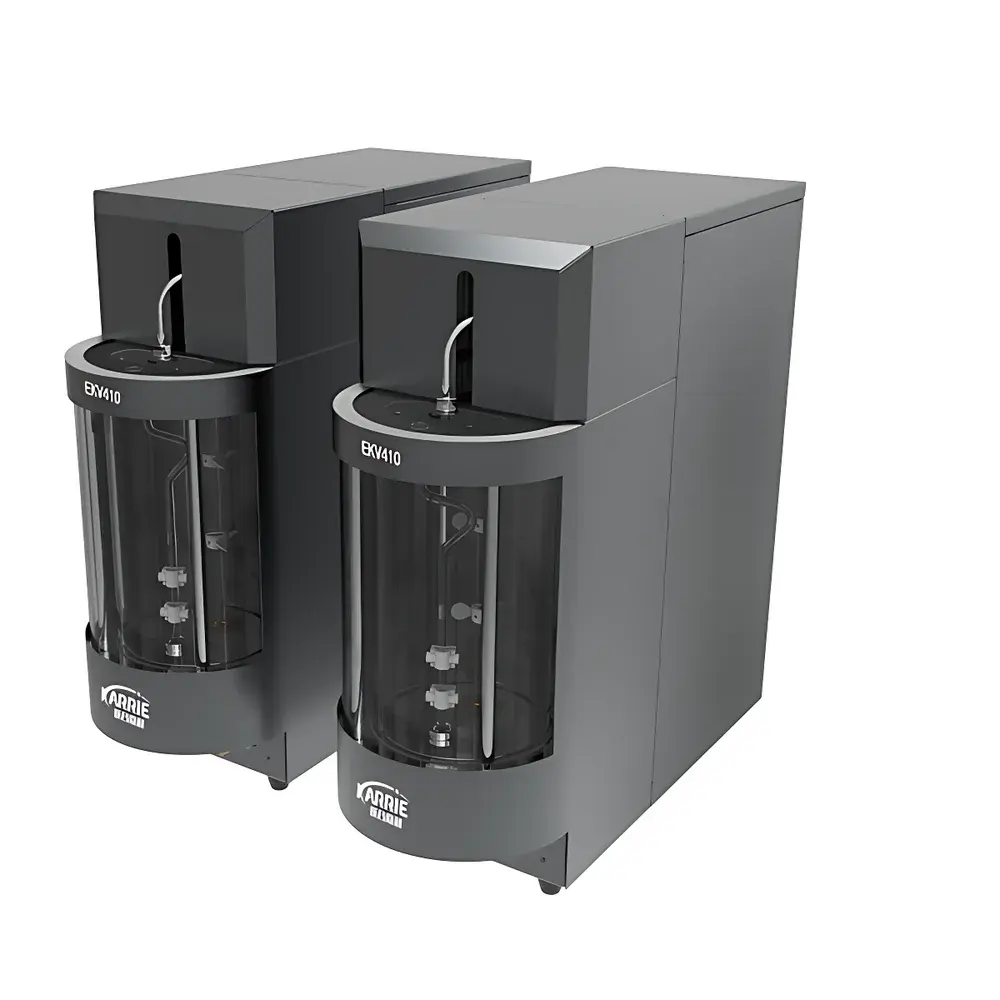
Carrie EKV410 Fully Automated Ubbelohde-Type Kinematic Viscosity Tester
| [Brand | Carrie |
|---|---|
| Model | EKV410 |
| Standards Compliance | ASTM D445, ASTM D7279, ASTM D446, NB/SH/T 0956–2017, T/CEC 127–2016 |
| Temperature Range | 20–100 °C |
| Temperature Stability | ±0.01 °C |
| Temperature Resolution | 0.01 °C |
| Timing Accuracy | 0.01 s |
| Cooling Method | Integrated Peltier cooling |
| Sample Capacity | 36-position top-loading auto-sampler |
| Detection Method | Photocell-based capillary transit time measurement |
| Bath Type | Dual-wall constant-temperature bath |
| Bath Fluid | 10# methyl silicone oil |
| Power Supply | AC 220 V, 50 Hz |
| Power Consumption | 1000 W |
| Reproducibility | ≤0.5% |
| Repeatability | ≤0.5% |
| Sensor | PT100 platinum resistance thermometer |
| Dimensions (W×D×H) | 536 × 208 × 547 mm |
| Weight | 20 kg] |
Overview
The Carrie EKV410 Fully Automated Ubbelohde-Type Kinematic Viscosity Tester is an engineered solution for precise, high-throughput kinematic viscosity determination of petroleum liquids in accordance with globally recognized standards including ASTM D445, ASTM D7279, ASTM D446, NB/SH/T 0956–2017, and T/CEC 127–2016. It employs the classical capillary flow principle—specifically the Ubbelohde (or “折管”) viscometer geometry—wherein kinematic viscosity (ν) is calculated as ν = C × t, with C representing the calibrated viscometer constant and t the efflux time measured between two precisely positioned photodetectors. The instrument is validated for both transparent and opaque petroleum products, including crude oil, distillates, residual fuels, lubricants, additives, and biofuels—without requiring manual dilution or pre-filtration.
Key Features
- Fully automated workflow: automatic sample aspiration, thermal equilibration, efflux timing, cleaning, and drying—no operator intervention required after initial loading.
- Dual-wall constant-temperature bath with integrated Peltier cooling and PT100 feedback control, ensuring ±0.01 °C stability across the full 20–100 °C operating range.
- 36-position top-access autosampler enabling unattended batch analysis; supports sequential or priority-based queue execution.
- Ubbelohde-style folded-capillary viscometers (0.6 mm nominal bore), optimized for low-flow laminar conditions and certified traceability to NIST-traceable reference oils.
- Embedded ARM microcontroller coupled with Windows 7-based host PC for real-time temperature regulation, timing acquisition, and data logging—ensuring deterministic response and sub-10 ms timing resolution.
- Self-diagnostic architecture with predictive fault alerts, system health monitoring, and automated calibration verification routines.
- Comprehensive cleaning cycle: solvent rinse (via dedicated wash bottle assembly), air purge, and hot-air drying—eliminating cross-contamination and manual handling.
Sample Compatibility & Compliance
The EKV410 accommodates a broad spectrum of petroleum-derived fluids per ASTM D445 scope definitions: from low-viscosity naphthas and jet fuels to high-viscosity bunker fuels and bitumen blends. Its optical detection system is insensitive to sample opacity, enabling direct measurement of dark or particulate-laden samples without centrifugation or filtration. All hardware and software components comply with GLP and GMP-aligned laboratory practices. Data integrity safeguards—including electronic audit trails, user access levels, and timestamped raw efflux logs—support regulatory readiness for FDA 21 CFR Part 11 and ISO/IEC 17025 accreditation. The instrument’s firmware and calibration certificates are fully traceable to national metrology institutes via documented uncertainty budgets.
Software & Data Management
The proprietary Windows-based application provides a bilingual (English/Chinese/Russian) interface with configurable report templates compliant with ASTM reporting conventions. Raw transit times, temperature logs, viscosity results (mm²/s), and statistical summaries (mean, SD, RSD, confidence intervals) are stored in encrypted SQLite databases with version-controlled backups. Export options include CSV, PDF, XML, and LIMS-compatible HL7/ASTM E1384 formats. Communication interfaces include RS-232, USB 2.0, and Ethernet (RJ-45), enabling seamless integration into enterprise laboratory networks and centralized data repositories. Audit trail functionality records all user actions, parameter modifications, and calibration events with immutable timestamps—fully satisfying ALCOA+ (Attributable, Legible, Contemporaneous, Original, Accurate, Complete, Consistent, Enduring, Available) data governance requirements.
Applications
- Refinery QC/QA labs: routine monitoring of distillate fractions, blending stock consistency, and finished product release testing.
- Lubricant formulation R&D: screening base oil viscosity indices, additive interaction effects, and shear stability assessment.
- Independent testing laboratories: accredited viscosity certification per ISO 5715 and API RP 1172 protocols.
- Biofuel compliance verification: ASTM D7467 (biodiesel blends) and EN 14214 (FAME) kinematic viscosity validation.
- Research institutions: fundamental fluid property studies under controlled thermal gradients and multi-point viscosity-temperature profiling.
FAQ
What viscosity standards are supported by the EKV410?
The instrument is factory-calibrated using NIST-traceable reference oils (e.g., Cannon N4000 series) and supports user-defined calibration curves per ASTM D445 Annex A1.
Can the system operate without a connected PC?
No—the host PC is integral to the control architecture; the ARM module handles real-time thermoregulation and timing, but the GUI, data storage, and reporting functions require the Windows host.
Is the 10# methyl silicone oil bath fluid supplied with the instrument?
Yes—a full-volume fill of certified 10# methyl silicone oil is included in the standard configuration, with recommended replacement intervals specified in the maintenance manual.
How is viscosity tube cleaning validated?
Each cleaning cycle includes pressure-sensor-monitored solvent delivery, timed air purge, and thermal-dry verification; post-clean baseline timing checks confirm capillary clearance before next sample injection.
Does the EKV410 support remote diagnostics or firmware updates?
Yes—via secure HTTPS-enabled web interface (accessible over LAN); firmware updates require authenticated administrator credentials and generate full rollback-capable version archives.